If you keep up with the conversations on wealth management LinkedIn about financial advisor fee models, you’ll do a lot of reading and find a wide range of ardent, esoteric views.
Processing Content
Planners may use as many types of fee models these days, as registered investment advisory firms tinker with the traditional client expense structure of 1% of assets under management in countless permutations.
Even among planners who attended the first of the Transparent Advisor Movement’s “Flat Fridays” events held outside Chicago last month, the tough critics of AUM fees said that they see a lot of nuances in the discussion and shared the wide variation in their charging models. Their opinions defy any generalizations about the extent they believe that advisory practices must reduce or eliminate the conflict of interest associated with recommending that clients bring their assets under their management while having a vested incentive in collecting 1% of them.
Regardless, the movement’s collaborative and highly communicative champion, lead generation and marketing consultant Sara Grillo, is aiming for the gatherings to shape the future of the planning profession, she told Financial Planning in an email.
“My goal is to establish a Flat Friday chapter in every single major city in the United States by 2030, so that flat fee, hourly and advice-only planning can have a bigger impact on local communities,” Grillo said.
Scroll down toward the bottom of the page to view the many shades of flat fees used by the firms of six planners in attendance at last month’s meeting.
READ MORE: Client demand has RIAs, CPAs rethinking strategic partnerships
Numbers and nuances
That message has been resonating with people like Katie Balberchak, an independent financial advice industry analyst who has worked with Grillo in the past and is currently supporting Steven Fox’s registered investment advisory and flat-fee service provider firm AdviceOnly. The movement got Balberchak’s attention because of its “authenticity, generous sharing of knowledge and ideas, and culture of integrity” after her family “had a bad experience with a large RIA (that charged a percentage of AUM),” she said in an email. Now, she’s scheduled to be the facilitating leader of a Flat Friday meeting herself next month outside Washington, D.C.
“Most fee-only financial advisors are still primarily compensated by charging a percentage of AUM, which can psychologically feel like a small amount to a client even when the actual dollar amount increases significantly over time,” Balberchak said. “Flat-fee planners intentionally charge in a way that diverges from the industry norm — bringing attention to the dollar amounts clients pay rather than downplaying or attempting to hide them. Because flat fees are more salient than those quoted as percentages, flat-fee planners purposefully demonstrate transparency when they clearly state the amount they charge.”
Such strong words and no shortage of fierce online debates among advisors, though, may lead to the misunderstanding that they must choose between what appear to be sides of the debate. Adding to the tension are periodic “risk alerts” (like the one from this week) or, more seriously, legal cases frequently filed by the Securities and Exchange Commission about the disclosures of fees and conflicts of interest.
Flat fee planners often report difficulties with state regulators’ scrutiny of their models, as well. But no laws require advisors to pick either AUM or flat fees.
In fact, nearly 85% of RIA firms that were registered with the SEC last year and said that they provided financial planning services used some form of fixed or hourly fees, according to the latest “snapshot” report by the Investment Adviser Association and Comply. That’s despite the fact that 96% of all kinds of RIAs charge AUM fees.
Smaller shares use fixed fees (45%), hourly charges (29%) or subscriptions (1%). Just 18% use only AUM fees, and the share collecting fixed fees has jumped by nine percentage points in the past 25 years.
“In 2025, only 4.5% of advisers did not offer a fee based on assets under management,” the report said. “While this is a small group of firms, they accounted for nearly 30% of the industry’s non-asset management clients and nearly one-fifth of the industry’s non-high net worth clients.”
And, when surveyed through Financial Planning’s Financial Advisor Confidence Outlook survey about their fee models, more than 60% of advisors said they think about adjusting the amount and structure of their charges at least once a year.
But the flat-fee advocates do face a challenge in talking with prospective clients about their fees: One survey of affluent investors’ preferences found that AUM fees, self-directed expenses and even commissions rated higher than retainer fees. The clients may not be thinking as deeply about them as their advisors.
“Wealth management firms and advisors often carefully consider and reevaluate how to price their advice fees,” research and consulting firm Cerulli Associates said in a report earlier this year. “While this is an important and worthwhile exercise, Cerulli has found through qualitative interviews with wealth executives and financial advisors who had undergone a recent fee change, [that] clients hardly notice the change. For those aware of it, the number of clients who chose to leave that advice relationship was negligible. Generally speaking, clients will remain in their advice relationship as long as they see value in the service being provided, and they rarely are concerned enough to split hairs over pricing.”
READ MORE: Firms that can and can’t fetch 20-times EBITDA with private equity

Tobias Salinger
Flat, advice-only fees can be big business, just not in terms of AUM
With the backdrop of a lot of strong opinions and lengthy debates among planners spanning decades and a lot of subtle distinctions in business models across the industry, certain clients do gravitate to flat fees.
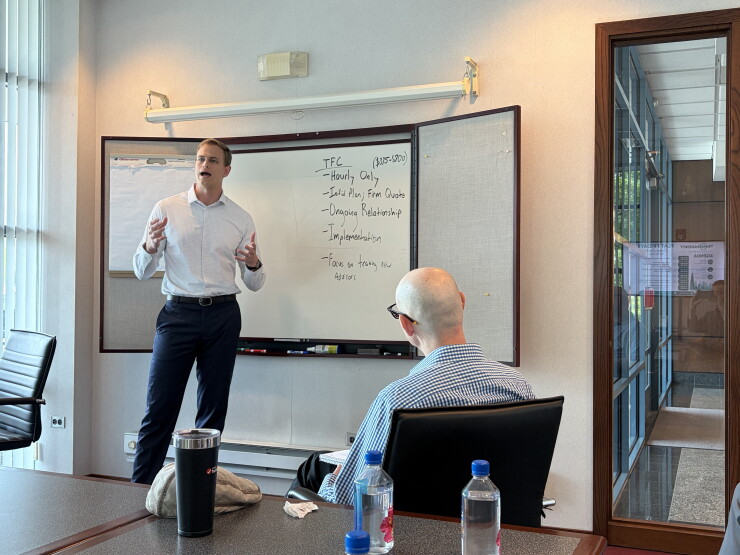
For instance, Wheaton, Illinois-based Timothy Financial Counsel Founding Principal Mark Berg had “kept it small” with the firm’s client base for roughly its first 15 years in business before “he started seeing there was just more and more of a need and a desire for hourly-only planning” and set out to grow the firm in 2015, according to a presentation at the movement’s event last month by Andrew Swierenga, a financial advisor with the firm.
Wall Street Journal coverage, podcast appearances with Christine Benz of Morningstar and word-of-mouth references are adding to the expanding base of customers at the firm, whose website describes it as the “largest hourly-only financial planning firm” in the U.S., even though, as a so-called advice-only firm, it doesn’t have a single dollar of assets under management.
“We’ve had demand. People want our services. We’ve been training new advisors,” Swierenga said. “Last year I took on around 30 new clients. It should be similar this year. So a lot of my time is spent doing the initial work, but then the ongoing is a huge part of it, so each initial project that I do, I am talking to prospects, and I’m saying, ‘Listen, the value in what we do is in the long-term relationship.'”
On the other end of the spectrum in terms of seeking to expand the client base, Warrenville, Illinois-based RIA firm Retirement Portfolio Partners founder Erik Barnes has purposely restricted his headcount of customers to his current ranks of 53 retirees or preretirees who are at least 60 years old, he said in another presentation at the event.
As a planner who has “been doing it 25 years and restarted three times,” he said that the key question for anyone launching an advisory practice is, “Can you keep it alive long enough [until] it becomes profitable?” And, even though there are many paths to success in the industry besides being a flat-fee, solo-advisor model, there is a finite amount of time within which they’re likely to know the answer as to whether they have chosen a sustainable business model.
“It’s a three-year build,” Barnes said. “The first year is figuring it out. The second year, you get more clients. Third year, it should start to build, and if it’s not, you need to re-examine why it’s not, because it should start to build by year three. And if it’s not, you’re three years in and, I would say, wasting ample financial time where you should be saving for 401(k)s and all this other stuff that you’re not, so not only is it the business, it’s a detriment to your family, too, and you should move on.”
READ MORE: How to use equity compensation to boost RIA valuation and more

Tobias Salinger
The reason advisors are so passionate about fees
As they weigh that balance against their passion for the highest ideals of a profession that helps people, advisors take a variety of approaches. For example, Linda Rapisardo, the founder of Riverside, Illinois-based RIA firm Canela Wealth, refrains from directly managing portfolios and other client assets as a means of working with clients who often didn’t grow up in wealthy families and represent the first generation building it over time, she said.
“I like the advice-only model because it allows me, from an overhead perspective, to have lower overhead costs for myself and then pass those savings on to the client so that I can have as low fees as possible and serve that particular client base. It’s a good way for me to educate my clients and give them the ability to manage investments for themselves,” Rapisardo said. “Sometimes there’s a little bit of a distrust to financial advisors and just the financial services industry as a whole.”
At the same time, launching and running a small business of any kind can be tough. James “JB” Brewer started Chicago-based RIA firm Envision Wealth Planning nearly eight years ago, after working at large firms for most of his career.
“It’s really overwhelming. It only slowed down for me after, I guess, like five years,” Brewer said. “I say it’s the hardest thing I’ve ever done, but yet it’s the most exhilarating thing that I’ve ever experienced.”
That’s why he and all the planners in attendance at the Flat Fridays meeting recommended that any current or aspiring RIA owners connect with fellow professionals who have implemented any number of different fee models at their own firms.
For a mini version of such discussions, scroll down the page for more of their thoughts on fees, RIA structures and professional lessons for other planners in the field. To read Financial Planning’s award-winning practice management series, “Starting an RIA,” click here.
Michael Hollis
Fees: A “foundations” level for one-time plans and do-it-yourself investors of $4,800 for individuals or $6,000 for couples; a “core” tier with ongoing implementation and adaptation of the plan and portfolio management at $8,400 per year for individuals or $9,600 for couples; and a “legacy” charge of $13,200 for individuals or $14,400 for couples for business owners, estate strategies and the greatest complexity; as well as a “financial coaching” engagement over three months and seven meetings focused on cash flow, budgeting and paying off debt for $1,750 or an educational “consultation” session that is typically two to three hours at $350 per hour.
The founder of newly launched Aurora, Illinois-based RIA firm TapestryFP suggested that any advisors considering a change to their fee mode take their time “understanding the pros and cons” by taking part in professional discussions through, for example, the movement’s webinars or more formalized programs such as Amplified Planning’s Externship.
“There’s a lot of tug out there to go one way or the other, and there’s a lot of strong opinions,” Hollis said. “None of these are perfect. They all have varying degrees of challenges for advisors to pull these off.”
He arrived at his firm’s approach after reading a lot of regulatory filings and listening “to lots and lots of different financial advisors talk about how they started their businesses and how they landed on their fee structures,” he said. Then he applied those lessons and his priorities to land on his fee model.
“It’s really tugging on me to try to offer financial planning services to people who maybe don’t make a lot and don’t have a ton of assets,” Hollis said.
READ MORE: Adapt or disappear: AI search is rapidly changing the referral game

Focused Up Financial.
Charlie Horonzy
Fees: Clients’ preference of either a minimum of $10,000 per year, or an AUM-based structure of 1% of assets, plus a 0.25% turnkey asset management program fee.
The founder of Chicago-area RIA firm Focused Up Financial has shifted his firm’s business model, and he had some advice for fellow planners trying to explain the value of their services to prospective clients.
“Initially, I operated strictly on a flat-fee basis,” Horonzy said in an email. “However, I found that paying out of pocket created unnecessary friction for some clients, preventing them from accessing much-needed planning. Adding an AUM option allowed me to reduce that friction while still delivering comprehensive, full-picture financial planning that goes well beyond just the assets I manage.
“There is no single ‘right’ fee model, but absolute transparency is non-negotiable,” he continued. “Many prospects don’t intuitively translate a percentage into hard dollars, so clearly outlining exactly what they will pay in dollars is crucial. Whether you use a flat fee or an AUM model, showing clients the actual dollar amount — and educating them on your value compared to industry standards — is the best way to build immediate trust.”

Canela Wealth
Linda Rapisardo
Fees: One-time financial plan fee, starting at $2,500 for individuals and $4,000 for couples, and ongoing planning, advice and implementation services, starting at $3,600 per year for individuals and $5,400 for couples with a one-time onboarding charge of $1,500.
Rapisardo picked the Spanish word “canela,” meaning “cinnamon” in Spanish, for her RIA as a reference to her Mexican-American heritage and a signal to fellow “first-generation wealth builders,” she said. At some point, she may try a different model.
But she has chosen to use her current rates and provide advice-only services without direct asset management because she “needed to build a practice that’s going to work for them” while creating a sustainable venture as well, she said.
“The people I’m typically speaking with have never worked with a financial planner. Their parents never had a financial advisor,” Rapisardo said. “Its kind of an entry point for these individuals to see the value in a financial planner.”
READ MORE: The 4 AI tools I use in my practice — and 3 questions to avoid ‘AI ick’

Envision Wealth Planning
James “JB” Brewer
Fees: Typical financial planning and advice fees between $3,600 and $4,800 per year, or more, based on complexity, as well as tiered AUM-based fees for portfolio management ranging from passive strategies to principles-based screens for impact investing.
Brewer of Envision Wealth felt a duty to carefully think through how he collects fees as a planner based on “the beautiful thing” about the work aiding families in avoiding financial disasters and gaining the confidence that they’re prepared for the future, he said.
“I’ve actually had two people — maybe it’s three — cry about their financial situations,” he said. “For someone to open up their financial life to you and the vulnerability that they’re exposing themselves to — that means a ton to me.”
Erik Barnes
Fees: $6,000 per year for comprehensive advice, planning and portfolio management.
Once planners reach a point in their businesses and careers in which they can choose whether or not to accept new clients, they can design their advisory practice with other flexible elements, noted Barnes of Retirement Portfolio. His “PTSD from earlier careers” has encouraged him to work primarily from his home, rather than a traditional office, he said.
“The nice part about being solo is that you don’t have to work normal-ass business hours,” Barnes said. “I’m a bit of a night owl, and I hate the mornings, so speaking of everything I hated. I put in work from eight to midnight, because my family’s asleep, and it’s either that or watch TV. So, like, being a solo, you can do that, or if you had people, I mean, I would imagine sending them something at 11 p.m. at night would kind of kill any camaraderie or company stuff.”
READ MORE: The estate planning ‘haircut’ advisors should know about
Tobias Salinger
Andrew Swierenga
Fees: Five levels based on complexity for advice and planning but no discretionary portfolio management, typically at a range between $375 and $800 per hour, adding up to $3,750 to $18,000 per year or more at the highest levels of complexity.
One aspect of flat, advice-only fees that may get overlooked shows up in the experiences of early-career planners starting out at the firms, according to Swierenga of Timothy. Financial advisors’ rewarding careers often pose a high barrier to entry among novice professionals trying to build a base of clients.
“One of the things that appealed to me coming out of college was, it’s not a friends-and-family model. It’s not ‘Go knock on doors,'” Swierenga said. “You work hard, you get trained and then we’ve got a wait list of, at that point, it was over 100 clients. And people were calling us, and we were turning them away, or we were saying 12 months on the wait list. So we’ve worked it down now. It’s more manageable to a couple of months, but that was a huge benefit for a newer advisor coming into the industry.”