Listen to the article
Dive Brief:
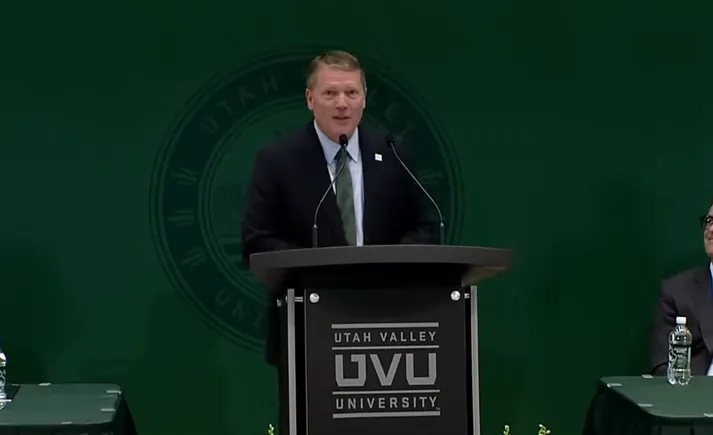
The U.S. Department of Education is planning policy and regulatory changes to smooth the pathway for college mergers and acquisitions, Under Secretary Nicholas Kent said Tuesday during the annual National Association of Student Financial Aid Administrators conference.
“We need to make this process of consolidations, mergers and acquisitions — even closures — a lot easier for institutions,” Kent said, adding that some of the changes would require new regulations.
Kent’s comments come just one day before a host of higher education regulations take effect, including new loan limits and an earnings test that academic programs must meet or else risk losing their eligibility for federal loans and Pell Grants.
Dive Insight:
A suite of new Education Department regulations will take effect on Wednesday to carry out the One Big Beautiful Bill Act, the sweeping tax and spending legislation that Republicans passed last summer.
The agency has been racing to issue regulations in time to carry out the law. On Monday, the Education Department released a final rule to establish a new earnings test that college programs will face. If they fail the test in two out of three consecutive years, they will lose eligibility for federal student loans, according to the regulations.
Under the final rule, undergraduate programs will have to show that their graduates earn more than a typical worker in their state with only a high school diploma. Graduate programs will face a similar test, though their graduates are compared against students whose highest credential is a bachelor’s degree.
In certain situations, a college’s programs that consistently fail to meet the earnings threshold will also risk losing access to Pell Grants.
“What the American people expect is that if their son or daughter enrolled in college, they believe that they should be slightly better off than if they had never enrolled in the first place,” Kent told conference attendees on Tuesday. “I think it’s a pretty low bar, to be honest.”
However, critics have also slammed the regulatory language, arguing that it will weaken the Biden administration’s gainful employment rule and make it easier for poor-performing colleges to retain access to federal aid programs.
The Biden-era gainful employment rule requires for-profit college programs, as well as nondegree programs, to pass a similar earnings test or else risk their access to federal financial aid. They also have to pass an additional debt-to-earnings test designed to ensure colleges aren’t saddling students with unaffordable amounts of debt.
The Trump administration’s rule taking effect Wednesday will effectively replace the gainful employment rule by eliminating the debt-to-earnings test and applying the same new earnings test across all college programs.
Also taking effect Wednesday are new federal student loan limits.
OBBBA mandated that Grad PLUS loans, which allow graduate students to borrow up to the cost of attendance, be phased out. Moreover, most graduate students will only be able to borrow $100,000 in federal student loans for their programs.
Students in graduate programs deemed professional, however, will have a higher cap of $200,000. The Education Department released regulations in April classifying just 11 fields as professional, including medicine, law and dentistry.
The move spurred several lawsuits, which argued that the Education Department unlawfully excluded key fields, such as nursing. A federal judge temporarily paused the department’s definition just days before the new regulations were set to take effect.
Kent called the ruling a “flawed outcome” on Tuesday.
“She, I don’t think, had the benefit of really understanding the nuances within the rule,” Kent said of the judge in the case.
He added that the department would now have the time to “really educate the court on how we developed this definition in such a way that she may feel more comfortable moving forward.”
On Monday, the Education Department announced it would treat several additional fields as professional degrees while the ruling was in effect, including occupational therapy and nursing.
However, it said some graduate fields that it deemed as professional under its regulatory definition wouldn’t qualify for that designation for the time being, including theology and certain pharmacy programs.