
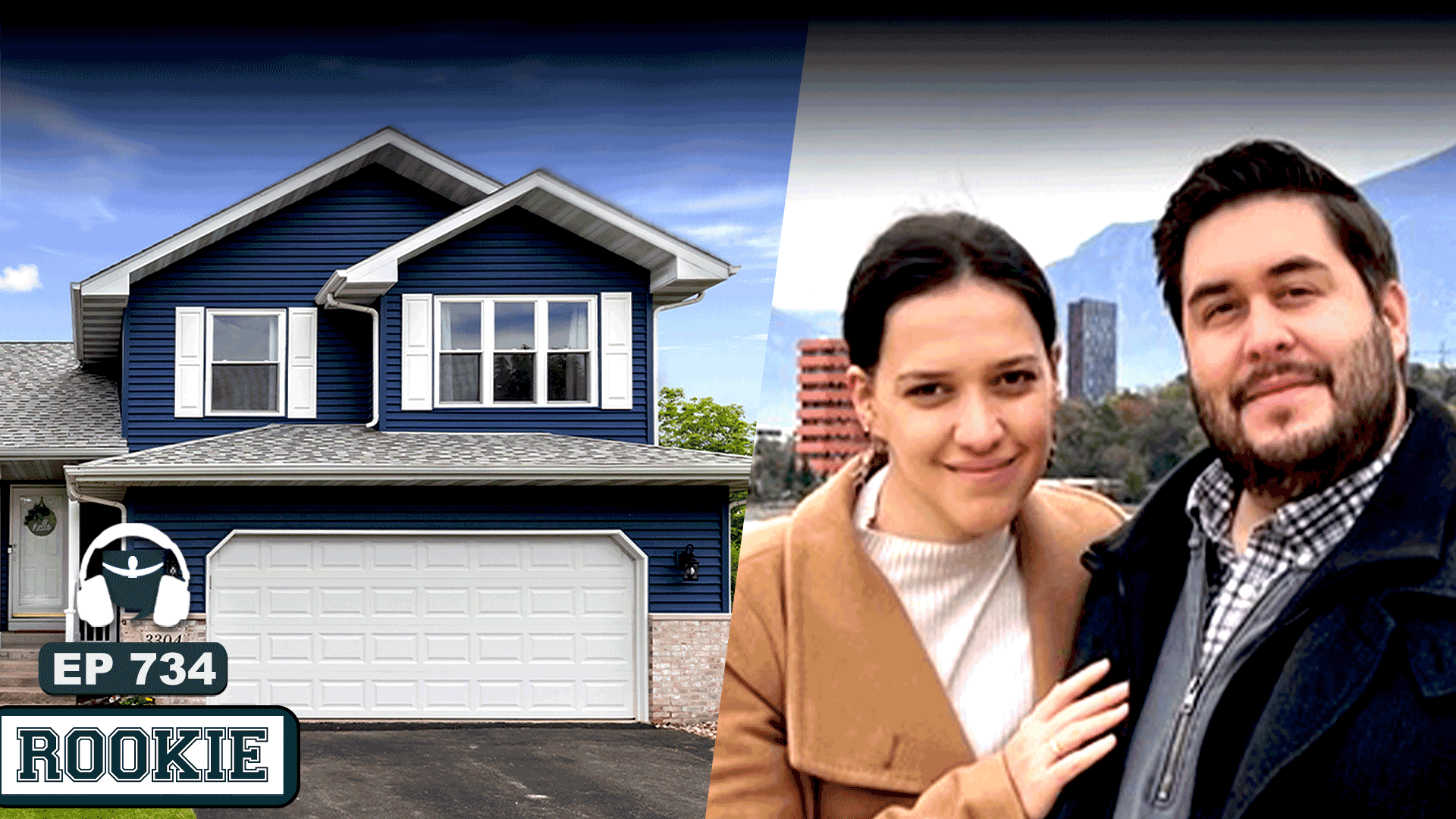
At 31, James sat down at a kitchen table with his wife Aida, ran the numbers on the next 30 years, and didn’t like what he saw—$200,000 in student loans and a retirement plan neither of them believed in. So they stopped waiting for a change, and built something instead.
Welcome back to the Real Estate Rookie podcast! Our guest, James Doren, and wife, Aida, didn’t have a trust fund or an obvious path forward. They had a spreadsheet, a private money lender, and an empty space above their garage. This accessory dwelling unit (ADU) solution added 50% value on their equity, wiped out their student loans, and set them on a path that most investors never consider: intentionally shrinking their portfolio from 10 doors to 4. But the deal that surprised them most didn’t come from an agent or Zillow. It came from a tenant who knocked on their door with a problem the bank couldn’t solve!
James breaks down the house hack that started it all, how he convinced a private money lender to fund the build, and the rent-to-own agreement he structured for his tenant that gave both sides exactly what they needed. If you’ve ever sat at your own kitchen table and wondered if there’s a better way…James’s story is your proof that there is!
Ashley:Today’s guest was climbing the corporate ladder, had a stable job and good income. But when he sat down with his partner at their kitchen table and they actually ran the math on what their next 30 years looked like, they didn’t really like the answer.
Tony:He was 31. She was 24 and quietly running the numbers on a retirement plan they didn’t believe in. Then she looked up at the empty space above their garage and designed the deal that broke them out.
Ashley:This is The Real Estate Rookie Podcast. I’m Ashley Kehr.
Tony:And I’m Tony J. Robinson. And with that, let’s give a big warm welcome to James. James, thank you for joining us in the Real Estate Rookie Podcast today.
James:Thanks for having me, Ashley and Tony. Appreciate it.
Ashley:So James, let’s start with that moment at your kitchen table. So is this something you guys would usually do is sit down and kind of put together a financial game plan, look at the future plan, or was this the first time that you had done that?
James:No. Yeah, that’s something we pretty regularly did. We’d sit down and have money dates and talk about our finances and our future and how to get set up and get to where we want to be.
Tony:James, let me ask just really quickly because I love the idea of the money dates. For rookies that are listening that want to replicate that, just give us the quick agenda. How often and what were you guys talking about in those meetings? Because clearly it had a big impact on your financial future.
James:Yeah, we’ve actually kept it up for years now at this point. Once a week, an hour out of the week before, usually before we start our actual date night. That way we’re not too tired. We got all the stuff that we had sitting on our shelves, brewing in our minds off our plate and we’re able to enjoy our time together. But we sit down, we review what we spent, what we plan on spending, where we are compared to the budget that we set, any adjustments that need to be made. And since we’re doing it so frequently week to week, there’s not really any room for things to get too off the rails.
Ashley:Now, James, when this point in your life, when you’re looking down and not liking what you see for the future, where were your financials at at this point? Did you own a home? Did you have any debt, things like that?
James:So I had just accepted a new job that moved us out to Pennsylvania. We didn’t know the area at all. So we were renting a house while we figured out exactly where we wanted to live. We were making pretty good money on paper. I was a director for a healthcare company. She was a data scientist for an insurance company. Household income about 300K. But the reality of that was we also had 200K in student loans, two car payments. We were saving less than 10% of our income. So that’s kind of where we were. I was 31, she was 24 at the time and we realized sitting down at that money date at the kitchen table, hey, this is going to be 30 or 40 years of this grind and neither of us were really willing to wait that long to dedicate more time together.
Tony:I think there are a lot of people, James, who maybe have that same realization though where they sit down and they’re like, “Man, the path that we’re on is not going to actually get us to the end result that we want. ” And they wait months, sometimes years before they actually take action. What was the first thing that you guys did that wasn’t reading another book or listening to another podcast? What was the first thing you did in the real world that gave you some forward momentum towards changing that trajectory?
James:Sure. Yeah. I liked how you mentioned not reading another book, not listening to other podcasts because we’ve done all of that at that point. And I think we had spreadsheets coming out of our ears. So the first thing that we did was call a local real estate office. We called to connect with an agent. We said, “Hey, look, we’re throwing all this money away renting. We know that we should own a home. We want to treat it like an investment, not just a nice place for us to live. It’s something that will aid our financial goals.” And Ida had the idea of house hacking. So we said, all right, let me call local office, get the best investor-friendly agent that they have to hook us up and teach us to show us all the exciting things. So that was the very first step that we took and started going on some tours with him to look at things that we thought fit our model.
Tony:What did that conversation with the realtor maybe teach you that not listening to another podcast or another book could have taught you, that first real world taste of being a real estate investor, what was different than the books in the podcast?
James:Yeah, I think it was a blessing in disguise that he actually wasn’t the right agent for us. He kept talking us out of every opportunity that we looked at, everything that we came across. And the thing that gave us the confidence that we weren’t going to get from books or podcasts or anything was realizing that independently, even though this expert was telling us that it didn’t fit our vision or it wasn’t a good deal or wasn’t a good idea, we independently felt differently and we saw the opportunity in it. We were like, “Hey, we can make this work.” And when we coordinated together after doing that showing, we realized, you know what, we don’t necessarily need everybody to align with our vision. We believe in this, so we’re going to go for it.
Ashley:So take us through some of those deals that you looked at. Did you make offers on any before you ended up on the one that you actually purchased?
James:We didn’t actually, no. We only offered on the first one that we purchased. We did walk through a lot of different houses though. He was taking us all over town. There was a lot of traditional duplexes that were built for the purpose of two families, three family homes even. There was a lot of homes that were in a multifamily zoning but were single family homes. So they were listed at a litle bit of a cheaper price, needed a little bit more work, had the opportunity there, but not the actual structure. So it really required some imagination and thinking outside of the box, I think, to see those come to life. So eventually we landed on one that was in that latter group of being zoned properly but was really just a single family house and we saw the opportunity to do what we did there.
Ashley:And now with this property, that opportunity was this garage space then?
James:Yes, exactly. So there was a main house about a 2,500 square foot four bed, three bathhouse. There was a detached garage, two-car garage oversized, really quite large and a empty but somewhat built out livable area above the farage there. So that’s how we saw that vision. And Ida was on it right away. She’s like, “We can live in that little apartment. We can make it nice. We’ll rent out the main house.” I was a little bit more, “Well, I’ve been working my butt off. I’m over 30 years old. I’d like to live in the nice part of the house and maybe we rent out the smaller one and we’ll collect less profit.” But she wrote the math down on paper, showed it to me and was like, “This gets us to our goal, this dozen, which one do we want to do? ” So we removed the emotion from the decision or I removed the emotion from the decision and we went with what made sense on paper.
Ashley:But James, in a way that is still taking your own personal preference into consideration. Just because you’re giving up what you want now, you are giving that up so you can get what you want in the future. And so it’s not really sacrificing something or it’s not giving up.You are actually just changing something now so that you can have what you want later. And part of the motivation of real estate investing, if you want it really bad, sometimes that motivation to get to what you want is going to make you do things like this where, okay, I’m going to live in the ADO and not live in the main house. I 100% would do that. I would see that vision too. I’m with Ida as to like, let’s make as much as we can as fast as we can renting out the bigger house and we’ll just live in this smaller apartment.But I think that can get lost with people. And I love that she sat down with you and kind of wrote it out. I think so many people are visual learners and need to actually see it rather than be told it. And I think that was just a great example right there.
James:Yeah, absolutely. I mean, she has an amazing story and background and I think it’s allowed her to really be comfortable with this concept of delayed gratification. And me having a very different background, I had to learn that from her over time and it’s been a wonderful thing.
Tony:And just for Rick, in case we didn’t clarify, Ida is James’ wife who’s been his partner throughout all these deals. I know we’ve thrown that name around a bit, but James, most rookies I think stall on real estate, not because they don’t see the path, because they don’t have the vision, but they saw because they can’t necessarily agree on the risk associated with investing in real estate. And you kind of talked to us a litle bit about the mathematical approach that you guys took, but in those early days between you and your wife, who was maybe the brakes and who was the gas pedal and how did the two of you actually align on what you were willing to put at stake in order to actually get things started?
James:Yeah, that’s a great question. I mean, especially when it’s not just a business partnership, it’s a marriage. There’s a delicate balance to be upheld there. I was probably more of the gas and Ida was the break. She was rooted heavily in math I think just from a background and a natural personality type of thing. And I was a little bit more of the one willing to execute. So we’d have an idea together and it’s like, all right, let’s go. I see all the steps to get there. So I’d get excited. I started running scenarios where it could work and she just pulled the spreadsheet towards her and make us look at the math again, not make sure that nothing was optimistic, make sure that we didn’t need best case scenario for several components of the deal for anything to work. She really reigned the whole operation in and forced everything to be based on math and not emotions, like I said before, that very first deal.
Ashley:Well, we’re going to take a short break, but when we come back, we’re going to get into what actually made this deal work. So we’ll be right back. Okay, welcome back. So before the break, we heard about James and Ida doing a nightly deal analysis around the kitchen table. The thing they were missing was the actual deal itself until they find that this property with the empty space above their garage and they actually started doing math very differently. Okay. James, let’s break down the numbers on this actual property. So walk us through what did the ADU actually cost you and how much did you put into the renovation on this property and how long did it take?
James:Yeah, so it took about six months end to end all in the ADU came out at about $57,000. So six months from when we started to when we actually moved into the ADU was that timeline. We financed it with a 50K loan from a private lender that we built a relationship with. We put the rest of our own cash and we were able to refinance at a much higher value after that ADU was built and completed.
Tony:Two things, James, that sound ask me from your story are the timeframe, but then also the money that you borrowed from a private money lender. So let’s talk about the private money piece first. I feel like that’s probably the part that a lot of rookie investors want to know more about is how did you do that? So who was this individual and how did you approach them with the opportunity to invest in the ADU with you?
James:Yeah, great question. I mean, I think pretty similar to a lot of investors early on that the story’s the same. It was a family friend essentially that had the money, wanted to do something with it, wanted to help us out, understood that we were reliable and trustworthy because they’ve known us for a while. So that’s how that came about initially.
Tony:But James, how did you actually broach that conversation with them? Did they know that you guys had already been searching and were interested in real estate? Was it just a cold outreach because maybe you knew they had some capital sitting around? What did that conversation actually look like to get you to the point where they actually ended up funding a good portion of that deal for you?
James:Gotcha. Yeah, we’re both pretty direct people, so they were aware that we were looking for a house. We were very close and spoke regularly in our lives. So it wasn’t a surprise that we were looking for a house. It was a surprise when we had this idea of a house hack and a burr, and we threw all these terms around and pitched them the deal. They were honestly very skeptical at first a lot of questions around, well, how do you know how much it’s going to be worth afterwards? How do you know what you’re going to be able to get a loan for? And how can you guarantee that I’m going to get the money back, let alone additional interest? And so we anticipated a lot of those questions. We showed the math. We really broke it down step by step of what we did to arrive at those numbers.Here’s how it works, here’s why this works, here’s other examples of people doing that. I have a close friend that’s also in the real estate and I had him explain and be a case study for how he’s done that several times. So all of those things helped and were part of that initial conversation with them.
Ashley:During the rehab process, did you hire out all of the work or did you guys do any of the work yourself?
James:We made the mistake of doing a lot of the work ourself and I say the mistake because it took much longer and probably cost us more in holding costs, which we weren’t super, I guess aware of on our very first deal than it would’ve to just pay a contractor to do it. It was a great experience. We learned a lot about construction in general, but yeah, we had a mix. So a lot of the large foundational components, say along with plumbing and electric, we had contractors for … My father was a carpenter for many years, so he helped us install the kitchen and do a bunch of other things, kind of a mix.
Ashley:Okay. So James, once you’ve finished the rehab, you guys move into the ADU property and did you refinance this right away and give us wrap it all together here?
James:Yeah, we did. It was end of 2021 when we went under contract early 2022 when we closed on the deal or early 2022 when we started the construction, we refinanced right away and rented out. We actually lived in the living room of the main house while the ADU was being built, slept on an air mattress on the floor. We’re getting dressed that our clothes being in garbage bags, it was a nightmare. We did that for a couple of months until the ADU was livable but not finished. And then we moved into there and finished building it and then refinanced right away. And as soon as we moved into the ADU, we also rented out the main house. So that one was ready to go. We started collecting some income even before the ADU was built That helped a lot and we finished it while we were living through the renovations there.
Ashley:What was the amount of the rent that you were able to charge?
James:So we charged 2,750 for the main house. The mortgage was about 2,650, so we’re netting about a hundred and living for free.
Tony:I mean, that is the goal. That’s like a perfect house because someone’s paying you to live in the place that you already want to live in. And then what about the refinance on the backend? So what was the total all- in cost of your purchase price and your rehab of the ADU and then what was the final appraised value?
James:Yeah, so the house was 445. We put about 60K, I think 57K into the ADU, I said. So took us a little bit over 500K all in plus the holding cost took us to about 515 and it appraised for way more than we anticipated about 675. So it was a home run right off the bat. We had a bunch of equity in there. Rates were great at that time, so we had a pretty good deal going.
Ashley:You got to tell us what was the rate?
James:It was 3.4.
Tony:Wow. James, but did you guys do anything to the main house or was all of the renovation budget just on the ADU?
James:The main house was in almost turnkey conditions. We hardly did anything there. There was a few minor cosmetic things. We had to paint one of the rooms. We had to fix part of the ceiling and clean, but that’s about it.
Tony:I mean, you said you bought it for 445 and then it appraised for 675. So we’re talking over $200,000 in equity gain just because of the 60 some odd grand you spent on the ADU.
James:Yeah, adding a whole nother family to be able to live in that place. And now we rent that out for 2,000 a month. So that’s 2,000 additional on top of the main house covering the mortgage. So
Tony:Now that you’ve moved out, you’re collecting what, almost 5,700, almost five grand a month in rents and your mortgage is still 26. I mean, what are you clearing after all expenses like two grand a month basically on this deal?
James:Almost. Yeah.
Tony:That’s a great first deal. You got to thank Ida a little bit more, James, for having that vision, man.
James:Every day I do, because I really started the snowball and we never would’ve got there without her. Now,
Ashley:James, what about the next deal and your deals going forward? So you’ve got this great first deal and I know that you’ve said that you would rather miss out on 10 deals than force one deal. So what does the future look like after you got this home run deal and now you’ve moved out of the property? What’s next?
James:Yeah, so we actually stayed there for as long as we could to keep saving money living for free. We used that opportunity to pay down all of our debt. We eliminated 200K of student loans in a year and a half.
Ashley:Congratulations.
James:Yeah, thanks. We reduced our car pay or paid off our cars. We just focused on getting rid of our debt and not really doing another deal right away. We wanted to be in a better financial position and be able to approach the future deals from a position of power. So that was our number one goal. Our number two goal after that was, hey, we learned a lot about construction, about managing contractors, about holding costs, for example. So we felt like we had the experience and the education to keep moving forward. So we looked through our next deals came from a mix of areas, not the same agent, but a different investor, friendly agent who passed us a couple of off-market deals. Zillow, we pulled our last two deals just straight off of Zillow. They were on MLS and one of them came from one of our tenants, so kind of a weird mix of sources.
Tony:Yeah. James, so for the agents who are sending you off-market deals, that’s the goal for a lot of rookies, that they just have agents sending them deals that no one else has access to. That’s like the holy grail of deal finding. How did you build those relationships, or maybe better yet, why did those agents come to you as one of the people on their short list of properties to show these off-market opportunities?
James:Yeah, that’s a great question. I think that the biggest thing is communication. Whether I was interested in a deal or not, we always got back to them with a reason. I took the time to write out a paragraph or more of, here’s why this would work, here’s what we like about it, here’s why it doesn’t work, here’s our thinking of what we’re not going through. And I think that showed that we’re serious about our next deal, they’re going to keep sending us things, but also it made us easier to work with and made them understand exactly what we want to do and what we’re looking for and we’re able to refine their search a litle bit and it let them know we were there. We’re live bodies looking to interact and make deals and when they weren’t just sending stuff to an empty inbox. So I’m sure we’re not the only ones getting exclusive access to these deals, but we’re always at top of mind for them.
Tony:Yeah, that’s great, man. And then what does the portfolio look like today?
James:So we intentionally consolidated very recently. We have four active properties right now, four doors down from over 10. And yeah, we’ve intentionally consolidated. We’re looking to do a little bit larger deals apartment buildings going forward.
Tony:Talk us through that because I think for a lot of Ricky’s, they fixate on the numbers, the number of doors. So what was the math for you to say, “Hey, actually going from 10 to four is the right move for us.”
James:Yeah, I mean more doors is more management, more risk. We’re extremely conservative in our risk profile. We really don’t want to be over-leveraged in any case I believe in I guess what has been coined as a small but mighty portfolio, you have high equity, low debt across your portfolio and you’re able to pay those off and snowball that and your overall net income increases from paying down your debt, not so much from adding more and more and more doors. So our thinking there was along those same lines. We never really had the goal of having 50 single family homes or something like that or more, which many people do and that works also. But that was a little too risky for us and we didn’t want to be over-leveraged. So we consolidated, we have four really solid properties. That first one we ever bought is still staying strong.So that one hasn’t left our portfolio and yeah, we’re looking to get into apartment buildings, 10 to 20 unit buildings to diversify and help reduce that risk further in economic downturns.
Tony:Well, you guys continue to scale. Oh, go ahead Ash.
Ashley:James, what would be a good first step if somebody’s in the same position for you where they maybe have built a smaller portfolio but they want to make that transition into larger multifamily complexes, what are some of the things that you’re actively doing now to not only prepare yourself to shift asset classes, but to know how to analyze the deal, manage these properties are totally different. What’s something that someone else could replicate in getting themselves ready to take on multifamily?
James:Yeah, that’s a great question because it’s a whole different set of underwriting. It’s a whole different way of looking at the deals. It’s a whole different set of financing tools that are available. So learning all of that similar to before taking that first step, we were in the stage of learning all of that. We took a couple of courses and we sent the same route of books and podcasts and became as educated as possible. And then remembering our initial experience of, okay, time to take the first step. I made a call to somebody that we’ve become very close with and now in the industry that has several large apartment buildings in their portfolio and got a lot of advice from them and just kind of picked their brain and it became kind of a formal mentorship. I think that was key. That was really helpful.We put a business plan together to formalize it and make sure we knew what are the steps we need to take to accomplish the goals that we need to. So that was helpful also seeing it on paper. We’re going to need financing, we’re going to need property management, we need relationships for realtors and lenders and all these different contractors and people in each of the places that we’re looking to invest.
Tony:Yeah. Well, James, you guys have continued to scale the portfolio with a very disciplined approach, but then a tenant of yours walked up with a request that completely changed how you thought about what real estate investing was even meant to do. So we’ll cover what that pivot was in your portfolio after a quick word from today’s show sponsors. All right guys, welcome back. So we’re here with James and he built a system that brings them deal flow, but the deal we want to talk about next didn’t come from any of those channels. It came from a tenant who walked up with a question. So James, give us the backstory here. You had a tenant and I guess how long had he been renting from you and what was the conversation that kind of started this new strategy that you really hadn’t considered before and what did he tell you he actually wanted that the bank told him he couldn’t have?
James:Yeah, this was a really cool one and kind of an eyeopening moment for us because it was a reminder of why we even started this company and why we’re doing what we’re doing. It was an opportunity to help somebody else while still having a successful deal ourselves. And so he was a tenant in one of our properties. He lived there for almost a year and he was a great tenant during that year. We kind of took a little bit of a chance on him because he recently quit his W2 job and opened up a food truck so he didn’t exactly have verifiable income. So that was another problem with the banks, which is why he was renting in the first place, but he looked great on paper. His business was great. It was a food truck and the food was delicious so I believed in the product as well.So it’s just overall great guy. Took care of the place, was really, really respectful and polite. And he came to us Sunday and he said, “Hey, I know I found this condo that I really like, would love to be able to move into it. I would love to rent it from you. I can’t exactly get a bank loan at the moment because they need, especially for self-employed, I think they told them they needed two years worth of income history and he had only owned his business for little under a year at that point. So me and I and I looked at each other and we’re like, I think we could figure out how to do this. ” We have all the knowledge to get creative and the expertise to get creative and figure out how to structure this and how to make a deal work.So he really loved the place. That’s where he saw himself long-term. He was set on that being the place that he wanted to live. We were able to work out a deal with the seller to get a reasonable price who was also a great guy and looking to get rid of the place and help people out as well. So that helped it click and we put a rent-to-own agreement together for our tenant. We bought the place for 185K. We’re going to rent it for … He gave us an option fee and we’re going to rent it to him for two years and sell it back to him at 205K.
Ashley:So he moves out of your current rental into this condo that you buy and you set up this agreement, which kind of is giving you multiple exit strategies for this property. You have an end buyer in two years or you retain the property as a rental if he doesn’t execute on the rent to own or you could list it onto the market and sell it to someone else or continue to rent it. So this is interesting. I don’t think that we’ve ever heard of this situation before where a tenant has actually came to a landlord and said, “I want you to buy a different property and not the one I’m living in and I want to move to that one.” But any tenants listening, this feels like a dream for a landlord, so bring deals to us.
James:Yeah, no, it was exciting. I mean, definitely unique. We had to put our heads together to figure out how to make it work. But like you said, it had multiple exit options. I mean, that’s something that we’re huge on if If a deal only works one or two ways, it’s not really a deal because things go wrong all the time. So it was nice having that optionality, that flexibility. And yeah, he’s a great guy. So he was able to get the house he wanted. We were able to make a little bit of a profit and put the deal together and maintain him as a tenant, which we know we already trusted him.
Tony:James, you mentioned an option fee. What is that? What was the amount? And then what happens to that option fee for whatever reason he’s unable to actually move forward with the purchase of the sale and the two-year timeframe?
James:Sure. Yeah. So for a rent-to-own agreement, the option fee is the amount collected upfront that gets taken off of the sale price at the end. So it’s kind of like his down payment early on. We actually collected, which is rather unusual, but it was because it was a relationship that we had already built with our tenant, but we collected 20% of the purchase price as the option fee. So that kind of removed all of our risk from the equation. And what happens if he doesn’t purchase the place is that we keep that option fee. So it’s technically earned income at the time that we received it. We keep that option fee if he defaults on the rent or if he doesn’t want to buy the place at the end. And basically we got that 20% down payment for the condo. If he does decide to buy it, that option fee comes off of the 205,000 purchase price.
Ashley:So who came up, I guess, with this structure? Is this something you just proposed off the bat or did it take some kind of negotiating to do? I mean, for somebody who’s never done this before, how did you figure out where to start, I guess, with structuring this deal?
James:Google. Google is a great
Ashley:Job.
James:But yeah, no, we had-
Ashley:Yeah, I guess ChatGPT could probably tell you what to do. Yeah,
James:You’re right. Yeah. No, it’s a fairly standard arrangement for rent to own. We saw a few standard templates. We consulted a lawyer to make sure that we were doing it right. We didn’t want to be putting him in a position that wasn’t good. We didn’t want to put ourselves in a position that exposed us to a lot of risk. So we did consult a real estate lawyer to help us put the contract together, but it really was just independent research and trying to figure out, hey, how can we make this work? Rent to own is a thing. It’s not super common nowadays, I would say, but it is a viable strategy that’s out there.
Tony:Yeah. Well, James, I mean, you’ve had, again, some incredible success with the portfolio that you guys have built, but for the rookies that are listening who they have some money saved, maybe they’re in a W2 that they’re not super thrilled about saying in for the next 30 years either. What roadmap should they be following? What’s one move you want them to make in the next 30 days to actually make progress toward their goal of getting that first deal?
James:That’s a good one. I mean, don’t take a course, don’t read another book, don’t analyze 50 different markets. Pick one that works that is nearby or that you’re familiar with. Run honest numbers on different properties every day. Not just the numbers from Zillow, not just the numbers that the listing agent sends you that are almost always inflated and incorrect. Go deep on what you’re doing and what you know and what’s there. I don’t think you need the expertise of anybody else really that you can just start taking action there.
Ashley:I think one thing I would add on to that, James, and I think that’s great is asking questions and not even finding a mentor and asking them, but figure out what’s holding you back from maybe getting the next deal done and ask yourself, what are the things you’re concerned about? So are you concerned about where you’re going to get the money from? And figure out all of these things that you don’t know. For longest time, I didn’t know what skip tracing was and I would just like, I don’t know what that is. And I would just let it go. And it’s like a simple Google search of what if told me what skip tracing was. And it’s like as you’ll become more confident and comfortable if these questions or these things that you don’t know if you actually identify what these questions are that you have and you do the work to actually answer those questions, you will feel much more confident moving into a deal, analyzing your numbers, underwriting, all of that.So I think that was great advice, James.
James:Yeah, no, you made some great points there as well. Makes a lot of sense.
Ashley:Well, James, thank you so much for joining us today on Real Estate Rookie. Where can people reach out to you and find out more information about your journey?
James:Yeah, thanks for having me. It’s been a pleasure. The best place is our website, www.riseup.capital. We’re on Instagram too @invest with RiseUp.
Ashley:Well, thank you so much. We really enjoyed having you on to share your experience. We really did miss not having eyed on, but we’ll have to have her on for a separate episode to get her insight into your real estate journey.
James:Yeah, that sounds great. Thank you guys for having me. It’s been a pleasure talking with you.
Ashley:Thank you, rookies for listening to today’s episode. I’m Ashley and he’s Tony, and we’ll see you on the next one.
Help us reach new listeners on iTunes by leaving us a rating and review! It takes just 30 seconds and instructions can be found here. Thanks! We really appreciate it!
Interested in learning more about today’s sponsors or becoming a BiggerPockets partner yourself? Email [email protected].








-1024x683.jpg "Judge Who Helped Violent Illegal Alien Evade ICE Faces New Test")



-1024x683.jpg "Montana Puts Democrats in a Bind as Senate Hopes Fade")











