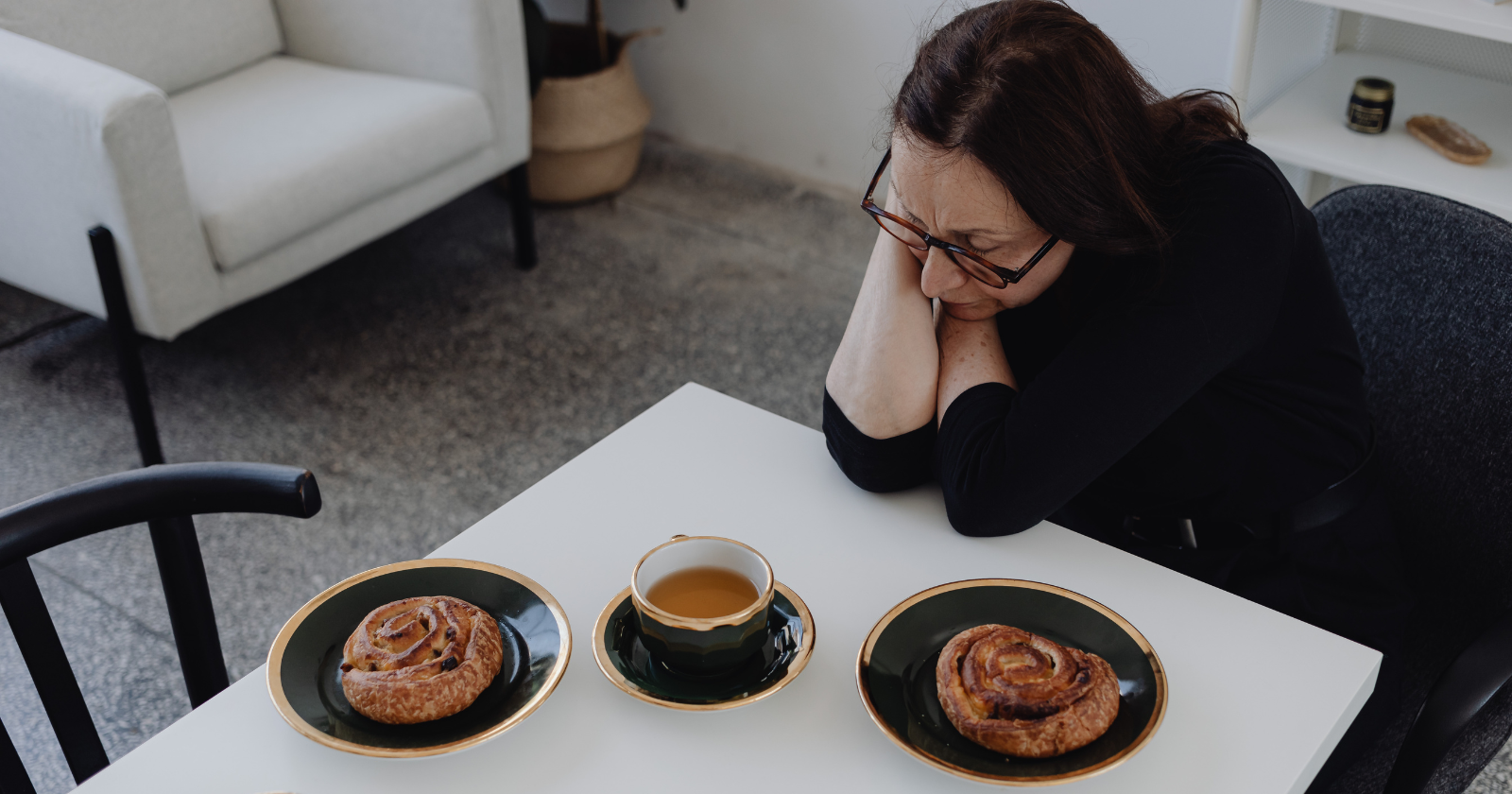
She is standing at the counter at five past five, and her hand has already opened the fridge before she has thought about dinner. Two chicken breasts come out. She sets them on the cutting board the way she has set them on the cutting board for forty-three years, and only then, somewhere behind her eyes, does she remember that she is cooking for one.
She peels the second potato anyway. The extra portion will go in a yoghurt tub, into a freezer she has stopped pretending she will empty.
Most people think of widowhood as a story about absence. The empty chair, the unused side of the bed, the silence where there used to be a voice asking what’s for dinner.
But the more honest story is about presence. About all the small actions a long partnership wrote into the body, and how those actions keep firing long after the person they were written for is gone.
Cooking for two is one of them. So is setting two mugs by the kettle. So is buying the brand of mustard only he ate.
The muscle memory of a shared life
Habit is not sentiment. It is neural architecture, and it does not care that someone has died.
Repeated daily actions become encoded so deeply in the brain’s procedural systems that they require almost no conscious effort to execute. A woman who cooked dinner for the same person for forty-three years is not running a decision tree at 5 p.m. She is running a routine. The chicken comes out of the fridge at the hour the chicken has always come out of the fridge. The hand reaches for the second breast because the hand has reached for the second breast every night for decades, and the hand does not consult the calendar. It consults the kitchen. The kitchen still looks the way it looked when there were two of them, and so the hand behaves accordingly, and by the time conscious thought catches up, dinner for two is already underway.
Two breasts, because two breasts is what dinner has always been.
Recent research on how everyday cues shape habits suggests that environmental triggers, the kitchen at a certain hour, the sound of the evening news, the click of the oven preheating, activate behavioural sequences whether or not the original reason for them still exists. The cue fires. The hand moves.
This is why the widow cooks for two. Not because she is in denial. Because her kitchen still is.
What the second portion is actually doing
Ask a grief counsellor and they will tell you that continuing pre-loss rituals is one of the most common, and most under-discussed, ways bereaved people cope.
Yusen Zhai, who directs the University of Alabama at Birmingham’s Community Counseling Clinic, has written that healing after loss is rarely a linear process, and that the small milestones along the way matter more than any prescribed timeline. The second portion is one of those milestones, repeated daily. It is the widow saying: I have not yet decided to be one person.
That is not pathology. That is pacing.
The cultural impulse to categorise grief into tidy stages risks creating unrealistic expectations about how grief is supposed to progress. The woman cooking for two is not stuck on stage three. She is doing the actual work of grief, which is mostly invisible and mostly happens in the hands.
The identity that doesn’t dissolve when one person leaves
A long marriage builds something psychologists sometimes call a couple identity. Not the romantic version. The practical one.
You become the person who buys the bread because he does the milk. You become the person who handles birthdays because he handles taxes. The labour of being two people is split so finely, over so many years, that pulling one half out doesn’t leave the other half intact. It leaves a structure that no longer knows what it is.
Bereaved spouses describe this as one of the hardest parts of widowhood: the slow, often resented process of rebuilding an individual identity out of pieces that were designed to interlock with someone else’s.
Cooking for two is a refusal to do that work prematurely. It is a way of saying: I was a wife yesterday. I will be a wife today. Tomorrow is tomorrow’s problem.
The widow is not lonely the way the world thinks she is
There is a tendency, especially among adult children, to read these continued rituals as evidence of unbearable loneliness. To worry. To suggest she join a club, downsize, learn to make smaller meals.
The well-meaning advice often misses what is actually happening. Roughly 11.8 percent of older adults experience loneliness, and the risks are real. Higher rates of depression, heart disease, cognitive decline. Loneliness in old age is a public health problem worth taking seriously.
But loneliness and ritual are not the same thing. A widow who cooks for two may be doing the opposite of isolating. She may be maintaining, through her stove, a relationship she is not ready to renegotiate.
The mug on the counter is not a symptom. It is a conversation.
We’ve written before about how people in long marriages can feel lonely without being ungrateful, missing the version of being seen that comfort quietly replaced. Widowhood reveals the inverse truth: the comfort and routine were themselves a form of being seen, and they can keep delivering that recognition long after the person on the other side has gone.
Why the freezer fills up
Walk into the kitchen of a woman who has been widowed for two years and look in the freezer. You will often find it stacked with single portions in old yoghurt tubs, labelled in handwriting that gets neater the more recent the date.
She is not hoarding. She is archiving.
Each container is a meal she cooked for two and ate as one. The leftover portion is the part of the day where she was still married. Throwing it away would mean acknowledging that she cooked too much, and acknowledging that she cooked too much would mean acknowledging why.
So it goes in the freezer. The freezer becomes the place where the marriage continues to take up room.
This is not denial in the clinical sense. It is what the body does when the mind has not finished catching up.

The day she cooks for one
It happens, eventually. Usually not on an anniversary. Usually not on a day anyone could have predicted.
She buys one chicken thigh because the package of two looks suddenly absurd. Or she pulls out the smaller pan, the one she used to use for lunches when he was at work, and realises it has been three months since the big pan came out at all.
The shift is rarely dramatic. It is often noticed only in retrospect, weeks later, when she realises she has stopped saving leftovers. The freezer has been thawing out, one yoghurt tub at a time.
This kind of transition is often described as integration rather than recovery. The loss does not get smaller. The life gets bigger around it.
What helps, and what doesn’t
If you know a widow who is still cooking for two, the kindest thing is usually to let her.
Guidance from grief counselors emphasizes listening without judgment, offering a supportive ear without trying to fix people’s feelings, and steering clear of the platitudes that families fall into when they cannot bear someone else’s grief. They’re in a better place and time heals all wounds are the kinds of phrases that close conversations rather than open them.
What helps instead is presence. Sitting at her kitchen table while she does what she does. Eating the second portion if she offers it. Not commenting on the size of the pan.
There is a kind of intimacy that doesn’t need to be filled with words. We’ve explored how comfortable silence between two people can be a rare form of trust, and that trust is exactly what a grieving person needs from the people who visit. Not advice. Not a plan. Just the willingness to sit at the table where two places are still set, and not flinch.
The ritual is the relationship
There is a passage in writing on grief, including in Psychology Today’s reflections on how routines anchor people through loss, that returns to the same point in different forms. Sameness is not always avoidance. For many people, sameness is the structure that makes the rest of grief possible.
If everything changed at once, the bed, the meals, the kitchen, the routines, there would be no foothold left. The cooking-for-two is the foothold. From there, the slower work of becoming one person can happen on its own schedule.
Tonight, the chicken comes out of the fridge. Two breasts. She salts them both, slides them into the pan, and pulls two plates down from the cupboard before she remembers, and then she leaves them where they are.
The second plate stays on the counter while she eats. After, she scrapes the extra portion into a yoghurt tub, writes the date on the lid, and slides it into the freezer beside the others.
Then she turns off the kitchen light.