Private markets investors manage a roughly $15T global asset class, yet the workflows powering most deal decisions still depend on manual spreadsheet reconciliation, fragmented data rooms, and institutional knowledge that walks out the door every time a senior analyst moves on. The result is a structural inefficiency where firms capable of deploying billions in capital spend the majority of their analytical bandwidth on data extraction rather than judgment – and where the cost of a slow or missed underwriting decision compounds across every deal cycle. Into this gap steps F2, an AI-native platform that embeds directly into the deal workflows of private credit funds, commercial banks, and private equity teams, turning a firm’s accumulated deal history into a persistent, queryable knowledge asset that improves with every transaction. The platform combines an Excel-native financial analysis engine with agentic workflow automation across screening, underwriting, and portfolio monitoring, achieving 95.25% accuracy on SpreadsheetBench – the industry standard benchmark for spreadsheet AI – and is already deployed across 100+ funds and banks globally. Unlike horizontal AI tools that approximate financial analysis, F2 runs a real Excel engine underneath the AI, preserving cell dependencies, formula logic, and full data lineage so every number in an IC memo traces back to its original source.
AlleyWatch sat down with F2 Founder and CEO Don Muir to learn more about the business, its future plans, and recent $14M seed round that brings total funding to $24M.
Who were your investors and how much did you raise?
F2 raised $24M in total equity capital, including a $14M seed round. The seed round was led by HighlandX, with participation from Left Lane Capital, NFX, Y Combinator, and Torch Capital.
Tell us about the product or service that F2 offers.
F2 is a compounding intelligence platform for private markets investors. It delivers end-to-end agentic workflow automation across:
Screening
Underwriting
Portfolio monitoring
The platform transforms a firm’s deal history into a persistent, queryable knowledge asset and evaluates new opportunities using full contextual data (precedent deals, data rooms, market data). The platform is powered by an Excel-native financial analysis engine and includes tools like Adam (AI deal associate), Deal Intelligence, and Institutional Knowledge.
What inspired the start of F2?
F2 was founded to solve the needs of Arc’s lender customers as they reviewed and underwrote debt deals on the Arc capital markets platform.The system was initially an internal agentic underwriting tool, developed to address operational pain points firsthand. After proving effective, Don Muir presented it as a standalone commercial opportunity, leading to the creation of F2 with backing from prior investors.
In addition, private markets are at an inflection point, where firms embedding AI into sourcing, underwriting, and monitoring can build a structural competitive advantage over time.
How is F2 different?
F2 differentiates itself by: doing the following:
Embedding directly into deal workflows used by investment teams.
Delivering customized deployments for each enterprise.
Using a multi-model, LLM-agnostic architecture (Opus, ChatGPT, Gemini, and proprietary tools).
Achieving up to 60% better performance vs. generic agents and 5x token efficiency.
Providing enterprise-grade data privacy (zero-day retention, no training on client data).
What market does F2 target and how big is it?
F2 targets:
Private credit funds
Commercial banks
More broadly, private markets investors
The company operates within the global private markets ecosystem, a roughly $15 trillion asset class, where much of the investment process remains manual and under-digitized. F2 is already deployed across 100+ funds and banks globally.
What’s your business model?
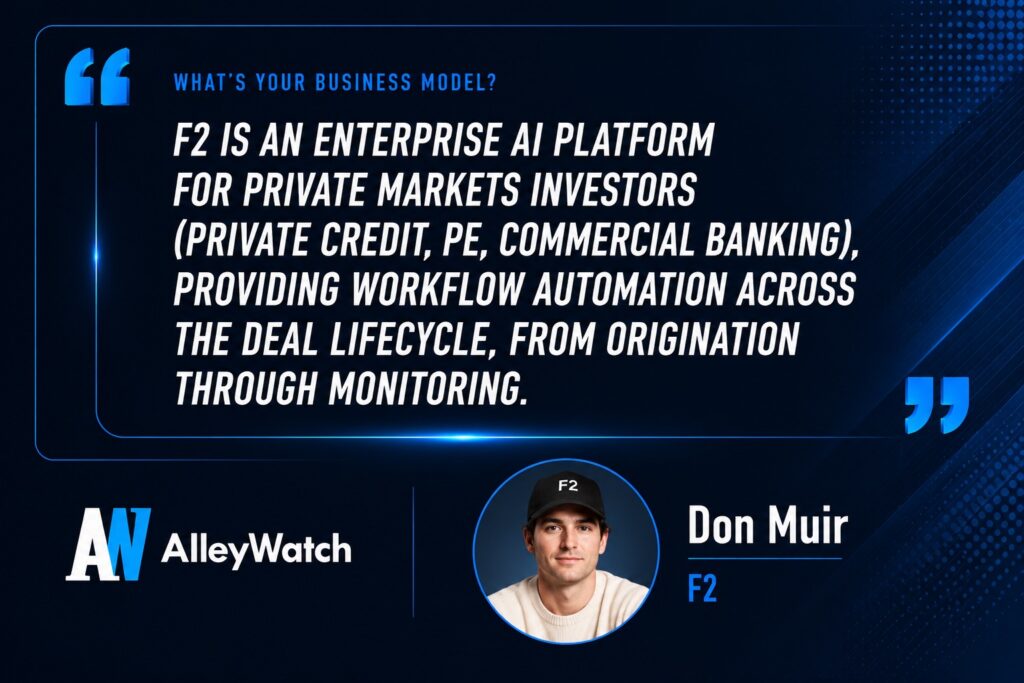
F2 is an enterprise AI platform for private markets investors (private credit, PE, commercial banking), providing workflow automation across the deal lifecycle. F2 sells an enterprise SaaS platform that helps investment teams move faster, standardize decision-making, and improve outcomes across the deal lifecycle.
It provides end-to-end workflow automation across key investment processes – screening, underwriting, and portfolio monitoring.
The platform embeds directly into firms’ existing deal workflows, rather than sitting as a standalone tool.
It converts raw deal materials and historical transactions into structured analysis and a persistent “institutional knowledge” layer, which compounds value over time.
How are you preparing for a potential economic slowdown?
F2 customers need technology regardless of market direction.
When capital markets were hot, the speed to underwrite and time to term sheet were important levers to win deals in a competitive market. F2 allows our clients to move faster. When they inevitably slow down – risk mitigation, and proactive risk monitoring become key. In that case, F2 helps identify risk faster and more effectively.
What was the funding process like?
F2 had early backing from about 50 investors tied to Arc. It has then continued to raise capital, including a recent fundraise tied to strong market demand for vertical AI in finance.
Funding has been largely driven by our credibility and direct product-market fit within private credit workflows.
What are the biggest challenges that you faced while raising capital?
The biggest challenge is shifting investor thesis on the application layer in the era of AI.
Will frontier labs win, or will vertical AI software? It has become increasingly clear throughout our process that the market believes that in complexly regulated areas like finance and healthcare, where “last mile” accuracy matters, “good enough” generic horizontal LLMs aren’t enough. It has become obvious that expert vertical solutions, like F2, are then necessary.
What factors about your business led your investors to write the check?
Craig Driscoll, who led the investment for HighlandX said, “Private markets are at an inflection point. The firms that build AI into the core of how they source, underwrite, and monitor will compound an advantage that becomes structural over time.” What sets F2 apart is its ability to embed directly into deal workflows and fit naturally into how serious investment teams operate.”
F2 has been able to demonstrate real traction and a clear path to sustainable growth. In this environment, there’s a higher premium on capital efficiency and strong unit economics, and we built the business with that discipline from the start. Combined with a differentiated product and a focused team, that gave investors confidence in both our near-term execution and long-term upside.
What are the milestones you plan to achieve in the next six months?
In the next few months we hope to chive the following:
Scaling deployments across credit funds and banks.
Expanding the product suite.
Growing our engineering and enterprise teams globally.
What advice can you offer companies in New York that do not have a fresh injection of capital in the bank?
The rules of the game have changed in the last 12 months, and the bar on growth and revenue have increased as new AI native companies have shown that it’s possible to build big companies much faster. Growth and scale aren’t the only metrics though: durability and defensibility is critical. That means proving high usage, sticky customers, and deep workflow. Tomorrow’s companies aren’t just building products, they are delivering product augmented service. That means aligning and tailoring product to your end customer not just giving them a turnkey solution.
Where do you see the company going now over the near term?
In the near term, F2 is focused on scaling adoption across leading lenders globally, while continuing to deepen its position within private credit and broader private markets. The company aims to become core infrastructure for investment teams, embedding AI directly into how firms source, underwrite, and manage deals. At the same time, F2 will continue expanding its platform capabilities and enterprise footprint, reinforcing its role in shaping the next generation of credit and investment workflows.
What’s your favorite spring destination in and around the city?
There is nothing quite like the Hamptons before Memorial Day!

You are seconds away from signing up for the hottest list in NYC Tech!
Sign up today