
Buffer zones are among the oldest concepts in military strategy. States facing persistent threats have long sought to place distance between themselves and potential adversaries. Rivers, mountains, deserts, fortified frontiers, demilitarized zones, and occupied territories have all served the same purpose: to provide warning, absorb attacks, and reduce vulnerability.
Israel’s security doctrine reflects this logic perhaps more than that of any other modern state. Since its founding, Israel has established multiple security buffer zones in Sinai, Gaza, Lebanon, and Syria. This has been done to counter repeated military threats, terrorist attacks, rocket strikes, and insurgent violence originating beyond its borders. Possessing limited geographic depth and highly concentrated population centers, Israel developed a security culture emphasizing intelligence superiority, rapid mobilization, preemption, and proactive threat management. By pushing threats farther from population centers, buffer zones can increase warning time, reduce infiltration, complicate enemy planning, and improve force protection.
The problem is that tactical success does not necessarily produce strategic success. For Israel, the strategic value of those buffer frontiers is increasingly undermined by three converging factors: the proximity of larger regional powers, the persistent regeneration of hostile forces in buffer regions, and the growing ability of inexpensive long-range weapons to penetrate territorial depth. Under these conditions, measures intended to increase security may instead generate expanding military, political, and diplomatic liabilities. This article examines the thesis that Israel’s continued reliance on buffer defense has become increasingly incompatible with its long-term security interests.
The Logic of Territorial Buffer Security
Israel’s pursuit of strategic depth is rooted in geography and history. The country’s narrow dimensions create vulnerabilities that would concern any military planner. In some regions, hostile forces historically required only limited advances to threaten major population centers or critical infrastructure.
The result has been the development of a comprehensive security doctrine extending far beyond conventional military operations. Intelligence services, surveillance systems, missile defenses, special operations forces, cyber capabilities, border controls, and preemptive military action function together as components of a broader security architecture designed to identify and neutralize threats before they mature.
The persistence of hostile actors reinforces this orientation. Every successful attack generates pressure for stronger security measures. Every newly discovered threat encourages demands for earlier warning and deeper defensive systems. Over time, insecurity and security become linked in a self-reinforcing cycle. From Israel’s perspective, this process is entirely rational. The pursuit of greater security depth is a considered response to recurring threats and the practical demands of threat management. The difficulty arises when tactical responses begin to conflict with strategic objectives.
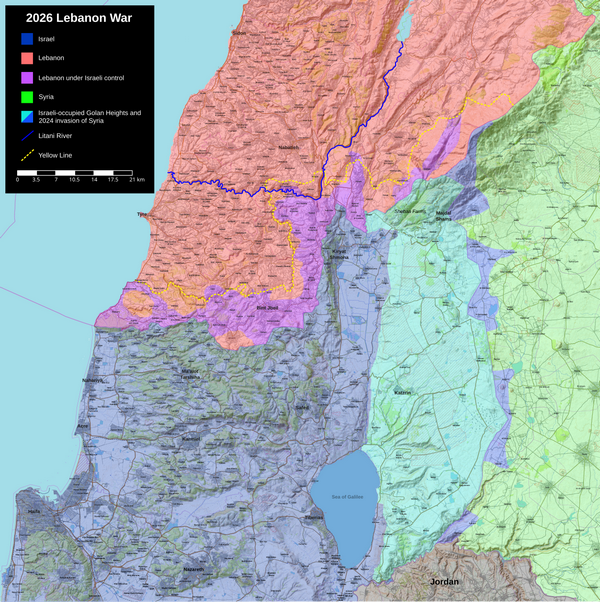
The following maps from Wikipedia show the current northern and southern Israeli security buffer zones.
Current Israeli northern buffer zones
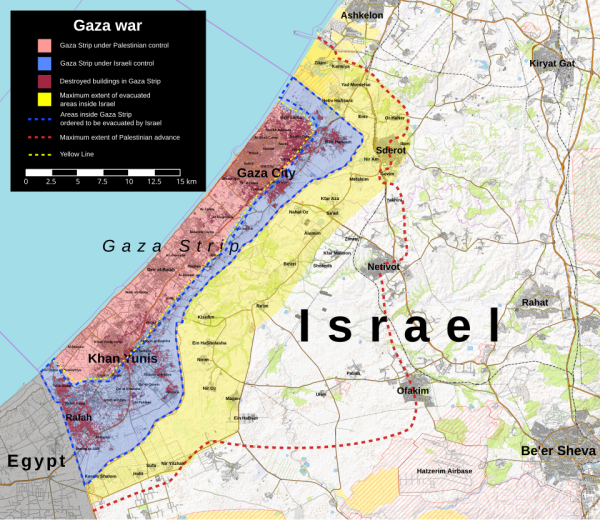
Current Israeli Gaza buffer zones
The Escalation of Security Buffer Tactics
Security buffers rarely remain static. Adversaries adapt. New infiltration methods emerge. Weapons gain greater range and precision. Intelligence networks evolve. Tactics change. Technologies spread. As threats adapt, pressure grows to strengthen the security buffer.
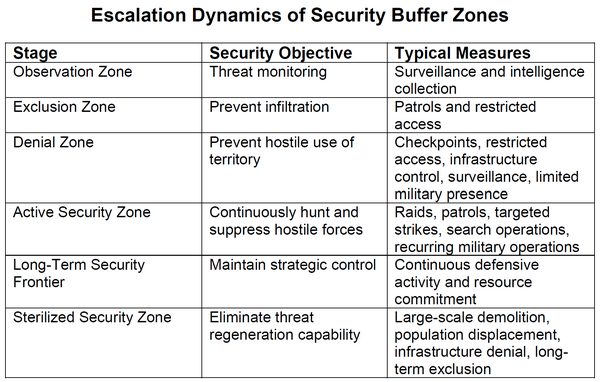
Observation zones become exclusion zones. Exclusion zones become denial zones. Denial zones increasingly require persistent surveillance, infrastructure control, freedom of military movement, and restrictions on civilian activity. Measures that originally appeared temporary often acquire a more permanent character as security planners seek to preserve their effectiveness.
The logic is incremental. If hostile actors exploit roads, the roads must be controlled. If they exploit buildings, the buildings become targets. If they exploit population centers, population movement becomes a security concern. Each individual measure may appear reasonable when evaluated independently. Yet the cumulative result can be a progressively expanding system of control whose scope grows with every new adaptation by the adversary.
New threats to a buffer zone give rise to new methods for maintaining the protective value of the buffer. The escalatory character of threat and response cycles leads to increasingly intensive measures over time. At some point, the economic and political costs of maintaining a security buffer may outweigh its defensive value.
The Regeneration of Hostile Forces
Every successful buffer creates a new frontier. If a threat operating near a border is pushed twenty miles away, the original frontier disappears, and a new frontier is established twenty miles farther outward. This is a basic weakness of the territorial buffer concept. The boundary changes, but the strategic problem remains. Adversaries relocate beyond the new perimeter and may infiltrate the expanded buffer zone. New operational requirements emerge. New threats appear. The security apparatus adapts and expands accordingly.
One of the recurring characteristics of insurgent and militant movements is their ability to regenerate after suffering severe military setbacks. Organizations lose leaders, facilities, weapons stockpiles, and territory, yet new structures and resources emerge to replace those that have been destroyed. The personnel may change. The names may change, but the underlying conflict often remains. Israel has faced this problem in combating both Hamas in Gaza and Hezbollah in Lebanon. This presents a fundamental challenge for buffer defense. The strategy assumes that moving hostile actors farther away will create lasting security benefits. However, if those actors reconstitute themselves beyond and within the latest frontier, the security gain becomes temporary rather than permanent.
Persistent insurgency creates an additional problem. As hostile organizations repeatedly reappear within buffer regions, pressure grows to adopt increasingly comprehensive methods of suppression. Military operations that initially focus on armed groups can gradually expand toward broader efforts intended to deny insurgents access to infrastructure, transportation networks, communications facilities, supply systems, and population centers from which support may be drawn.
The logic is understandable. If hostile forces continually regenerate within a particular environment, military planners naturally seek to alter that environment. Yet this process can produce a cycle of escalation in which maintaining the buffer requires progressively more aggressive intervention.
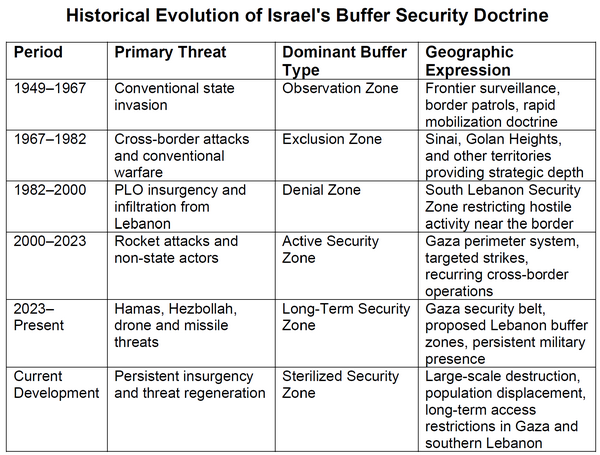
Recent operations in Gaza and southern Lebanon illustrate this dynamic. Security operations have increasingly incorporated large-scale demolition, infrastructure destruction, population displacement, and long-term denial of access to contested areas. Such measures may be intended to reduce the ability of hostile organizations to regenerate, but they also inflict great harm on noncombatants, resulting in intense international scrutiny and criticism.
The resulting reputational costs are not merely symbolic. Israel’s security depends not only upon military effectiveness but also upon diplomatic relationships, intelligence cooperation, economic integration, and political support among key allies. Actions viewed domestically as necessary security measures may be viewed internationally as disproportionate or punitive. As criticism grows, Israel risks weakening important sources of strategic support.
This creates a dilemma that lies at the heart of the buffer strategy. Persistent insurgency encourages increasingly severe measures to maintain security. Yet the political and diplomatic costs of those measures may gradually exceed the security benefits they are intended to produce. The challenge is therefore not that buffer zone military operations may fail. Many achieve their immediate objectives. The challenge is that repeated tactical success can generate a cycle in which security gains require ever greater political, diplomatic, and reputational costs to sustain them.
The Erosion of Protective Distance
Buffer defense ultimately rests upon a simple assumption: distance creates security. For most of military history this assumption was largely correct. Armies required time to move. Supply lines imposed limits on operations. Geographic obstacles constrained offensive action. Every additional mile separating an adversary from its target provided tangible defensive benefits.
Modern technology is steadily eroding those advantages. Missiles, drones, loitering munitions, precision-guided weapons, satellite navigation, and increasingly autonomous systems allow hostile actors to project power across distances that would once have provided substantial protection. Capabilities that were formerly available only to major states are becoming accessible to smaller states, militias, and insurgent organizations.
This technological trend has important implications for buffer strategy. If a hostile actor can launch attacks from dozens or even hundreds of kilometers away, the marginal security value of adding additional territorial depth begins to decline. A frontier pushed farther outward may still possess tactical significance, but it no longer provides the level of protection that similar distances offered in earlier eras.
The economics of modern warfare further strengthen this trend. Offensive systems are often becoming cheaper while defensive systems become more expensive. Relatively inexpensive drones and missiles can force defenders to deploy sophisticated and costly interception systems. The result is a growing asymmetry between the cost of attack and the cost of defense.
Under these conditions, buffer zones increasingly confront a technological reality for which they were never designed. Territorial depth remains useful, but its effectiveness is steadily being diluted by the growing range, precision, and affordability of modern weapons. A doctrine that relies heavily upon territorial separation must therefore contend with a changing technological environment in which distance is becoming militarily less significant.
The Perspective of Neighboring States
Security policies are not evaluated solely by those who develop them. They are also interpreted by neighboring populations and states whose interests may be affected. From the Israeli perspective, buffer zones are a defensive response to persistent threats. However, regional actors may view measures intended to increase Israeli security as territorial encroachment, coercive pressure, or evidence of aggressive intent.
These perceptions matter because the long-term consequences of buffer expansion will be shaped not only by local militant organizations but also by the reactions of larger regional powers. Perceptions of expansion need not be accurate to influence policy; they need only be widely believed. The significance of such perceptions grows over time. Local militant organizations may drive the initial creation of buffer zones, but states ultimately shape regional power balances. Security measures that appear manageable when directed against fragmented non-state actors may acquire very different implications when interpreted by larger regional powers possessing substantial economic, industrial, and military resources.
A buffer zone viewed by one side as a temporary security measure may be viewed by another as the beginning of a more permanent strategic presence. Such interpretations can influence military planning, diplomatic alignments, defense spending, and regional security relationships long before any direct confrontation occurs. History demonstrates that states routinely respond not only to present capabilities but also to perceived future intentions.
Ambiguity regarding those intentions can further reinforce such concerns. When political leaders, military officials, and competing domestic factions offer conflicting descriptions of the future status of buffer territories, neighboring states have little incentive to assume the most benign interpretation. Israel’s operations in Gaza and southern Lebanon have been described by different political actors as temporary security measures, long-term restricted zones, or future settlement areas. Faced with such contradictory messaging, regional governments are likely to plan against the most consequential possibility rather than the least threatening one. In strategic affairs, uncertainty often encourages caution, and caution frequently favors worst-case assumptions.
As security frontiers expand, neighboring states may increasingly adjust their military planning, diplomatic posture, and strategic relationships in response to what they perceive as a potential security threat. The most significant consequences of buffer expansion may therefore emerge not within the buffer itself, but in the reactions of larger powers beyond it.
The Rise of Turkey and Egypt
The strategic consequences of expanding security frontiers become more significant when viewed against long-term regional trends. For much of Israel’s modern history, immediate security concerns have centered on non-state actors, fragmented neighboring territories, and relatively localized threats. Yet the Middle East is not static. Demographic, economic, and military power continue to evolve.
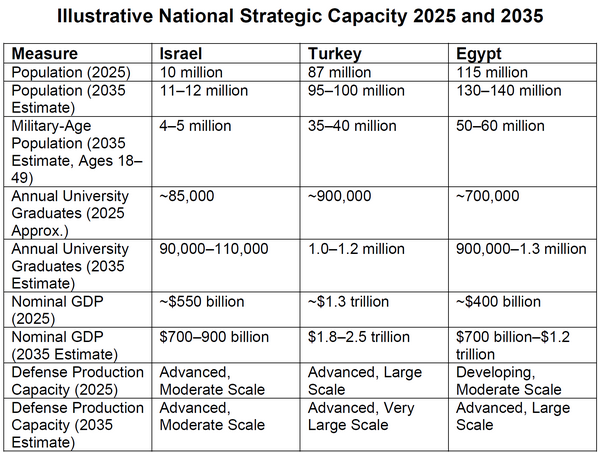
Two states in particular deserve attention: Turkey and Egypt. Both possess populations many times larger than Israel’s. Both possess substantial industrial bases. Both are expanding domestic defense industries. Both have demonstrated increasing capabilities in drone warfare, missile development, electronic warfare, and military production. Although Israel’s current security attention is focused elsewhere, Turkey and Egypt are potential adversaries whose future significance may increase as regional power balances evolve.
Turkey has emerged as a significant defense exporter whose drone systems have influenced conflicts from Libya to Ukraine to the Caucasus. Egypt continues to expand its military capabilities while occupying a critical geographic position linking North Africa, the Mediterranean, the Red Sea, and the Sinai.
Neither state currently represents an immediate military threat to Israel but strategic planning is concerned not merely with present realities but with future possibilities. Demographic growth, industrial expansion, technological development, and military modernization can alter regional power relationships over periods measured in decades rather than years. The strategic risks of confronting these states would be fundamentally different from those posed by the localized militant organizations that originally drove the expansion of Israel’s security perimeter.
History suggests that expansion of one state often generates balancing behavior by others. States that might otherwise compete with one another frequently discover common interests when confronted by increaing power of a potential adversary. Such responses need not take the form of formal alliances. Parallel military modernization, intelligence cooperation, diplomatic coordination, and strategic alignment against Israel may emerge gradually over time if its buffers expand.
The long-term consequences of Israel’s security buffer doctrine will therefore be determined not only by effects on the militant organizations operating along Israel’s borders, but also by how larger regional powers respond to the continuing expansion of Israeli security frontiers.
Conclusion
The central issue is not whether security buffers work tactically. They often do. The issue for Israel is whether the conditions required for their long-term success continue to exist. Israel’s buffer strategy was developed in an era when territorial depth offered significant defensive advantages, when hostile actors possessed more limited means of projecting power, and when local security threats could be more clearly separated from broader regional dynamics. Those conditions are changing.
Hostile organizations repeatedly regenerate beyond and within the latest frontier, transforming buffer zones into recurring security obligations rather than permanent solutions. At the same time, missiles, drones, and other long-range precision weapons are steadily reducing the defensive value of distance itself. Every additional mile of territorial depth now provides less security than it once did.
The geopolitical environment is also evolving. As Israel expands and maintains security frontiers beyond its borders, it risks generating increasing friction not only with local adversaries but also with larger regional powers possessing greater populations, larger economies, expanding defense industries, and growing military capabilities. The strategic consequences of such competition could ultimately prove far more significant than the localized threats that originally justified buffer expansion.
The fundamental weakness of Israel’s buffer defense is not that it fails to produce tactical results. The weakness is that the conditions necessary for its long-term success are steadily disappearing. A doctrine that once offered a practical means of increasing security is becoming progressively less effective, more costly, and more strategically burdensome. Israel’s next major security challenge may emerge not from the failure of the buffer doctrine, but from its perceived success under circumstances that are transforming a security solution into a strategic liability.
























