by Dennis Crouch
The Logic Games are no longer on the LSAT, but they are still present in the law, often arising in the context of complex civil litigation. This regularly arises with jury verdict forms, with judges seeking the simplest verdict form possible that still asks all the necessary questions. In Ollnova Technologies Ltd. v. ecobee Technologies ULC, No. 2025-1045 (Fed. Cir. June 4, 2026), the Federal Circuit found that Judge Gilstrap (E.D.Tex.) had gone too far on the side of simplicity.
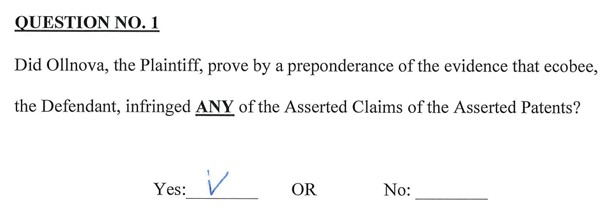
The infringement case asserted claims from four different patents, but the jury was asked simply did the Plaintiff (patentee) prove “that ecobee, the Defendant, infringed ANY of the Asserted Claims of the Asserted Patents?” As you can see from my screenshot above, the jury answered “yes” and ultimately awarded $11.5 million in damages.
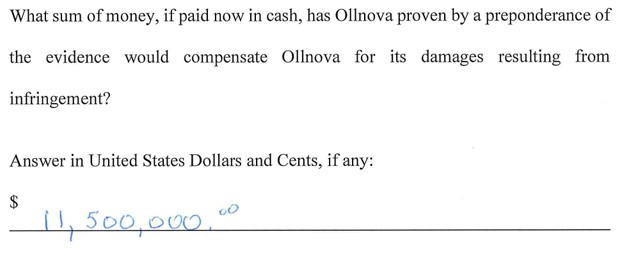
What the verdict fails to tell us is which patent (or which claim of which patent) ecobee infringed. More importantly for the appeal, the verdict leaves open the possibility that some jurors thought a claim of the ‘495 patent was infringed while others thought it was a claim of the ‘282 patent. In his decision, Judge Chen treated that gap as a constitutional defect, vacating the infringement and damages judgments and ordering a new trial. The risk here was the potential of non-unanimous verdict as to infringement of any particular claim.
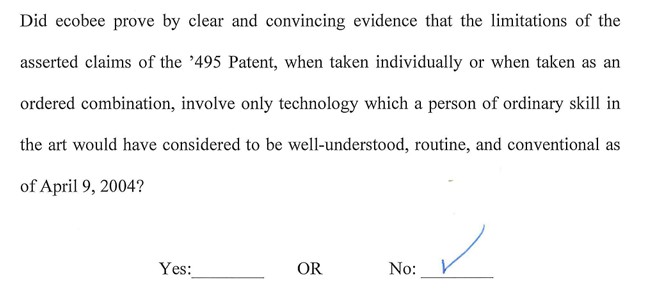
Judge Gilstrap also asked the jury to an eligibility question under Alice step two: whether the claims involve merely well-understood, routine, or conventional technology. The appellate panel found this jury instruction lacking – particularly because the jury was never told what the claimed abstract idea was (in the ‘495 patent), or that the abstract idea itself cannot supply the inventive concept.
The panel affirmed that the asserted claims of the ‘887 and ‘371 patents are not directed to an abstract idea at step one, and affirmed the denial of ecobee’s motion for judgment as a matter of law on ‘371 non-infringement.