11 minutes read
Published Jun 2, 2026
For solo and small law firms, AI serves as a powerful tool to recapture time by streamlining labor-intensive tasks like drafting demand letters, distilling complex email chains, and accelerating motion writing. Embracing these technologies allows time-strapped practitioners to shift their focus from administrative burdens to high-value legal strategy and client service.
Today, AI can do meaningful work in your practice. A demand letter can take months to gather all the details, and weeks to write once you do, but now the writing takes days. A long email chain gets distilled to its three actionable points. The motion you often lost a weekend to is in your outbox by Thursday. All of which raises a fair question: Where is the time it was supposed to save you?
According to Clio’s 2026 Legal Trends for Solo and Small Law Firms Report, 71% of solo practitioners and 75% of small firms are now using AI, yet only about a third report revenue growth. At the same time, many firms still say time is an obstacle to adopting new technology, with 27% of solos and 33% of small firms naming it as their biggest barrier.The contradiction starts to make sense when you look at where those saved hours actually go. They haven’t vanished. More often, they’re getting absorbed in two places: a billing model that passes much of AI’s efficiency back to clients, and the daily friction of tools that don’t talk to each other. Both are fixable, and neither requires rebuilding your practice. Here’s a closer look at how to get more out of AI at a small law firm.
You’re using AI. Why isn’t it paying off?
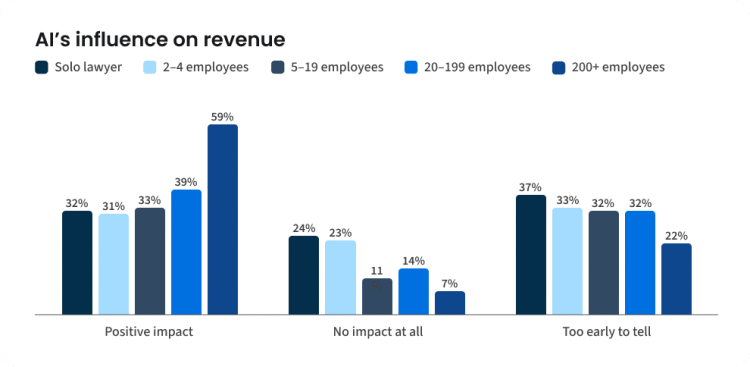
Our 2026 report calls it the “efficiency paradox,” and most solo practitioners and small firms are living with it. Ask about AI itself and you’ll hear that it’s improved the quality of the work, cut down the tedious parts of the day, and helped them get back to clients faster. Ask about revenue, and the answer is different. Only 32% of solos and 31% of small firms have grown revenue since adopting AI, compared to 39% of mid-market firms and 59% of enterprise firms. Another 24% of solos and 23% of small firms say AI hasn’t changed their revenue at all.
The first reason can be seen on every invoice. If a matter used to take five hours, and AI brings it down to one, billing hourly means you’ve just handed your client an 80% discount. They didn’t ask for it, and you didn’t negotiate it. It simply happened the moment the work got faster.That’s the position 86% of solos and 78% of small firms find themselves in right now, having made no pricing changes at all since bringing AI in. The frustrating part is that 71% of clients would already prefer to pay a flat or fixed fee, so the model that’s costing you margin is one most of your clients would happily walk away from if you offered them the alternative.You don’t have to rewrite every fee agreement to fix this. Pick one matter type you handle predictably, such as a residential closing or a simple will. Price it as a flat fee against what it actually costs you to deliver today, with AI doing its share. That’s one part of your practice that stops losing you money every time it gets faster, and it’s a straightforward way to start improving law firm cash flow without taking on more matters.
What should law firms do with the time AI saves?
Billing properly for the hour AI gave back only helps if that hour goes somewhere useful. Unfortunately, at most small practices, it doesn’t. The firms growing with AI have something most others don’t—a plan for that saved hour. They’ve decided in advance where the time goes, and they’ve put it on the calendar before something else can claim it. At a solo or small firm, the activities that pay back fastest are usually the easiest to push:
Intake that moves prospective clients to a consultation automatically. A prospective client fills out a form, gets a confirmation, and lands on your calendar. No phone tag, no manual follow-up, no leads going cold because someone forgot to circle back.
One concrete step per matter, every week. Focus on something the client can point to as proof the matter is moving, whether it’s a filed motion, a sent demand letter, or a status email with a specific next date. A surprising number of fee disputes and bar complaints start with a client who went weeks without hearing anything and decided that nothing was happening.
A weekly review of unbilled time. Spend half an hour going back through last week’s calendar, sent folder, and call log, and capture the quick client emails, phone calls, and document reviews that never made it into your time entries. Most lawyers find more billable time than they expect.
Scheduled intake calls. Keep two or three 15-minute slots on the calendar every week, held open specifically for new-client conversations. A thin pipeline is far more often a prospect hitting voicemail than it is a marketing problem.
Relationship and referral work. Consider scheduling a referral lunch with a lawyer in an adjacent practice area, answering a common client question in a LinkedIn group or local bar forum each month, or doing an annual pass through your firm’s website to update the bio, the practice areas, and the case results.
These aren’t new ideas, which is exactly the point. They’re the work that gets skipped because nothing on the calendar is protecting the time for it. When the saved hour lives in a standing block, the time gain finally becomes something you can point to at the end of the month.This is also where the pricing question comes back into the picture. If you’ve moved your predictable work onto flat fees but the saved hour just disappears into inbox triage, all you’ve done is make yourself faster at the same volume of work. How to increase law firm revenue with AI comes down to changing what you charge and changing what you do with the time. The two have to move together for either one to matter.
The “no time” barrier
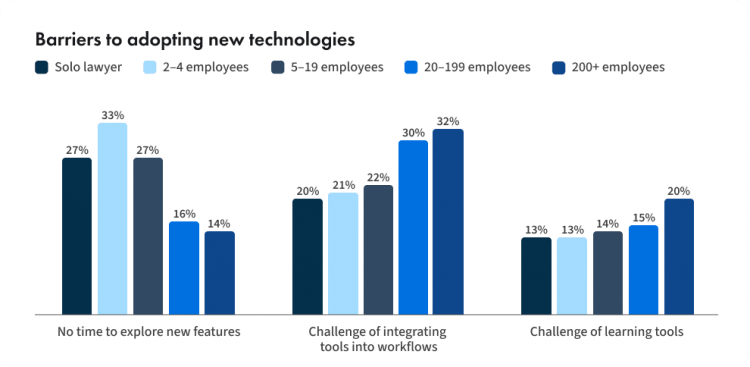
When roughly a third of solo and small firms say that lack of time is what’s keeping them from doing more with AI, they’re likely being honest. Running a solo or small practice can feel relentless. But it’s worth looking at where the hours are actually being spent, because the question of how solo lawyers can save time with technology usually has a different answer than “find more hours.” More often, it’s a question of fragmentation.Picture a typical week at a solo or small law firm. Case management lives in one system, billing in another, and the calendar somewhere else. Intake comes through a form that doesn’t talk to either. Documents sit in a folder you keep meaning to organize. Email is open in two tabs. A generic AI window waits in another, ready to be rebriefed on a matter it has no context on. The week disappears into the seams between those tools, and by Friday it feels like the problem is that you needed more hours, when the actual problem is what you spent the existing ones on.The cost is measurable. A Harvard Business Review study of workers across Fortune 500 companies found they toggled between applications around 1,200 times a day and spent nearly four hours a week—roughly five working weeks a year—just reorienting themselves after each switch. For a solo lawyer toggling between multiple systems all day, that’s a meaningful chunk of billable capacity.That same fragmentation creates a second problem. The 2026 Legal Trends for Solo and Small Law Firms Report found that 47% of solos and 48% of small firms use consumer-grade AI tools like ChatGPT or Microsoft Copilot. Yet 57% of solos and 55% of small firms have no written AI policy governing how those tools get used. That’s how confidential client information may end up in a public AI window, and from there into model training data. The damage can often show up later, as confidentiality breaches, hallucinated case citations in filings, and the sanctions, bar complaints, and malpractice exposure that follow them.
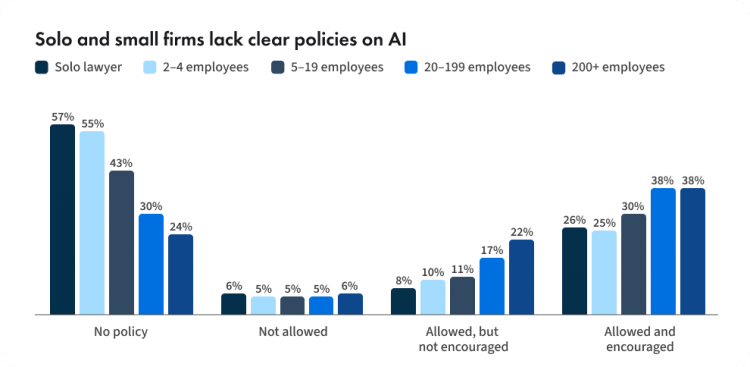
At a larger firm, a problem like that gets absorbed by a security team, an ethics committee, and a general counsel. At your scale, the risk function is you. A consumer chatbot running on top of a fragmented stack is the version of a small law firm AI strategy that’s hardest to defend if anyone ever asks how it works. There’s no record of what you typed, what the model did with it, or how its output ended up in your work.
Generic tools vs. a platform built for legal work
When AI starts to feel like it’s hitting a ceiling, the instinct is almost always to buy another tool to layer on top of the case management system, the billing app, and the document storage you already pay for. Each new tool may solve a real problem on its own, but it doesn’t know about any of the others, and the client information they all rely on ends up scattered across multiple places at once. The only thing actually holding the picture together is you.The most effective AI tools for small law firms and AI tools for solo law firms tend to share one thing: They live inside the same platform as the rest of the practice. Intake feeds the matter file. The matter file feeds your billing entries. The AI sits inside that system instead of next to it, so it already knows who the client is and what the matter is about before you type a single prompt.A few things change once that’s the setup. You log in once, not several times. You stop re-explaining matters to the AI, because the file is right there. Client data stays in one system, under one set of security and privacy terms written for law firms. New features build on the data you’ve already entered rather than asking you to set it up again somewhere new. Training takes less time. And if a regulator or your malpractice carrier ever asks for a record of what was done, it’s already there.This is also where the revenue gap from earlier starts to close. The hour AI saves stops getting eaten up in the gaps between tools and goes back to billable work. If you’ve been asking how solo lawyers can use AI to grow a practice rather than just speed one up, that’s one of the most direct answers.
Is AI fueling solo and small firm growth, or slowing it down?
Clio’s new research digs into why working faster doesn’t always mean earning more, and what growing firms are doing differently. Get the full insights in the 2026 Legal Trends for Solo and Small Law Firms report.
Read the report

Start small: One task, one system
The simplest way to figure out how to save time with AI at a small law firm is to pick one task you do every week and move it inside the system that holds your client information. The point is to feel the difference based on a small piece of work you understand well, and then decide for yourself whether the same logic is worth applying to everything else.Pick a task that fits two criteria. First, you do it at least three times a week—frequent enough that small inefficiencies are adding up. Second, the AI work is currently happening outside the system that holds the matter information. Intake summaries, client memos, and drafts of routine letters are the most common starting points.What that looks like in your practice depends on the work:
Personal injury: Begin with intake summaries. A new-client conversation covers a lot of ground, and before anything else, you need to know whether the person actually has a case and whether it makes sense for your firm to take it. AI pulls the relevant facts into a structured summary, so you’re making that call with everything in front of you, not from memory. Once that’s working, medical treatment timelines from records are a natural next step for building the factual foundation your demand letter will rely on.
Family law: Tackle financial disclosure summaries first. Each one takes hours done manually, the inputs are predictable, and the output is something you’ll reuse throughout the matter. Affidavit outlines are a strong second.
Estate planning: AI generates a will document template, then builds a client questionnaire from it. The client fills out the questionnaire, and their answers populate the template automatically. The document is ready without anyone on your team touching it between step one and the final review.
Immigration and criminal defense: Focus on client histories. Both practices come down to how well you’ve documented the underlying facts, and details like listing every address from the past ten years. AI keeps those important timelines accurate, searchable, and easy to update as the case develops.
If it works on one task, the same setup tends to work on the next one, and the migration of your practice happens piece by piece rather than as a single big overhaul. By the time you’ve moved four or five recurring tasks across, you’re no longer toggling between tools for most of the work that fills a normal week, and the calendar starts to look different in a way you can feel.
Get more out of AI for your practice
The firms growing revenue from AI tend to share three habits. They’ve moved predictable work onto flat fees, so getting faster shows up as margin. They’ve given the saved hour a standing place to go, so efficiency turns into follow-ups, intake calls, and the relationship work that fills the pipeline. And they’ve stopped running their practice across five or six tools that don’t know about each other, so the time AI gives back is actually available to spend.Solo and small firm lawyers don’t need more hours in the day. They need fewer places for those hours to leak through. That’s how small law firms can do more with less. The gains come from closing the gaps between the tools you already pay for, not from working harder. The Legal Trends Report for Solo and Small Law Firms goes deeper into who’s growing, what’s working, and where the biggest gains are showing up at your size of practice. And if you want to see what it looks like to run your intake, billing, matter management, and AI from one place, that’s exactly what Clio is built for.
Loading …