by Dennis Crouch
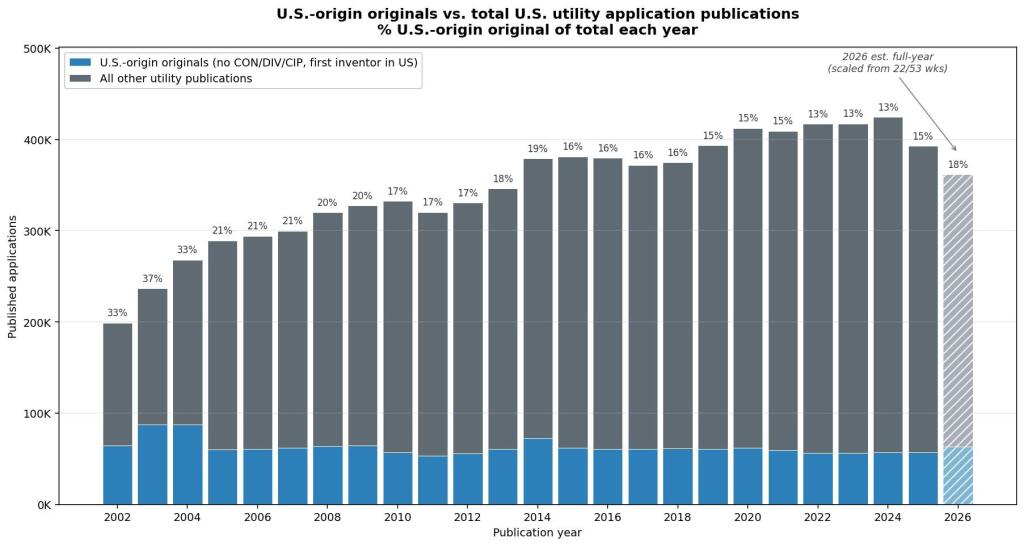
The standard story about American patenting is growth. Published U.S. utility patent applications roughly doubled over the past two decades, climbing from around 200k in 2002 to a peak near 425k in 2024 before easing back in 2025. That top line (grey in the chart below) looks like a steady expansion of American inventive activity. But, the chart actually tells a different story once you separate out what is actually growing.
The blue band at the base counts only U.S.-origin originals: applications whose first-named inventor sits in the United States and that are not continuations, divisionals, or continuations-in-part. That band has not grown. It sits in a flat or even declining range across the full twenty-plus years — and even higher in the mid-2000s than in the most recent completed years. As a share of the total, U.S.-origin originals fell from roughly a third early in the series to about 13% in 2022 through 2024.
The growth found in grey comes from two sources:
The first source is domestic continuation practice, which has increased over the years. These are follow-on patents relying on the same underlying disclosure of that U.S. original. Additional exclusive rights without the corresponding additional innovation.
The second source is foreign-origin filing, the rest of the world seeking U.S. patent rights. These have also grown significantly over the years as more nations come on-line as tech generators.
Neither of these measure growth in domestic original inventive output.
The interesting wrinkle is at the far right of the chart. The 2026 projection, scaled from the first 22 weeks of publication data, projects the U.S.-origin share rising back toward 18%. That reversal has two separate factors. One is a drop in continuation filings traceable to the January 2025 fee changes. The other is a small increase in U.S.-origin original applications that I don’t yet have an explanation for.
Note that timing wise, original applications published thus far in 2026 were almost all filed in 2024 (either as a provisional or non-provisional application). This was before the new administration took charge and began to shift the patenting outlook.