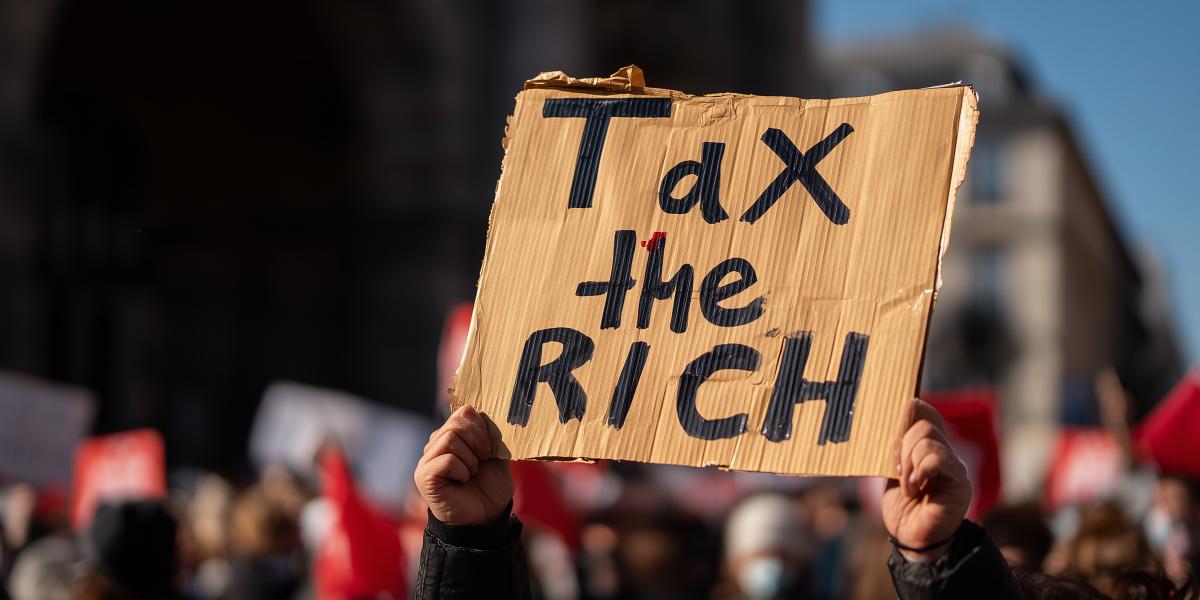
Redistribution lies at the heart of the problems currently plaguing Western societies and all those who emulate them. A hint comes from the prefix“re-” in this word, which implies a second distribution taking place on top of a previous one. Implicit is the idea that this second distribution takes place because the first one is considered flawed. Yet, this original distribution is the natural process of the free market, while the second distribution—or redistribution—is artificially organized by the state.
Free Market Distribution
The natural distribution process of the free market is its tendency towards equalization of all factors of productions across society. This process is best described by Mises in Human Action (1949), chapter XV, and by Rothbard in Man, Economy, and State (1961), chapters 7 and 8. As Rothbard wrote, there is a “general tendency toward the uniformity of the price of any good on the market” (italics in original), including goods, services, wages, interest rates, and rates of return.
Labor flows (workers seek employment) from areas of lower wages, relatively, to areas of higher wages. As Mises explained, “As is the case with material factors of production, the factor labor too is allocated to those employments in which it best serves the consumers. There prevails the tendency not to waste any quantity of labor for the satisfaction of less urgent demand if more urgent demand is still unsatisfied.” Similarly, capital flows from areas of lower rates of return to areas of higher rates; a process that naturally tends to align these rates, as well as, in Rothbard’s words, “establishing a uniform rate of interest throughout all time markets in the economy.”
Rothbard summarized: “regardless of the form of the market, the result of the market process is always to tend toward the establishment of the equilibrium…” This equilibrium state, also called by Mises the evenly rotating economy, is “a fictitious system in which the market prices of all goods and services coincide with the final prices.” This state is never reached in the real world “of ever-changing reality, changes in value scales and resources.” The free-market distribution is a never-ending optimization of the use of the factors of production as they exist at any given moment.
Since interest rates, wages, and prices of goods are not allowed to fluctuate freely today, this natural distribution is severely stunted, leading over time to the stagnation that many economies are experiencing today. Instead of giving pure capitalism, described above, a chance, the instinct of state planners, neo-Keynesian pundits, and MMT lovers is to double-down when the inevitable decline arrives: they typically introduce price controls, artificially lower the interest rate, increase the fiscal pressure, and support even more state debt to support spending that only partially reflect consumer demands.
The Inefficiency of State Redistribution
Redistribution happens when the state tries to improve on the natural distribution of the free market, but thereby smothering this market process, preventing it from working properly. Massive income redistribution is realized by multi-layered state bureaucracies, using tools such as inflation, taxation, transfers, credits, and subsidies.
Local, regional, national, and even supranational redistribution takes place; i.e., shockingly between distinct economies with different tax bases. Such redistribution is driven by a political rejection of any cultural or geographical differences with respect to productivity and standard of living. But why should Greeks live like Germans when they do not produce like Germans? Instead of letting free market distribution smooth out such differences over time, higher-productivity areas are coerced into subsidizing lower productivity areas.
The majority often accepts redistribution from a utilitarian point of view, based on the misconception that “it all goes back into society” and that “nothing is lost” so “everyone benefits indirectly.” But, as Prof. James Rolph Edwards correctly writes, “it is not possible, ever, for government to tax one set of persons and redistribute the same amount to a set of subsidy recipients.” Prof. Edwards continues: “public income redistribution agencies are estimated to absorb about two-thirds of each dollar budgeted to them in overhead costs, and in some cases as much as three-quarters of each dollar.” Redistribution could thus be rejected on the grounds of inefficiency alone, not to mention ethics.
But the inefficiency of redistribution goes beyond just the state’s waste of existing private sector income, since it also saps work incentive, distorts private investment and consumption, and prevents many entrepreneurial ideas from even becoming seeds. Thus, redistribution is inefficient also by preventing would-be wealth accumulation, in the sense of Bastiat’s “that which is not seen.” This means that inefficiency in and of itself constitutes a moral argument against redistribution.
The Immorality of State Redistribution
Redistribution—whether from individuals or companies—is not only immoral because it is inefficient, but more fundamentally because it violates private property rights. Contrary to the market distribution based on voluntary exchange, state redistribution is morally wrong because it is done without the explicit consent of the income owners. The result is a reduction of wealth accumulation and economic growth of the free market, directly and indirectly hurting individuals and companies.
A charitable and pragmatic position might accept redistribution organized only at municipal level according to majority rule. That would still be private property violation at least for some owners, but it would still be morally far better than the massive existing national (and supranational) redistribution. But this is unacceptable for the ruling minority because it goes against the forces of centralization.
Not only is redistribution morally wrong, but the state and its lackeys actually have the gall to use moral arguments to justify it. The moral justification used for this interventionism is the supposed need for “equality,” “social justice,” or “solidarity.” This conviction goes so deep that these justifications are hardly ever questioned, even by the net contributors who get the most fleeced of all!
For Marxists, the goal was extreme redistribution “from each according to his ability, to each according to his needs.” Socialists have the equally radical goal of “equality of outcome.” If implemented, such schemes usually lead within a generation to the breakdown of society. The lighter version, also based on a moral “need” to equalize society, namely, “equality of opportunity,” has been practiced for decades in Western societies, including the US of course, contributing to economic slowdown and social tensions.
In the case of redistribution through inflation, no moral justification is given. On the contrary, the real definition of inflation—the state’s artificial increase of the money supply and credit through a central bank—is always hidden. As Rothbard wrote, “Monetary expansion is a massive scheme of hidden redistribution.” This secrecy is not surprising since inflation is a regressive tax due to the Cantillon effect and since price increases of basic goods are more impacting on the less affluent. Instead, to add insult to injury, conventional wisdom has it that price inflation is a natural phenomenon, even though free market distribution leads to price deflation, as seen above.
In The Ethics of Redistribution (1952), Bertrand de Jouvenel saw income redistribution also as political, as “redistribution of power from individuals to the State.” Indeed, as the state takes on an ever-greater role of collecting, managing, and dispensing an ever-greater portion of the national income, there is a shift in the power balance from civil society towards the state, often expressed as a frustrating dependency on the munificence of powerful but anonymous civil servants.
The democratic system worsens the problem of redistribution since the electorate tends to vote for the promises of more social benefits. The ruled majority thus unwittingly contributes to hollowing out society, in a process akin to a “tragedy of the commons,” by which the voters’ possible short-term political gain happens to the long-term detriment of society, including himself. The pernicious effect of redistribution is to weaken individual responsibility for personal welfare and the interest in mutual aid. The result is the growth of a centralized bureaucracy, inefficient and impersonal, instead of decentralized cooperation and charity that enhance community ties in a free society.
Virtuous Market vs. Nefarious State
The difference between the two types of distribution in society is stark. Market distribution is a free and voluntary process of optimization driven by consumer preferences. It is therefore virtuous and fundamentally just, fully respecting private property. Redistribution by the state, on the other hand, is inefficient, coercive, and often arbitrary. It is nefarious to society and fundamentally unjust, since it systematically violates property rights. It is essential, therefore, to warn the public about redistribution and instead inform it about the natural distribution by the free market.