Millions of people who apply for Medicaid in the coming years will have to prove they’ve been working, going to school, or volunteering for at least a month before they can gain or retain health insurance through the government program.
But Republican lawmakers in some states think the new rules — part of the GOP’s One Big Beautiful Bill Act, signed last July by President Donald Trump — don’t go far enough.
Indiana is leading that charge, with a new law that requires applicants to prove they’ve been working or participating in a similar activity for three consecutive months to get benefits.
Meanwhile, residents in many other states will have to show they’ve been working just one month, the least cumbersome option under Trump’s signature tax-and-domestic-spending law. It instructs states to decide whether to require one, two, or three months of work history.
As in Indiana, Republican Idaho lawmakers approved a three-month requirement, and the state’s governor signed the bill into law on April 10.
The efforts, along with similar moves in Arizona, Missouri, and Kentucky, are aimed at restricting flexibility to implement the federal law at the state level.
“Normally, you would not see state legislators weighing in on these decisions,” said Lucy Dagneau, a senior official with the American Cancer Society’s advocacy arm.
The nonpartisan Congressional Budget Office estimated 18.5 million adults will be subject to the new rules, which will be enforced across 42 states and the District of Columbia. In Indiana, work rules will target about 33% of the state’s Medicaid population. The rules generally wouldn’t apply to children, people 65 or older, or people with disabilities or serious health issues.
Typically, state administrators — not lawmakers — detail how they plan to comply with new federal standards, and they often look to federal regulators for guidance. But officials at the Centers for Medicare & Medicaid Services have yet to tell states how to comply with many aspects of the sweeping budget law, leaving state lawmakers to intervene.
Gov. Mike Braun, a Republican, signed the Indiana bill into law on March 4, making his state the first to set the Medicaid work requirement at three months — the longest period allowed under the federal law.
Republican state Sen. Chris Garten introduced a bill in January, saying it was needed to “align” state law with the new federal Medicaid rules. He also pitched the bill as a way to crack down on “waste, fraud, and abuse” in public programs.
When ineligible people get enrolled, it robs “the truly vulnerable Hoosier who actually needs the help,” Garten said during a January committee hearing.
Democratic state Sen. Fady Qaddoura expressed skepticism during the hearing and questioned the necessity of the legislation. Qaddoura asked Indiana Family and Social Services Administration Secretary Mitch Roob to provide an estimate of the number of ineligible people who enrolled in Medicaid in the state.
“I think very few,” Roob replied. “It’ll never be none.”
After hearing Roob’s answer, Qaddoura said there is no evidence of a widespread problem in Indiana. He accused Republicans of using waste, fraud, and abuse as justification to deny health benefits and food aid to vulnerable Hoosiers.
Garten later called Qaddoura’s accusation a “fundamental mischaracterization” of the bill.
Republicans have said imposing these limits protects the Medicaid program’s longevity.
“We believe in a safety net for our most vulnerable, not a hammock for able-bodied adults that choose not to work,” Garten said. “By tightening these screws, we ensure that our safety net remains sustainable.”
Indiana’s Medicaid enrollment is expected to decrease because of Garten’s legislation, according to an analysis from Indiana’s nonpartisan Legislative Services Agency.
Medicaid helps keep people healthy, so they can continue to work, said Adam Mueller, executive director of the Indiana Justice Project, a nonpartisan legal advocacy organization focusing on health, housing, and food insecurity.
Mueller worries that people will struggle to prove their work history, especially those with nontraditional jobs.
“If the point is to get people engaged, the one month would do it,” Mueller said.
Ultimately, he fears the law will harm Hoosiers with the greatest need for assistance. “They’re going to get tripped up by the bureaucratic hurdles.”
An analysis by the Center on Budget and Policy Priorities predicted that work rules will impose new barriers to coverage and that how states choose to implement the rules will “significantly affect the number of people who lose coverage.” State policy decisions will determine just “how intense the burden is,” the left-leaning think tank found, and opting for a shorter look-back period “will enable more people to enroll.”
Lawmakers in multiple states considered limits. And the same right-leaning lobbying group, the Foundation for Government Accountability, testified in favor of these measures in Arizona, Indiana, and Missouri.
In Missouri, FGA lobbyist James Harris said the measure intends to “move people from dependency and give them back that dignity and pride of work.”
Missouri state Rep. Darin Chappell proposed requiring a three-month look-back period like the measure in Indiana. But the latest version of the bill he sponsored would require applicants to show they were working for only one month before enrolling.
Chappell, a Republican, said his initiative would encourage a “working mindset.”
Anna Meyer, owner of a small bakery in Columbia, Missouri, said the implication is that she and others on Medicaid are lazy. “I have been working since I was 15 years old,” she said. “I’m 43 now.”
Meyer, who voiced her opposition, said she previously had problems submitting information to the state Medicaid agency. She fears new reporting requirements will put her and others at risk of losing coverage, even if they meet the work rule.
She has fibromyalgia, a chronic condition that increases overall sensitivity to pain. She also has food allergies. Medicaid helps pay for medications and doctor visits that keep her healthy and allow her to keep working.
“I work very hard,” Meyer said.
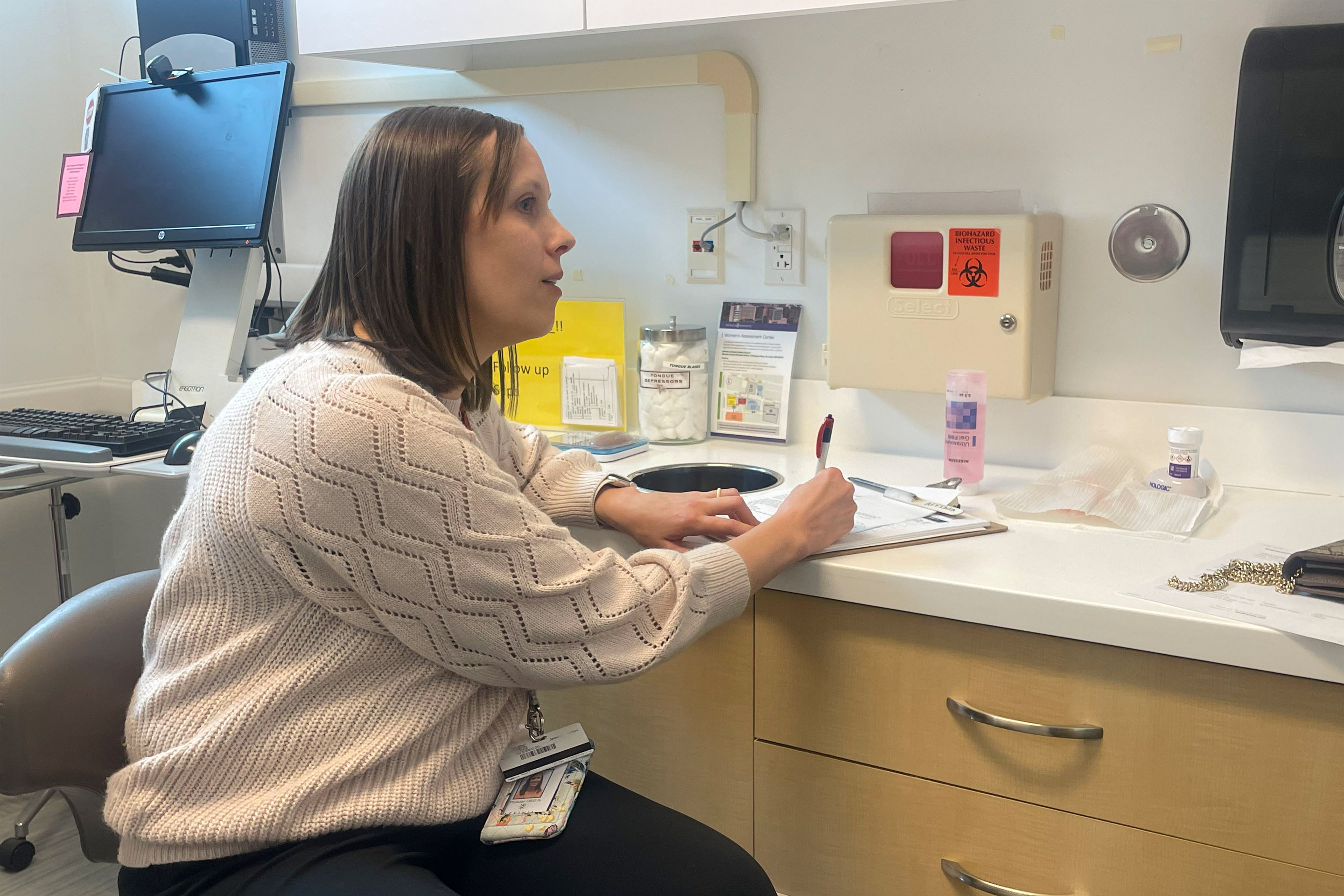
In St. Louis, Jessica Norton, an OB-GYN, treats many Medicaid patients at an Affinia Healthcare clinic. She said they struggle to remain insured even though Missouri extends a full year of Medicaid coverage to eligible women after they give birth. Some of her patients are inexplicably kicked off that coverage by the time of their checkups six weeks after birth. She fears red tape from the new work requirements will make it harder to hang on to insurance, even though pregnant women and new mothers are supposed to be exempt.
Norton criticized lawmakers for the message this policy sends to vulnerable patients. They are saying, “Oh, actually, health care is a privilege, and you have to earn it,” she said.
Nearly two-thirds of adults ages 19 to 64 on Medicaid already work, according to KFF. The reason many of the remaining adults on Medicaid are not working is that they are retired, serving as a caregiver, or too sick, KFF has found.
Some states are not only setting the strictest requirements but also blocking out the optional leniency built into the federal rules.
For example, states may adopt additional exemptions from work rules, such as allowing people to claim a “short-term hardship,” designed to provide continued Medicaid coverage to people with medical conditions that prevent them from working.
Missouri lawmakers are seeking a constitutional amendment to bar their state from offering such optional exemptions. But patient advocates warn these limits would harm the state’s vulnerable residents when they need coverage the most, particularly Missouri’s rural cancer patients.
Often, rural Missouri patients must travel to Kansas City or St. Louis for treatment, disrupting their ability to work, Emily Kalmer, a lobbyist for the American Cancer Society’s advocacy arm, testified at the January hearing. Recognizing this, the federal law provides certain exemptions for this kind of scenario.
But this short-term hardship exemption would be off the table in Missouri.
Time is “very important in the life of a cancer patient or a cancer survivor,” Kalmer said.
KFF Health News is a national newsroom that produces in-depth journalism about health issues and is one of the core operating programs at KFF—an independent source of health policy research, polling, and journalism. Learn more about KFF.
USE OUR CONTENT
This story can be republished for free (details).