
Americans spend nearly $5T annually on healthcare – more than any other nation – yet life expectancy continues to fall and chronic disease rates keep climbing, a paradox that points to a fundamental design flaw: the system is built to treat illness, not prevent it. Meanwhile, an explosion of consumer health data from wearables, direct-to-consumer genetic tests, and biomarker panels has given people more information about their bodies than ever before, but without a physician relationship to interpret and act on it, that data largely goes to waste. SONATA closes that gap with a doctor-led preventive healthcare membership that combines clinical-grade whole-genome sequencing, 140+ blood biomarkers, DNA methylation analysis, and an in-house clinical AI platform – all anchored by ongoing care from board-certified physicians who build and continuously refine a personalized health plan for each member. Unlike wellness platforms that hand users a PDF and move on, SONATA’s physicians stay with members over time, adjusting care plans as health, goals, and biology change – and the company is designed to catch risks that routine primary care almost never tests for, from polygenic predispositions to early metabolic dysfunction. By positioning between the data-only testing services that lack clinical depth and the traditional concierge medicine practices that charge $25K or more annually, SONATA makes physician-led preventive care accessible at a $2,500 founding membership price.
AlleyWatch sat down with SONATA cofounder and CEO Sagan Schultz to learn more about the business, its future plans, and the recent $7M seed round that brings the company out of stealth and into launch in New York, San Francisco, and Los Angeles.
Who were your investors and how much did you raise?
We raised $7M in seed funding from Lux Capital, BoxGroup, Sunflower Capital, and founders and operators from companies including Ramp and Linear. We’re announcing it alongside our launch. We wanted partners who want preventive, personalized healthcare to exist in the world, and who understand the complexity of building it.
Tell us about the product or service that SONATA offers.
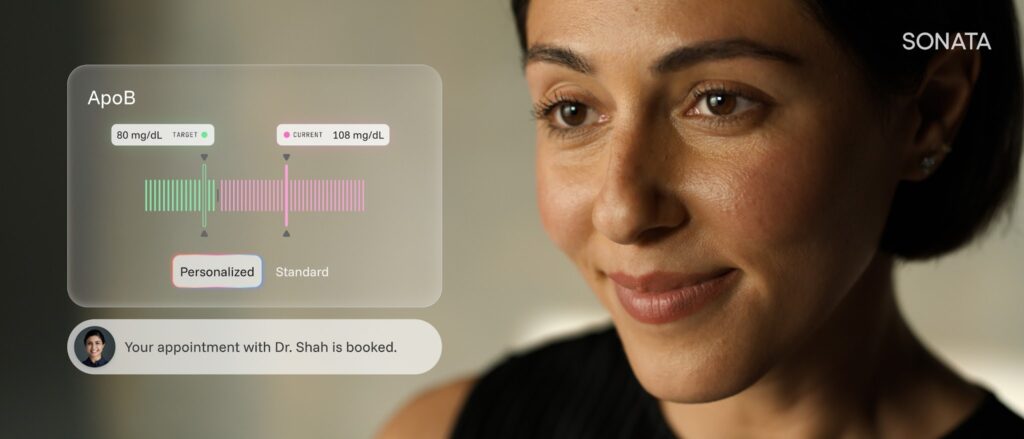
SONATA is a doctor-led healthcare membership focused on preventing disease before it starts. Board-certified physicians go deep into your whole biology, your genome, your biomarkers, how you’re actually aging, and stay with you over time. Behind them, clinical AI we built in-house connects the dots across your genetics, labs, medical history, and daily life, surfacing patterns that would otherwise go unseen. People have more health data than ever, but almost none of it turns into actual care. That’s the gap we built SONATA to close.
What inspired the start of SONATA?
My cofounder David and I kept coming back to the same observation. People have access to more health information than ever, from wearables and advanced testing to studies and AI tools, but more data alone hasn’t made us healthier. As a country, we spend nearly $5 trillion a year on healthcare, more than any nation on earth, and our outcomes trail nearly every peer country. We’re not well, and most of what’s making us unwell is preventable. What’s missing is the layer that turns all that information into actionable, ongoing care. People are left to carry that complexity on their own. We built SONATA so they don’t have to.
For me, it’s also personal. I spent nearly a decade working in NYC restaurants through college, med school, and business school. Hospitality is built on anticipating what someone needs before they ask. Then I’d walk into the hospital and watch medicine do the opposite, wait for disease, react to crisis, move on. I could never reconcile the two worlds. SONATA is the version of care I couldn’t find.
How is SONATA different?
A lot of what’s called preventive health today is really a wellness product, testing packaged with content, and it’s judged on engagement. We built SONATA as healthcare, and healthcare is judged on outcomes. The depth is different. We run a clinical-grade whole genome sequencing pipeline, we measure biological age through DNA methylation, the same method used in aging research, and our physicians read all of it against your medical history, biomarkers, wearables, and records to build one contextualized view of your health. Then they stay with you, guiding what happens next. Our clinical AI, built in-house, is embedded in how they practice, surfacing patterns across all of it while every clinical decision stays with the doctor. That’s the difference between a report and a relationship. Care that compounds.
What market does SONATA target and how big is it?
Our early members tend to be people in their 30s and 40s who are thinking differently about their health. They’re starting families, their own knees are starting to hurt after a run, they’re watching their parents deal with chronic disease, and they’re realizing a lot of those risks can be caught and addressed decades earlier. They’re already spending on their health, wearables, testing, training, and supplements, but none of it is coordinated by anyone with clinical depth.
The market is enormous and mostly unconverted. Americans spend roughly half a trillion dollars a year out of pocket on healthcare, and concierge medicine has proven that people will pay for relationship-based care, but at $25K+ a year, it stayed a luxury product. We think the real market is everyone who’s been priced out of that model but is already spending more than our membership costs on fragmented alternatives.
What’s your business model?
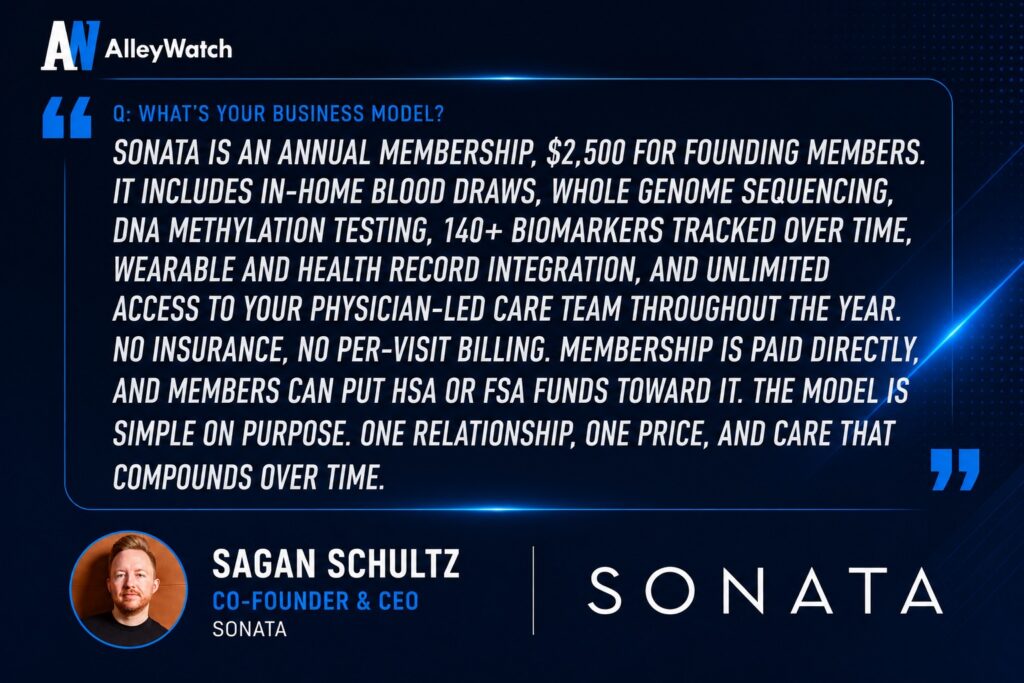
SONATA is an annual membership, $2,500 for founding members. It includes in-home blood draws, whole genome sequencing, DNA methylation testing, 140+ biomarkers tracked over time, wearable and health record integration, and unlimited access to your physician-led care team throughout the year. No insurance, no per-visit billing. Membership is paid directly, and members can put HSA or FSA funds toward it. The model is simple on purpose. One relationship, one price, and care that compounds over time.
How are you preparing for a potential economic slowdown?
We’re built for it in a few ways. We raised from investors who underwrite long time horizons, and we run lean by design. Our model is physician-led care supported by technology, not a clinic buildout in every market, so growth doesn’t drag overhead with it. Our product and engineering team is small and stays that way on purpose; we care about craft and quality over headcount, something I took directly from my time at Linear. On the demand side, health is one of the last things people cut. Our members aren’t making a one-time curiosity purchase; they’re buying the thing that keeps them ahead of problems that are far more expensive later. If anything, a slowdown sharpens the case for prevention. The most expensive healthcare is the kind you didn’t see coming.
What was the funding process like?
The process moved quickly because we weren’t pitching a trend, we were pitching a gap everyone in the room had personally felt. Nearly every investor we talked to was already doing some version of this themselves, tracking biomarkers, wearing a device, piecing together their own labs, and paying out of pocket for testing the system doesn’t offer. We didn’t have to convince anyone that the problem was real. The conversation was about whether we were the team to fix it. Between David and me, we cover medicine, product, and engineering, and we’ve built at places known for strong product and engineering orgs. We know what good looks like, and investors could see we knew what it takes to build it in healthcare. The ones who leaned in, Lux, BoxGroup, Sunflower, and founders from Ramp and Linear, understood both halves.
What are the biggest challenges that you faced while raising capital?
The consumer health space is incredibly noisy right now. There are a lot of companies making big claims about building the future of healthcare that are, underneath, marketing companies, some not even HIPAA compliant. They’ve been loud, and our model has no real precedent, so we spent a lot of the raise explaining how we’re different from things that sound superficially similar. The other challenge was the wedge obsession. Investors are trained to look for a narrow, cheap wedge product that expands later. We made a deliberate choice not to build one, because we want to compete on product and quality of experience, and you can’t do that by selling something cheap on social media and upselling from there, especially in a category where trust is already scarce. People can tell when they’re a funnel. We raised from investors willing to underwrite the full model from day one, real clinical depth and an ongoing physician relationship, because that’s the product we actually wanted to exist.
What factors about your business led your investors to write the check?
Three things. Timing, LLMs, and a founder bet. Timing, because the demand is finally here. People always cared about their health, but the spend never followed like it does now. Millennials watched our parents’ generation deal with chronic disease and decided not to accept the same path, and an ecosystem from Huberman to Bryan Johnson made health optimization mainstream. Meanwhile, the traditional system is heading toward a reckoning, $5 trillion a year and climbing, with outcomes getting worse. LLMs, because contextualizing complex personal health data at this depth wasn’t possible five years ago, and because a small team can now build product experiences that used to take a hundred people. And the founder bet, that healthcare is finally a product problem. The clinical knowledge exists. What’s been missing is anyone building the experience with craft. The founders of Linear and Ramp are on our cap table because they won on exactly that, and they saw the same opening in healthcare.
What are the milestones you plan to achieve in the next six months?
The next six months are about proving you can move fast and care deeply at the same time. We ship product improvements daily, and the pace won’t slow. But velocity only matters if the experience is exceptional, and that’s the real work. Staying close enough to our members to understand what’s actually hard for them, building against that instead of a roadmap written in a vacuum, and treating every detail of their experience like it matters, because it does. This is healthcare, and our bar is hospitality-grade, anticipating what members need before they ask. We’re growing our physician-led care team ahead of demand, and expansion to new cities comes as we earn it.
What advice can you offer companies in New York that do not have a fresh injection of capital in the bank?
I left Linear to start SONATA with a much smaller pre-seed, and the truth is you don’t need much capital to get started. Build something that solves a real problem, and figure out what that is by talking to real people. If customers aren’t pulling it out of your hands, keep listening. Growth you have to manufacture is usually a sign the problem isn’t real yet.
But be honest with yourself about why raising is hard, because eventually you’ll have to, and the underlying issue won’t fix itself. At the earliest stages, most bets are founder bets, and investors are really asking why you’re the right person for this problem. If that answer isn’t strong yet, one of the best moves is spending a few years at a fast-growing startup you admire, working for founders who’ve earned that conviction. The reps are priceless. You learn what good looks like, and you build the thing that matters most: your reputation. I can’t stress that enough.
Where do you see the company going now over the near term?
Near term, everything feeds one goal, proving the model with our founding members. Every member who stays ahead of a risk they didn’t know they had is the proof that this works. As that compounds, you’ll see us in more cities, and you’ll see the product get deeper. That means new offerings, and going especially deep on women’s health, which remains under-researched and underserved by the traditional system, we intend to be part of changing that. Because our care is physician-led and virtual-first rather than built around clinics, we can bring this to new markets at a pace traditional healthcare can’t. But the sequence matters. Exceptional care first, then scale.
What’s your favorite summer destination in and around the city?
Honestly, a leisurely night out in the Village, dinner somewhere good, maybe the Comedy Cellar, but nothing locked in. The best New York nights are the ones you don’t plan. And when I can swing it, out east during the week, when it’s calm.

You are seconds away from signing up for the hottest list in NYC Tech!
Sign up today







-1024x683.jpg "Socialists Show Democrat Establishment Has Lost Its Way")

















