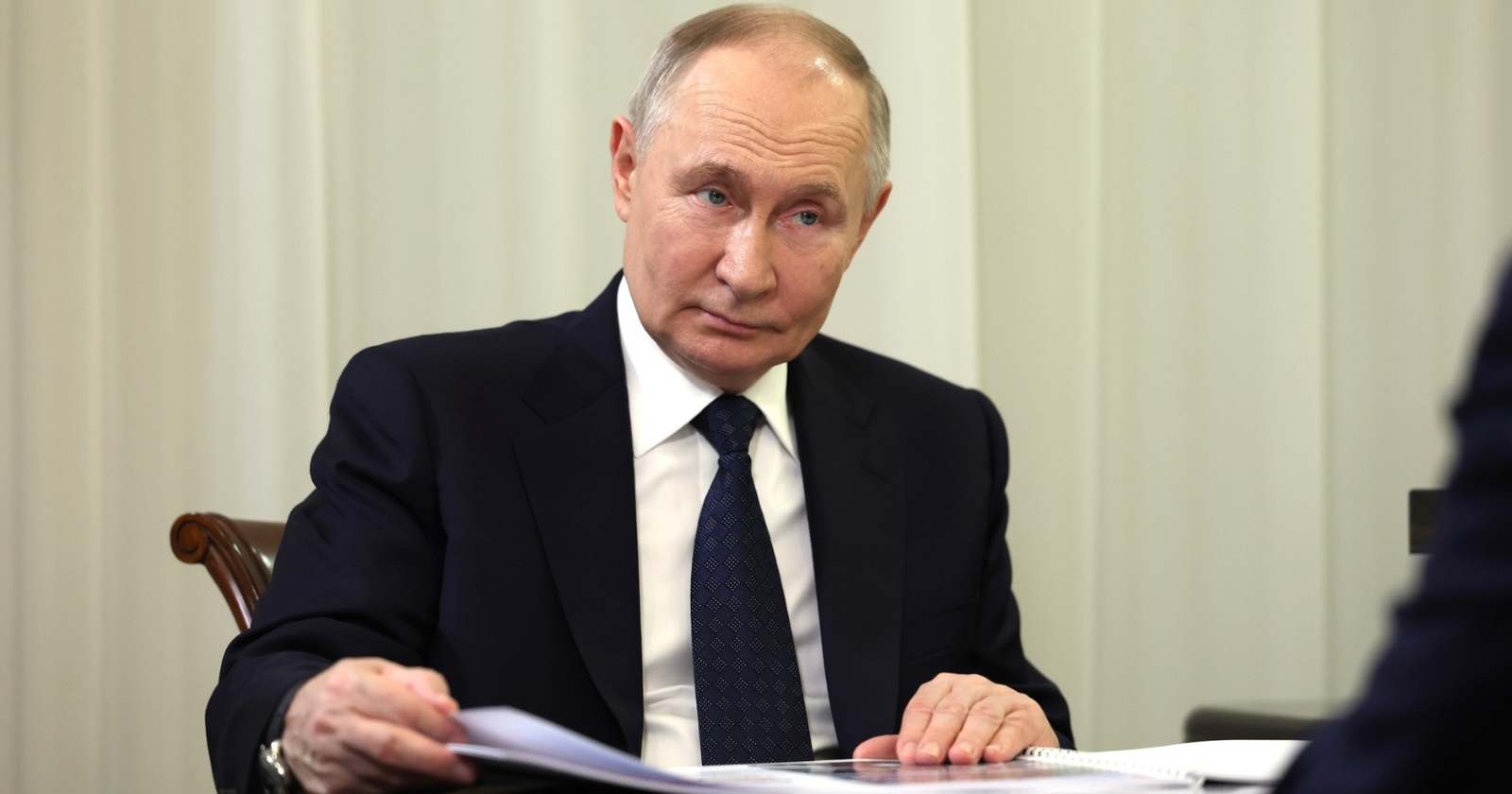
On Sunday 28 June 2026, in a Russian state television studio, Vladimir Putin used the word “no.” Asked about a Ukrainian proposal to halt long-range strikes deep inside each country’s territory, the Russian president confirmed the offer existed, characterised it on his own terms, and rejected it on air. He cast Kyiv’s proposal not as a step toward peace but as an attempt to relieve military pressure on Ukrainian forces along the front line.
According to Al Jazeera, Putin said Moscow would continue its more than four-year war and press ahead with its battlefield aims. The framing was deliberate. He did not treat the proposal as an opening to be explored. He aired it publicly, on his own terms, attributed it to Ukrainian weakness, and dismissed it before any joint statement could fix the wording.
That is a familiar choreography for anyone who has watched the diplomatic rhythms of this war. A Ukrainian initiative becomes Russian property the moment it is spoken aloud from Moscow, and here it was spoken aloud in order to be knocked down.
What Putin actually said
The disclosure was narrow. Ukraine, Putin said, had proposed that both sides stop long-range attacks, and per Russia’s account had also raised a meeting with Kyiv’s leadership. According to Al Jazeera’s coverage of the interview, Putin tied both strands together and rejected them, arguing that any such freeze would benefit Ukraine more than Russia. He claimed Russia’s counterstrikes deep inside Ukrainian territory were far more damaging than Ukraine’s. He suggested the offer reflected a severe manpower shortage in the Ukrainian armed forces along the roughly 1,250km front.
He said no.
Read closely, the asymmetry argument is the tell, and it was the stated basis for the rejection, not a reason to hesitate. Putin was not saying the proposal was unworkable. He was saying it was unequal. That distinction sets the table for counter-demands: territorial recognition, sanctions relief, restrictions on Western weapons deliveries, limits on Ukrainian drone manufacturing. Each has been a Russian negotiating ask at various points in the war, and each can now be framed as the price of any future balance.
Why a deep-strike pause would be the most consequential pause on offer
Long-range strikes have become the defining feature of the war’s later phases. Ukrainian drones now routinely reach oil refineries, fuel depots and military-industrial sites deep inside Russia. Russian missiles and Shahed-type drones continue to hit Ukrainian power generation, grid substations and residential blocks in cities far from the front. The fighting on the ground has, for long stretches, moved by metres. The strikes at distance have moved markets, fuel prices and civilian life.
A mutual halt would not end the war. It would change its texture. Ukrainian refining capacity, agricultural exports and winter heating would gain a degree of predictability. Russian oil throughput, currently squeezed by repeated drone attacks on Black Sea and Volga-region facilities, would recover. That second consequence helps explain why Putin had reason to be wary of locking in a freeze precisely when Ukrainian strikes are biting hardest.
The 2025 precedent that frames this moment
This is not the first time a partial pause has been floated. In March 2025, Putin agreed during a call with US President Donald Trump to a limited pause on strikes against Ukrainian energy infrastructure, while refusing a full ceasefire. Al Jazeera reported at the time that the arrangement was narrower than the broader ceasefire Washington and Kyiv had pushed for, and that Russia retained the ability to continue ground operations and other forms of attack.
That 2025 arrangement frayed within weeks. Both sides accused each other of violations. Energy strikes resumed. The mechanism for monitoring was never fully agreed, and the absence of any third-party verifier meant each capital became judge of the other’s compliance. The episode left a template: partial pauses can be announced, but without verification they tend to collapse into mutual recrimination that strengthens the hardliners on both sides.
The current proposal, as Putin describes it, is broader in scope, covering all deep strikes rather than only energy targets. But it would inherit the same structural weakness. Who counts a violation? Who decides whether a Ukrainian drone shot down over Bryansk was aimed at a refinery or a barracks? Who adjudicates whether a Russian missile that hit a Kyiv apartment block was targeting an adjacent air-defence site? Those questions are part of why a freeze is hard to build. They are also part of the cover Putin has to reject one.
The asymmetry argument, examined
Putin’s claim that the deal would favour Ukraine, the reason he gave for rejecting it, deserves scrutiny on its own terms. The Ukrainian deep-strike campaign has, over the past eighteen months, demonstrably degraded Russian fuel output and forced refinery shutdowns across multiple regions. Russian strikes on Ukrainian infrastructure, while devastating to civilians, have not stopped Ukrainian arms production or military operations at scale. By raw industrial impact, Ukraine’s long-range capability has arguably become the more strategically painful of the two.
From that vantage, a freeze would lock in a Russian disadvantage in the strike-and-counter-strike economy. Putin is, in effect, saying: you have just built a weapon that hurts us more than ours hurts you, and now you want us both to put them down. That logic makes his rejection coherent rather than merely obstinate.
But the inverse reading explains why Kyiv made the offer at all. A halt would relieve Ukrainian cities and grids of a constant winter threat. It would allow displaced civilians to return. It would stabilise an electricity system that has suffered extensive damage to its generating capacity. The relief on the Ukrainian home front would be immediate and material, and Kyiv’s negotiators would not have floated the proposal if they did not believe their side stood to gain.
The rejected meeting
The second strand, a meeting with Ukraine’s leadership, is in some ways the more politically charged. In early June 2026, President Volodymyr Zelenskyy wrote an open letter to Putin proposing a face-to-face meeting to discuss ending the war. Putin said he had rejected that proposal too. Russia has long questioned Zelenskyy’s legitimacy, particularly around the question of elections under martial law, and a formal Putin–Zelenskyy meeting would, by definition, treat Zelenskyy as Ukraine’s legitimate head of state. That is a concession Moscow has so far refused to make.
Russia’s preferred phrasing, referring vaguely to Kyiv’s leadership rather than to Zelenskyy by name, leaves room for a delegation rather than a summit. That ambiguity preserves the option of some future contact without conceding what a leader-level meeting would imply, even as the meeting itself was, for now, turned down.
What is missing from the Russian account
One of the most reliable rules of wartime diplomacy is that the side announcing a proposal usually controls its framing. As of Putin’s statement, Ukrainian officials had not publicly confirmed the offer in the terms Russia described. There was no parallel statement from Zelenskyy’s office endorsing the specifics, and no readout from the Ukrainian foreign ministry corroborating them. The proposal exists, for now, only as Putin has chosen to characterise it. And he characterised it on the way to rejecting it.
That gap is significant. It is possible the Ukrainian proposal was conveyed through a back channel. Mediators have played that role at different points, and Kyiv may have intended it as a private exploration rather than a public position. By airing and dismissing it, Putin has either forced Ukraine to confirm and defend the offer or to deny it and look as though it is retreating from its own initiative. Either way, the choice of how to respond now belongs to Kyiv, not to the proposal’s authors.
The Washington variable
Any deep-strike question sits inside a wider American context. The Trump administration has, since returning to office, repeatedly signalled it wants the war ended on terms that allow it to reduce US military aid commitments. Long-range strike capability is one of the areas where Ukrainian dependence on Western systems — ATACMS, Storm Shadow, Western targeting data — has been highest. A Ukrainian offer to halt deep strikes could, in part, reflect calculations about which capabilities Kyiv expects to retain access to. In the same interview, Putin said he expected US-led diplomacy to resume, with envoys Steve Witkoff and Jared Kushner expected in Moscow once the acute phase of the US–Israel conflict with Iran had passed.
The offer could also be a hedge. If Western long-range support is becoming uncertain, proposing a freeze now would bank eighteen months of demonstrated Ukrainian capability as a negotiating asset rather than letting it atrophy through ammunition shortages. That is a colder reading of the proposal, but it is consistent with how negotiating positions track the underlying logistics rather than the rhetoric around them. It is also one reason Moscow had an incentive to refuse rather than to bank the same freeze on Russia’s behalf.
What to watch in the next two weeks
Several signals will indicate whether this exchange is the start of a negotiating track or simply another round of posturing. The first is Kyiv’s response, and specifically whether Zelenskyy himself addresses the proposal or delegates it to a subordinate. The second is the tempo of strikes: both sides have historically intensified attacks around moments of diplomatic signalling to strengthen their hand, and a surge in either Russian missile launches or Ukrainian drone activity would be a tell.
The third is Washington. Putin said he expects US-led efforts to resume; whether that materialises, and whether any future framework builds in monitoring from the start rather than bolting it on afterward, will shape what any later pause is worth. The fourth is the Russian domestic line. State media framing of the rejection, whether as resolve or as a door left ajar, will indicate how much room Putin has to shift later.
The deeper pattern
Here is what the exchange actually reveals. Ukraine is now the side confident enough in its deep-strike reach to propose freezing it. Russia is the side rejecting a freeze it might once have welcomed. That is not the posture of a winning power. That is the posture of a power that has noticed it is losing an exchange and does not yet know how to stop losing it.
Putin’s “no” can be read two ways, and only one of them is flattering to Moscow. The confident reading is that Russia believes its battlefield advance will outpace whatever damage Ukrainian drones can do to its refineries, so why trade away leverage. The brittle reading is that the Kremlin cannot afford to validate, even implicitly, the proposition that Ukraine now holds a strategic weapon Russia would like to neutralise. The asymmetry argument Putin chose to deploy points, awkwardly for him, toward the second.
That is the question the next phase of the war will answer, and it will answer it in fuel depots and substations rather than in interviews. If Ukrainian strikes keep biting and Russian refining keeps degrading through the winter, the offer Putin rejected on Sunday will look, by spring, like the better deal he turned down. If they do not, he will look like a man who read his hand correctly. One of those two things is about to be true.