
No Result
View All Result
SUBMIT YOUR ARTICLES
  • Login
Thursday, May 28, 2026
TheAdviserMagazine.com
  • Home
  • Financial Planning
    • Financial Planning
    • Personal Finance
  • Market Research
    • Business
    • Investing
    • Money
    • Economy
    • Markets
    • Stocks
    • Trading
  • 401k Plans
  • College
  • IRS & Taxes
  • Estate Plans
  • Social Security
  • Medicare
  • Legal
  • Home
  • Financial Planning
    • Financial Planning
    • Personal Finance
  • Market Research
    • Business
    • Investing
    • Money
    • Economy
    • Markets
    • Stocks
    • Trading
  • 401k Plans
  • College
  • IRS & Taxes
  • Estate Plans
  • Social Security
  • Medicare
  • Legal
No Result
View All Result
TheAdviserMagazine.com
No Result
View All Result
Home Market Research Markets

AI Just Broke the Old Computing Model

by TheAdviserMagazine
1 month ago
in Markets
Reading Time: 5 mins read
A A
AI Just Broke the Old Computing Model
Share on FacebookShare on TwitterShare on LInkedIn


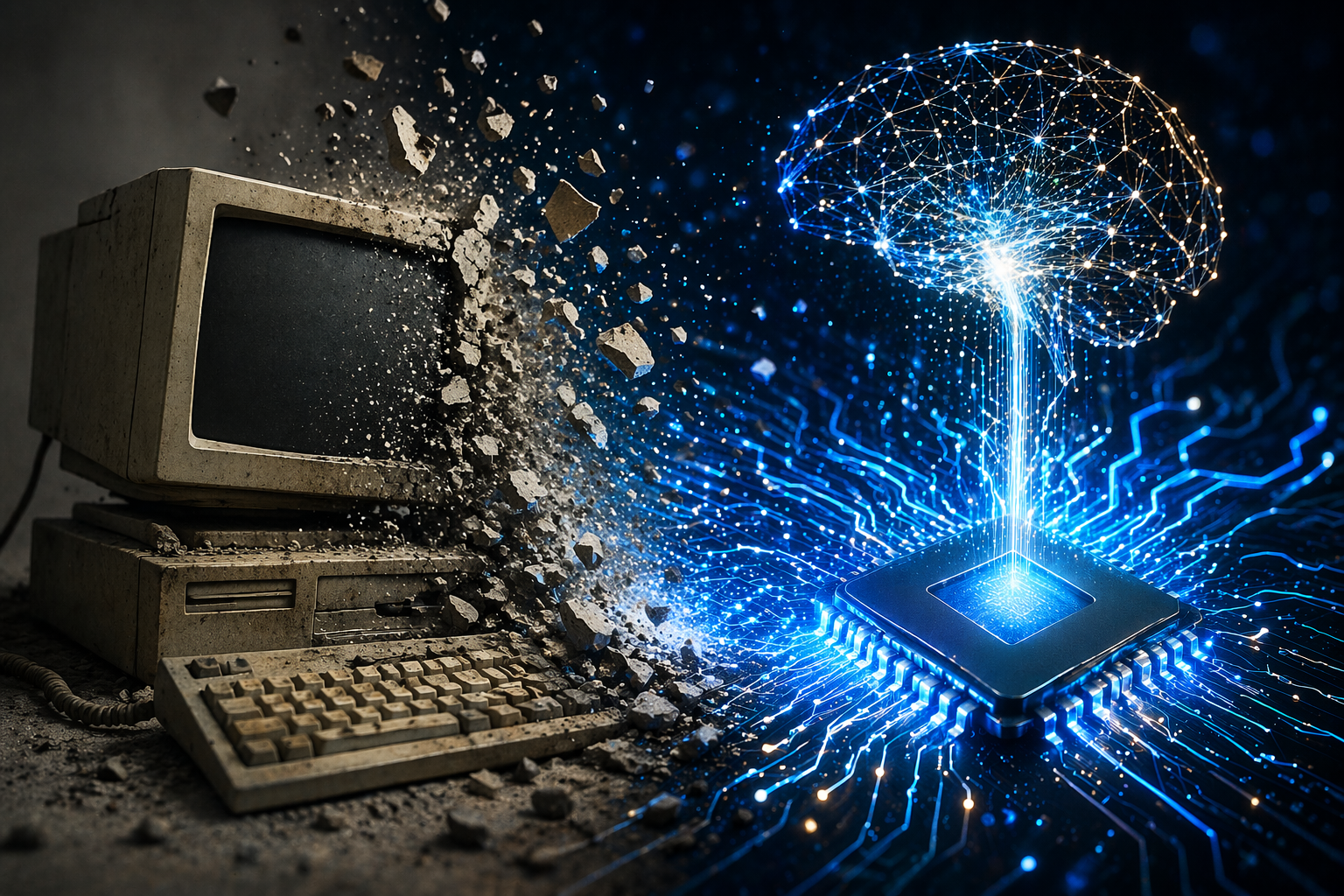
The entire foundation of computing is coming apart.

But there’s no need to panic. Because it’s happened before.

In the early days of the internet, one server did everything. It handled traffic, stored data, delivered content and kept websites running.

That worked… until it didn’t.

As more people came online, those machines started to struggle. So a new kind of infrastructure emerged.

Instead of one machine doing everything, each task got its own solution. Routers directed traffic, while storage systems handled data. Some systems moved data closer to users. Others spread out demand.

That specialization is why companies like Cisco (Nasdaq: CSCO), Amazon (Nasdaq: AMZN) and Google (Nasdaq: GOOG) became so important during the internet buildout.

They were each attempting to make a part of the internet work better.

The same thing is happening again today.

Only this time, it’s happening with the chips that power artificial intelligence.

The End of General-Purpose Compute

For decades, the central processing unit, or CPU, has been the center of gravity in computing.

Image: Wikimedia Commons

It’s flexible and reliable enough to handle most workloads, which makes it incredibly valuable in a world where computing needs are relatively simple.

But AI’s needs are far from simple.

Training AI models takes a lot of computing power. Running them at scale requires speed and efficiency. And both depend on moving huge amounts of data without slowing things down.

So the old model of relying on a single, general-purpose CPU doesn’t work anymore.

That’s why the AI industry is now assigning each task to a chip designed specifically for it.

Graphics chips, or GPUs, have long been the go-to for training AI because they can handle a lot of calculations at the same time.

Image: Wikimedia Commons

From there, customization has spread.

Google has its TPUs, which are custom-designed AI chips for training and running models.
Amazon has its Trainium chips for training and Inferentia chips for running A models.
And Microsoft is building its own Maia chips to improve how its systems run.

Even memory isn’t just a supporting component anymore. In many cases, it’s just as important as compute itself.

High-bandwidth memory, or HBM, has become a critical piece of the system because AI needs to feed data into chips fast enough that they don’t sit idle.

Some analysts estimate the HBM market will reach $54.6 billion in 2026, up 58% from the prior year.

Image: globalxetfs.com

Demand for AI memory is now so strong that supply is being locked up years in advance.

And it’s becoming a real bottleneck.

SK Hynix, one of the world’s largest memory chipmakers, says much of its high-end memory for 2026 is already sold out.

That’s why I pounded the table about Micron Technologies (Nasdaq: MU) in Strategic Fortunes when DRAM prices started skyrocketing in late 2024. I could see where this was going.

But memory isn’t AI’s only constraint.

Power is starting to limit how fast new AI infrastructure can be built too. Training and running AI models also require enormous amounts of electricity, and in some cases, access to power determines where new data centers can even go.

In other words, AI has been growing so fast that bottlenecks are popping up everywhere.

Because of this, companies are being forced to redesign how everything works together.

That’s why the biggest AI infrastructure players are now designing their own chips. Because even small efficiency gains at the chip level can translate into massive advantages across their entire AI systems.

Amazon, Google, Meta (Nasdaq: META) and Microsoft (Nasdaq: MSFT) alone are on track to spend around $665 billion on AI infrastructure in 2026.

One reason behind this enormous amount of spending today is that the industry is breaking computing into pieces and rebuilding it in a more specialized way.

Data centers are no longer built around interchangeable machines. They’re being redesigned as tightly integrated environments where different types of chips handle different parts of the workload.

So compute, memory and networking are all being optimized together.

This also happened in the Internet era, when computing evolved from standalone servers into layered systems. Each layer handled a specific function, and together they created a faster, more scalable network.

That’s what’s happening inside AI infrastructure today.

It’s a leading reason why the semiconductor market is growing so quickly right now.

Because demand isn’t just increasing in volume, it’s also increasing in complexity. And that’s pulling the entire semiconductor industry in a new direction.

From general-purpose chips…

To purpose-built systems.

Here’s My Take

The real story here is that AI isn’t just changing what compute looks like. It’s changing who controls it.

We’re moving away from a world where general-purpose chips could be bought by anyone and used for almost anything. That made computing widely accessible.

But specialized systems don’t work that way.

They require custom chips, tightly integrated hardware and massive amounts of capital to build and operate. And that naturally concentrates power in the hands of the companies that can afford to build and run them.

This isn’t new.

During the internet buildout, profits didn’t stay evenly distributed. It concentrated in the companies that controlled key layers of its infrastructure.

The same thing is starting to happen again.

Only this time, it’s happening at the foundation of computing itself.

And it means the gap between the companies building AI infrastructure and everyone else is likely to widen.

Regards,

Ian King's SignatureIan KingChief Strategist, Banyan Hill Publishing

Editor’s Note: We’d love to hear from you!

If you want to share your thoughts or suggestions about the Daily Disruptor, or if there are any specific topics you’d like us to cover, just send an email to [email protected].

Don’t worry, we won’t reveal your full name in the event we publish a response. So feel free to comment away!


Source link

Tags: brokeComputingmodel
ShareTweetShare
Previous Post

Tax firm AI platform vs. point solution: 2026 buyer’s guide

Next Post

The Markets Where Renters Have the Most Power—And What Investors Can Do About It

Related Posts

edit post
Chart of the Week: The Future of Work Just Changed

Chart of the Week: The Future of Work Just Changed

by TheAdviserMagazine
May 28, 2026
0

Last week, I showed you evidence from Stanford that AI progress isn’t slowing down. Today, I want to look at...

edit post
S&P Global (SPGI) Has an Essential-Intelligence Moat the Cycle Alone Cannot Explain

S&P Global (SPGI) Has an Essential-Intelligence Moat the Cycle Alone Cannot Explain

by TheAdviserMagazine
May 28, 2026
0

Why S&P Global should be viewed as an information workflow platform, not just a ratings cycle trade S&P Global is...

edit post
States have lost  billion due to prediction markets: Gaming association

States have lost $1 billion due to prediction markets: Gaming association

by TheAdviserMagazine
May 28, 2026
0

The American Gaming Association now estimates that states have missed out on more than $1 billion in tax revenue due...

edit post
5 Costco Clothing Items You Should Grab — and 5 You Shouldn’t Touch

5 Costco Clothing Items You Should Grab — and 5 You Shouldn’t Touch

by TheAdviserMagazine
May 28, 2026
0

Walk into a Costco, and the clothing section barely looks like a clothing section. No mannequins. No mood lighting. No...

edit post
Nio surges 9% after releasing first flagship EV in more than two years

Nio surges 9% after releasing first flagship EV in more than two years

by TheAdviserMagazine
May 27, 2026
0

Chinese electric car company Nio announced May 27, 2026, that former NBA player Yao Ming (R) would be a representative...

edit post
Google employee polymarket insider trading

Google employee polymarket insider trading

by TheAdviserMagazine
May 27, 2026
0

Signage at the Situation Room by Polymarket pop-up bar in Washington, DC, US, on Friday, March 20, 2026. Graeme Sloan...

Next Post
edit post
The Markets Where Renters Have the Most Power—And What Investors Can Do About It

The Markets Where Renters Have the Most Power—And What Investors Can Do About It

edit post
Occidental Petroleum Drops 7.5% Amid Sector-Wide Selling

Occidental Petroleum Drops 7.5% Amid Sector-Wide Selling

  • Trending
  • Comments
  • Latest
edit post
Supreme Court Delivers More Bad Redistricting News for Democrats

Supreme Court Delivers More Bad Redistricting News for Democrats

May 19, 2026
edit post
From Maine to Michigan, Democrats Are Making Communism Great Again

From Maine to Michigan, Democrats Are Making Communism Great Again

May 16, 2026
edit post
Gavin Newsom issues ‘final warning’ amid California’s dire housing crisis — what’s at stake for millions of residents

Gavin Newsom issues ‘final warning’ amid California’s dire housing crisis — what’s at stake for millions of residents

May 3, 2026
edit post
Minnesota Wealth Tax | Intangible Personal Property Tax

Minnesota Wealth Tax | Intangible Personal Property Tax

May 6, 2026
edit post
It’s Time To Talk About Massie

It’s Time To Talk About Massie

May 23, 2026
edit post
10 Cheapest High Dividend Stocks With P/E Ratios Under 10

10 Cheapest High Dividend Stocks With P/E Ratios Under 10

April 13, 2026
edit post
How to Navigate the Growing Small Modular Reactor Market?

How to Navigate the Growing Small Modular Reactor Market?

0
edit post
RBC recruiting boosts U.S. net new assets

RBC recruiting boosts U.S. net new assets

0
edit post
Chart of the Week: The Future of Work Just Changed

Chart of the Week: The Future of Work Just Changed

0
edit post
XRP Sends A Rare Signal As Whale-Retail Dynamics Are Shifting – Traders Are Watching

XRP Sends A Rare Signal As Whale-Retail Dynamics Are Shifting – Traders Are Watching

0
edit post
6 Reasons Retirement Accounts Are Lasting Less Time Than Expected for Some Seniors

6 Reasons Retirement Accounts Are Lasting Less Time Than Expected for Some Seniors

0
edit post
Canada Moves To Destroy Encryption – Demands Backdoor Access To ALL Available Data

Canada Moves To Destroy Encryption – Demands Backdoor Access To ALL Available Data

0
edit post
6 Reasons Retirement Accounts Are Lasting Less Time Than Expected for Some Seniors

6 Reasons Retirement Accounts Are Lasting Less Time Than Expected for Some Seniors

May 28, 2026
edit post
XRP Sends A Rare Signal As Whale-Retail Dynamics Are Shifting – Traders Are Watching

XRP Sends A Rare Signal As Whale-Retail Dynamics Are Shifting – Traders Are Watching

May 28, 2026
edit post
Chart of the Week: The Future of Work Just Changed

Chart of the Week: The Future of Work Just Changed

May 28, 2026
edit post
RBC recruiting boosts U.S. net new assets

RBC recruiting boosts U.S. net new assets

May 28, 2026
edit post
Micron and Sandisk aren’t the only tech stocks booming — take a look at these 3 cybersecurity plays

Micron and Sandisk aren’t the only tech stocks booming — take a look at these 3 cybersecurity plays

May 28, 2026
edit post
S&P Global (SPGI) Has an Essential-Intelligence Moat the Cycle Alone Cannot Explain

S&P Global (SPGI) Has an Essential-Intelligence Moat the Cycle Alone Cannot Explain

May 28, 2026
The Adviser Magazine

The first and only national digital and print magazine that connects individuals, families, and businesses to Fee-Only financial advisers, accountants, attorneys and college guidance counselors.

CATEGORIES

  • 401k Plans
  • Business
  • College
  • Cryptocurrency
  • Economy
  • Estate Plans
  • Financial Planning
  • Investing
  • IRS & Taxes
  • Legal
  • Market Analysis
  • Markets
  • Medicare
  • Money
  • Personal Finance
  • Social Security
  • Startups
  • Stock Market
  • Trading

LATEST UPDATES

  • 6 Reasons Retirement Accounts Are Lasting Less Time Than Expected for Some Seniors
  • XRP Sends A Rare Signal As Whale-Retail Dynamics Are Shifting – Traders Are Watching
  • Chart of the Week: The Future of Work Just Changed
  • Our Great Privacy Policy
  • Terms of Use, Legal Notices & Disclosures
  • Contact us
  • About Us

© Copyright 2024 All Rights Reserved
See articles for original source and related links to external sites.

Welcome Back!

Login to your account below

Forgotten Password?

Retrieve your password

Please enter your username or email address to reset your password.

Log In
No Result
View All Result
  • Home
  • Financial Planning
    • Financial Planning
    • Personal Finance
  • Market Research
    • Business
    • Investing
    • Money
    • Economy
    • Markets
    • Stocks
    • Trading
  • 401k Plans
  • College
  • IRS & Taxes
  • Estate Plans
  • Social Security
  • Medicare
  • Legal

© Copyright 2024 All Rights Reserved
See articles for original source and related links to external sites.












