
Nuclear power used to be a big story.
It was all about big budgets and big plants.
But after the failures of Three Mile Island, Chernobyl and Fukushima, what once looked like a big future for nuclear energy became a much smaller story. And only recently has it started to make a comeback.
Maybe that’s for the best.
Because the next nuclear breakthrough might come in something small enough to fit on a truck.
But it could help make nuclear power big again in a very different way.
Microreactors
Nuclear power provides about 9% of electricity globally, and closer to 19% in the U.S. But in dollar terms it’s a relatively small industry, around $40 to $50 billion a year.
Why is this?
Because throughout the atomic age, the model for nuclear energy was to go big. Large reactors were supposed to drive economies of scale and deliver abundant power.
But in practice, bigger often means more cost, more delays and more political friction.
That’s why I’m more interested in what’s happening at the other end of the spectrum.
You see, instead of trying to make nuclear work through ever-larger projects, a growing group of developers are focused on what happens if you shrink the reactor.
And I’m not talking about small modular reactors that can still be the size of industrial buildings.
I’m talking about something much smaller.
Image: datacenterknowledge.com
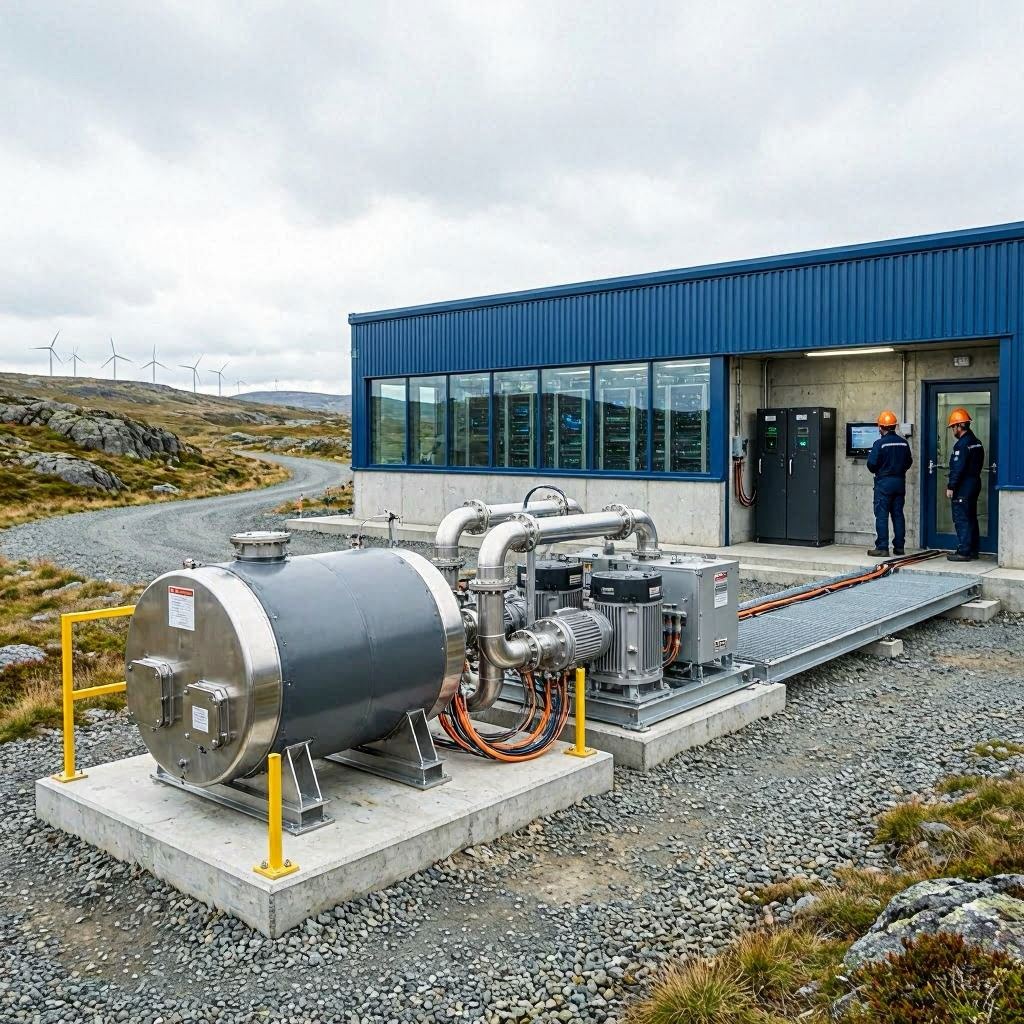
They’re called microreactors, compact nuclear systems that generate modest amounts of power and, in some cases, can fit inside something as small as a shipping container.
And they aren’t just concepts.
Last month, the U.S. Air Force selected the companies Radiant, Antares Nuclear and Westinghouse to advance microreactor projects at bases in Colorado, Texas and Montana. The goal is to get an advanced reactor operating on an installation by 2030 or sooner.
That tells me something exciting could be happening here.
The federal government could be helping to create an early market for microreactors.
It wouldn’t be the first time this has happened. The government played a major role in the early growth of the internet, semiconductors and the private space industry.
And the details of these systems help explain why the military is interested.
Radiant’s Kaleidos microreactor is designed to generate about 1.2 megawatts of power and is expected to operate for five or more years before needing to be refueled.

Image: Radiant
Westinghouse’s eVinci can produce up to 5 megawatts and operate for eight years or more without refueling.
Putting those numbers in context, a traditional nuclear plant might generate 1,000 megawatts or more. But these microreactors are a fraction of that size because they aren’t trying to power cities. They’re aimed at something far more common and far less efficient.
Diesel generators.
In many remote locations, electricity still comes from fuel that has to be trucked in. That adds cost and complexity, and in military settings it can be extremely risky.
Fuel convoys have historically been among the most vulnerable targets in conflict zones.

Image: NARA & DVIDS Public Domain Archive
But a compact reactor that can be deployed to a remote site and run for years without refueling eliminates this problem entirely.
It also opens the door to a much more distributed energy model.
If reactors can be built in factories and deployed where they’re needed nuclear power can go from being a one-off infrastructure project to something that can scale.
We’ve seen that kind of transition before when computing moved from mainframes to distributed systems. Instead of one large computer serving everyone, processing spread out to servers, personal computers and eventually the cloud.
Nuclear energy could be following a similar path, with power increasingly deployed where it’s needed instead of only coming from large plants.
And it could be happening at the perfect time…
Just as demand for electricity is starting to surge, driven by the rapid buildout of AI data centers and the electrification of cars, factories and buildings.
Microreactors could be used to power these facilities just as easily as they could be used in factories, mining operations or remote military bases.
Amazon-backed X-Energy (Nasdaq: XE) recently went public at an $11.9 billion valuation, which gives you a sense of how seriously this technology is starting to be taken.
And it’s just one of many companies working on it.
Oklo, Last Energy, Deep Fission and Aalo are all taking different approaches to advanced nuclear power. But they’re all making a similar bet that smaller, standardized reactors can succeed where large, custom-built projects have struggled.
Of course, that doesn’t guarantee success. Licensing is still a challenge, fuel supply chains need to mature and these systems have to prove they can be built repeatedly at a reasonable cost.
But if nuclear power no longer has to come from massive plants, this could become more than a comeback story.
It could change the way energy is produced and delivered.
Here’s My Take
Members of Strategic Fortunes know that I’ve been early on the return of nuclear energy. It’s why we hold positions in BWX Technologies Inc. (NYSE: BWXT), Cameco Corp. (NYSE: CCJ), and Oklo Inc. (NYSE: OKLO) in our model portfolio.
But I don’t think the story here is simply that nuclear energy is coming back.
I believe the model of providing nuclear power might be changing.
If reactors can get small enough to deploy like equipment instead of infrastructure, then this could become one of the most overlooked energy revolutions taking shape today.
The irony is that as nuclear power becomes big again…
It might be doing it by getting very small.
Regards,
 Ian KingChief Strategist, Banyan Hill Publishing
Editor’s Note: We’d love to hear from you!
If you want to share your thoughts or suggestions about the Daily Disruptor, or if there are any specific topics you’d like us to cover, just send an email to [email protected].
Don’t worry, we won’t reveal your full name in the event we publish a response. So feel free to comment away!



















