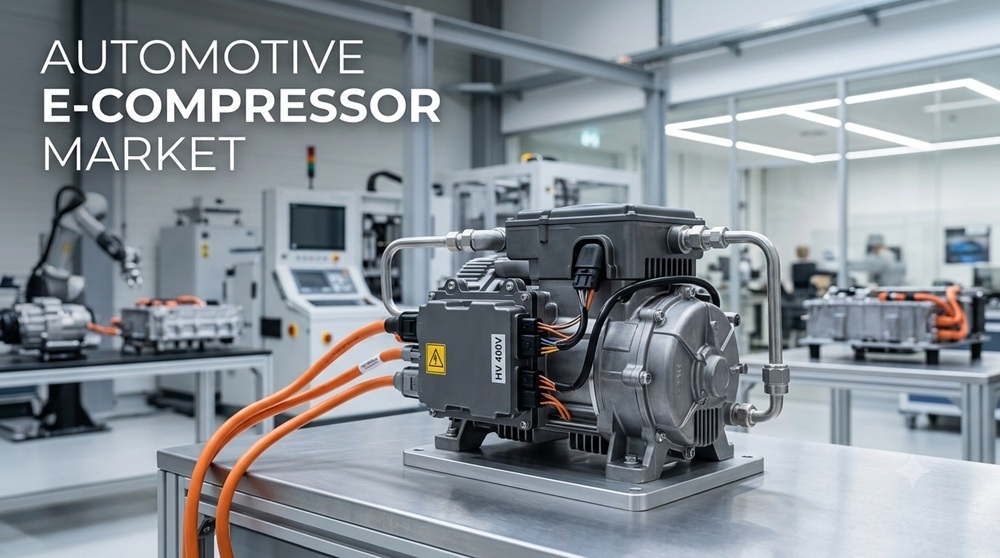
The Automotive E-Compressor Market is expanding alongside the rapid transition toward electric and hybrid mobility. Automotive e-compressors play a critical role in vehicle thermal management by providing efficient air-conditioning performance independent of conventional belt-driven systems. According to BIS Research, the market is projected to grow from $6.90 billion in 2024 to $20.72 billion by 2034, registering a CAGR of 11.63% during the forecast period.
What are the Key Drivers of the Automotive E-Compressor Market?
Growing adoption of battery electric and hybrid vehicles requiring electrically powered thermal management systems.
Increasing focus on energy-efficient vehicle components that reduce mechanical losses.
Rising demand for advanced thermal management solutions to improve vehicle performance and passenger comfort.
Ongoing technological advancements supporting the transition toward cleaner and more sustainable transportation.
What are the Key Trends in the Automotive E-Compressor Market?
Increasing integration of e-compressors into electric and hybrid vehicle platforms.
Growing adoption of variable frequency drive (VFD) technologies.
Continued product diversification across multiple compressor types and vehicle categories.
Get A Sample for Automotive E-Compressor Market – Focus on Vehicle Type, Compressor Type, Capacity, Propulsion Type, Technology Type and Region – Analysis and Forecast, 2024-2034
What is the Role of Compressor Type in the Market?
The market includes several compressor technologies, including scroll, rotary, centrifugal, reciprocating, and axial compressors. This broad product portfolio enables manufacturers to address different vehicle requirements and thermal management needs across passenger cars, light commercial vehicles, and heavy commercial vehicles while supporting various electric propulsion systems.
What Does the Propulsion Type Segment Indicate?
The Automotive E-Compressor Market is segmented into Battery Electric Vehicles (BEVs), Plug-in Hybrid Electric Vehicles (PHEVs), Fuel-cell Electric Vehicles (FCEVs), and Hybrid Electric Vehicles (HEVs). E-compressors are essential for maintaining efficient thermal management and air-conditioning performance across these electrified vehicle categories, as they operate independently of conventional engine-driven systems. As the adoption of electric and hybrid mobility continues to increase, demand for e-compressors is expected to grow across all propulsion types, with each segment contributing to the market based on its specific thermal management requirements.
What Does the Regional Analysis Indicate?
The Automotive E-Compressor Market is analyzed across North America, Europe, Asia-Pacific, and the Rest-of-the-World. The report evaluates regional market performance based on factors such as vehicle adoption trends, technology deployment, regulatory landscape, supply chain dynamics, and competitive developments across each geography.
What Challenges and Opportunities Shape the Market?
The market continues to evolve alongside the broader automotive electrification landscape. Manufacturers are focusing on research and development, product innovation, patent activity, and technology improvements to strengthen competitiveness. Opportunities are emerging from expanding electric vehicle production, while evolving regulations, changing customer requirements, and continuous innovation remain important factors influencing future market development.
Click Here to Download the ToC
Conclusion
The Automotive E-Compressor Market is positioned for sustained long-term growth as vehicle electrification accelerates worldwide. Electrically driven compressors are becoming increasingly important for efficient thermal management in modern electric and hybrid vehicles. BIS Research forecasts strong market expansion through 2034, supported by technological innovation, increasing adoption of electrified vehicles, and ongoing advancements across compressor technologies, vehicle platforms, and regional markets.