Updated on May 3rd, 2026 by Nathan Parsh
Income investors often find high-yielding stocks attractive due to the income they can produce. But sometimes, the need for income can blind investors to the company’s issues. If this is the case, investors can be blindsided when the company cuts its dividend.
The same can be said for monthly dividend-paying companies. Investors might overlook a company’s weak fundamentals when obtaining monthly dividend payments. Monthly dividend stocks can be appealing as they create more regular cash flow for investors.
We cover all 119 monthly dividend stocks. You can download our full Excel spreadsheet of all monthly dividend stocks (along with metrics that matter like dividend yield and payout ratio) by clicking on the link below:

But investors shouldn’t buy a high-yield monthly dividend-paying stock simply because of its monthly payments. This is particularly true for oil and gas royalty trusts.
Permian Basin Royalty Trust (PBT) fits the description of a dividend stock with a questionable outlook. Distributions vary on a month-to-month basis based on profitability.
In fact, distributions have declined dramatically in recent years, which has led to a much lower yield. Investors have have received or are scheduled to receive $0.1162 per share so far in 2026, which corresponds to an annualized yield of just 1.2%. The average yield was as high as 6% to 7% in the period before 2022. We note, however, that dividends are highly volatile and subject to change.
This article will look at Permian Basin’s business, growth prospects and dividend to show why investors should avoid this stock.
Business Overview
Permian Basin holds overriding royalty interests in several oil and gas properties in the United States. The trust has typically on the small side, but the share price has more than doubled over the last year and the stock now trades with a market capitalization of more than $1 billion. The trust has oil and gas-producing properties in Texas.
The trust was established in 1980 and has a 75% net profit royalty interest in the Waddell Ranch properties. These properties consist of over 300 net-productive oil wells, over 100 net-producing gas wells, and 120 net injection wells.
Permian Basin also holds a 95% net profit royalty interest in the Texas Royalty Properties, which consist of approximately 125 separate royalty interests across 33 counties in Texas covering 51,000 net producing acres.
The trust’s assets are static, so it cannot add new properties to its portfolio.
Growth Prospects
As an oil and gas trust, it goes without saying that Permian Basin will perform in direct relation to oil and natural gas prices. Investments like Permian Basin are designed as income vehicles. Higher energy prices will likely lead to higher royalty payments, driving up demand for units. In the same way, lower energy prices will lead to lower dividend payments.
Distributions are based on the prices of natural gas and crude oil. Permian Basin is impacted in two ways when the price of either declines. First, distributable income from royalties is reduced, lowering dividend payments. In addition, plans for exploration and development may be delayed or canceled, which could lead to future dividend cuts.
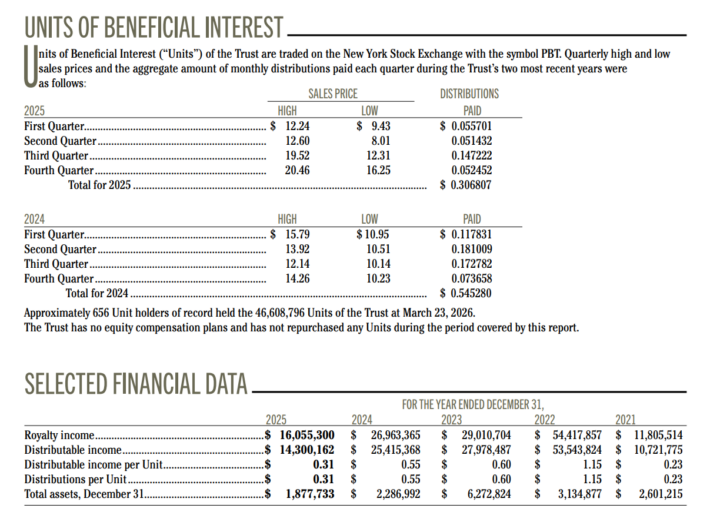
The trust reported results for the full fiscal year 2025 on March 27th, 2026.
Source: Investor presentation
Permian Basin reported royalty income of $16.1 million for the year, which was a 40.5% decrease from the prior year. The average realized price of gas grew 22.8%to $1.78 per Mcf, but the price of oil fell 13.1% per barrel. As a result, distributable income per unit decreased 43% to $0.31.
After several months of disappointing distributions, which were the result of higher operating expenses on the Waddell Ranch properties, Permian Basin raised its May distribution to $0.0380 per unit, which is a 255% increase from the preceding month and a 93.9% improvement from the same period of 2025.
Despite disappointing distributions in recent years, which were impacted by high operating expenses on the Waddell Ranch properties, PBT has often increased its distributions. The rally of the oil price has resulted from the recovery of global demand from the pandemic, tight global supply, and the invasion of Russia in Ukraine.
More recently, the price of oil has increased due to the war in Iran. With the Strait of Hormuz closed, supply has been limited. Approximately 20 million barrels of oil, or 20% of global supply, and a significant amount of natural gas pass through the Strait of Hormuz on a daily basis.
This has caused prices to climb, with Brent crude recently closing at $108 per barrel, which is a 58% increase since the conflict began.
While the operating environment is somewhat favorable for Permian Basin, we are concerned about the unreliable and volatile business performance of the trust over the long run.
Dividend & Valuation Analysis
Royalty trusts are usually owned for their dividends. These investments are not likely to have multiple decades of dividend growth like the more well-known dividend-paying companies such as Johnson & Johnson (JNJ) or Procter & Gamble (PG). That is because trusts like Permian Basin depend entirely on the prices of oil and gas to determine dividend payments.
Listed below are the trust’s dividends per share over the last seven years:
2014 dividends per share: $1.02
2015 dividends per share: $0.34 (67% decline)
2016 dividends per share: $0.42 (24% increase)
2017 dividends per share: $0.63 (50% increase)
2018 dividends per share: $0.66 (5% increase)
2019 dividends per share: $0.42 (36% decline)
2020 dividends per share: $0.235 (44% decline)
2021 dividends per share: $0.23 (2% decline)
2022 dividends per share: $1.1487 (399% increase)
2023 dividends per share: $0.60 (48% decline)
2024 dividends per share: $0.55 (8% decline)
2025 dividends per share: $0.31 (44% decline)
Dividends come directly from royalties, so higher oil and gas prices will likely lead to distribution growth. Given this, it shouldn’t come as a surprise that Permian Basin shareholders saw a significant decline in dividends during the 2014 to 2016 oil market downturn.
As oil prices stabilized following this downturn, dividends returned to growth. As you can see, dividend growth was extremely high as energy prices improved.
Annualized, this would come out to a distribution of $0.26 per share for the full year. This would mark a decrease from the prior year, but it would still be higher than the distribution in 2021.
Based on the recent share price, this expected dividend per share yields 1.2%. While the yield compares slightly favorable relative to the 1.1% average yield of the S&P 500 Index, this is well below the trust’s average yields that were routinely in the 6% to 7% range in the early part of the last decade.
Shares of Permian Basin trade at more than 86 times our expected DCFU for 2026. Reverting to our target multiple of 13 by 2031 would reduce annual returns by 31.5% over this period.
Combined with our DCFU growth rate of 12% and the dividend yield, total returns could be -19% per year for the next five years.
Final Thoughts
Monthly dividend-paying stocks can help investors even out cash flows compared with stocks that follow the traditional quarterly payments. Monthly payments can also help investors compound income at a faster rate.
Permian Basin used to be a high yielding stock, but today’s yield barely beats the S&P 500 Index. This low yield hardly compensates for what we think will be a significant rerating in the valuation over the next five years. In addition, distributions are volatile and investors could actually see a lower yield than the current one.
Given these factors, along with a sizeable projected negative total return, we rate shares of Permian Basin as a sell. Investors who need a steady, reliable income are strongly encouraged to invest elsewhere.
Don’t miss the resources below for more monthly dividend stock investing research.
And see the resources below for more compelling investment ideas for dividend growth stocks and/or high-yield investment securities.
Thanks for reading this article. Please send any feedback, corrections, or questions to [email protected].