Updated on July 9th, 2026 by Nathan Parsh
Becton, Dickinson & Company (BDX) has increased its dividend for 54 consecutive years, and as a result, it recently joined the exclusive list of Dividend Kings.
The Dividend Kings have raised dividend payouts for at least 50 consecutive years.
You can download the full list of Dividend Kings, plus important financial metrics such as dividend yields and price-to-earnings ratios, by clicking on the link below:
You can see all 58 Dividend Kings here.
BDX has maintained its long history of dividend increases thanks to its superior position in the industry. Its competitive advantages have fueled the company’s long-term growth.
As we see the potential for continued growth in the healthcare industry, BDX should continue to increase its dividend each year.
This article will discuss BDX’s business model, growth catalysts, and expected returns.
Business Overview
Becton, Dickinson & Company is a global leader in the medical supply industry. Founded in 1897, it operates in 190 countries and generates annual sales of almost $22billion. Nearly half of the company’s revenue comes from outside the U.S. BDX is valued at $41 billion.
The company operates four segments, including Medical Essentials, Connected Care, BioPharma Systems, and Interventional.
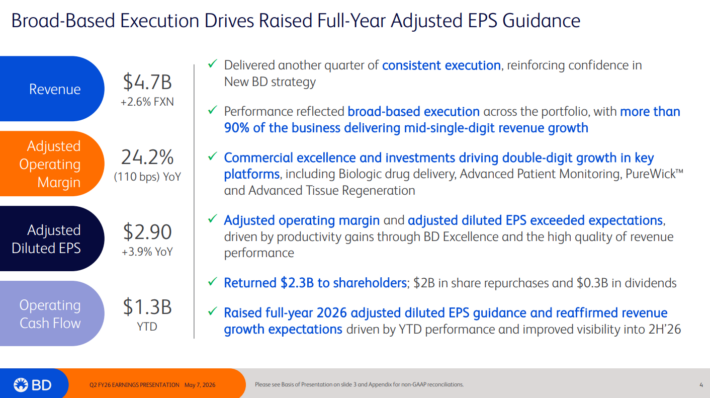
On May 7th, 2026, BDX released earnings results for the second quarter of fiscal year 2026.
Source: Investor Presentation
For the quarter, revenue grew 5.2% to $4.7 billion, which was $30 million better than expected. Adjusted earnings-per-share from continuing operations equaled $2.90, which was up from $2.79 in the prior year and was $0.13 ahead of estimates.
Medical Essentials grew 4.7% to $1.65 billion as gains in U.S. Vascular Access Management and the BD Vacutainer portfolio were only partially offset by sales weakness in China. Connected Care was up 4.9% to $1.12 billion due to strength in Smart Recovery and modest growth in U.S. Infusion. BioPharma was higher by 2.5% to $575 million as double-digit growth in Biologics was offset by lower demand for vaccines. Interventional increased 7.3% to $1.36 billion due to higher demand for Pure Wick, Infection Prevention, and the Rotarex Atherectomy System.
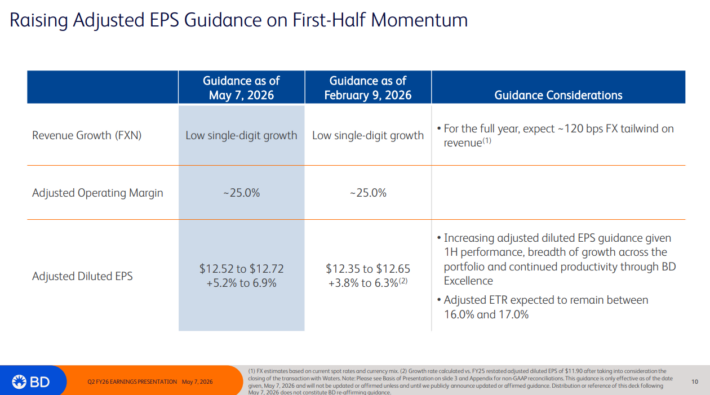
BDX provided an updated outlook for the fiscal year as well.
Source: Investor Presentation
The company now expects adjusted earnings-per-share in a range of $12.52 to $12.72 for the fiscal year, up from $12.35 to $12.65 previously. At the midpoint, adjusted EPS is projected to decline 12.4% for FY 2026. This decline can largely be explained by the separation of the company’s Biosciences and Diagnostic Solutions business. Adjusting for this, the midpoint would represent 6.1% growth from FY 2025.
The company’s acquisition strategy and innovation initiatives are noteworthy. BDX completed its $4.2 billion acquisition of Edwards Lifesciences’ Critical Care Product Group in September of 2024, bolstering its portfolio in advanced monitoring technology.
In recent years, BDX secured FDA approval for its Life Sciences division to collect self-collected cervical cancer screening samples in healthcare settings, thereby enhancing its diagnostic capabilities. Furthermore, BDX expanded its single-cell research offerings by launching the BD Rhapsody™ ATAC-Seq Assay. These strategic moves align with BD’s goals under its BD X2025 strategy, as noted by CEO Tom Polen, who highlighted the company’s drive toward innovation and leadership in the MedTech sector.
Growth Prospects
Healthcare stocks like BDX are typically purchased for their steady long-term growth. BDX is no exception; the company has grown its earnings per share by 5.9% per year over the past decade.
Going forward, we expect the company to post 5% annual EPS growth rate over the next five years. This growth will be driven mainly by the aging U.S. population, which is expected to continue rising demand for healthcare supplies in the future.
U.S. health expenditures are expected to total more than $6 trillion in 2026 and rise to $9 trillion in 2034, representing a 50% increase over this period.
This should be a broad tailwind from which major healthcare manufacturers, such as BDX, will benefit.
BDX continues investing heavily in product innovation, which is critical to the company’s long-term growth objectives.
Becton, Dickinson & Company has aggressively added to its core business. This includes the company’s $24 billion acquisition of Bard in 2017, its $1.525 billion purchase of pharmacy automation solutions provider Parata Systems in 2022, and its $4+ billion acquisition of Edwards Lifesciences’ Critical Care Product Group, among many others.
Further acquisitions and share repurchases over the long term are likely to lead to additional growth in the future.
Additionally, BDX completed its planned separation of its Biosciences and Diagnostic Solutions business, which was then combined with Waters Corporation (WAT), during the most recent quarter. The remaining businesses for BDX will be a pure-play medical technology company that has leading positions in many large and growing end-markets. The Biosciences and Diagnostic Solutions business will also be a leader in its respective areas of operation, with annual sales exceeding $3 billion. Recurring revenue represents more than 80% of this total. The separation was completed on February 9th, 2026.
Competitive Advantages & Recession Performance
Becton, Dickinson & Company has significant competitive advantages, including scale and a vast patent portfolio. These advantages are due to high investment spending.
BDX spends over $1.0 billion each year on research and development. This investment is critical to the company’s ability to generate long-term growth and maintain its industry leadership.
It is clear that its R&D spending has paid off, as the company possesses over 29,000 active patents.
These competitive advantages enable the company to achieve consistent growth, even during economic downturns.
Becton, Dickinson & Company steadily grew earnings during the Great Recession. Becton Dickinson’s earnings-per-share during the recession are as follows:
2007 earnings-per-share of $3.84
2008 earnings-per-share of $4.46 (16% increase)
2009 earnings-per-share of $4.95 (11% increase)
2010 earnings-per-share of $4.94 (0.2% decline)
Becton, Dickinson & Company generated double-digit earnings growth in 2008 and 2009, during the worst years of the recession. It took a small step back in 2010 but continued to grow in the years since, along with the economic recovery.
The ability to consistently grow earnings each year during the Great Recession, arguably the worst economic downturn in decades, is extremely impressive.
The company continued to perform well in 2020, despite the coronavirus pandemic causing the U.S. economy to enter a recession. BDX remained highly profitable during this period and continued its streak of dividend increases.
The reason for its recession resilience is that healthcare patients need medical supplies regardless of the state of the broader economy. This helps maintain steady demand from year to year.
Valuation & Expected Returns
We expect BDX to generate earnings per share of $12.62 this year. As a result, the stock is currently trading at a price-to-earnings ratio of 11.9.
We consider 19.0 to be a valuation for this stock, which is slightly below the 10-year average multiple.
As a result, we view BDX stock as undervalued right now.
If the P/E multiple increases from 11.9 to 19.0 over the next five years, shareholder returns would increase by 9.8% annually.
Additionally, dividend and earnings-per-share growth will enhance shareholder returns. BDX shares currently yield 2.8%, which is one of the highest yields in the last decade. We expect 5% annual EPS growth over the next five years.
Therefore, BDX stock is expected to generate annual returns of 17.1% over the next five years.
Final Thoughts
Becton, Dickinson & Company is one of the newest members of the exclusive Dividend Kings list. Due to its leading position in the healthcare industry, the company has maintained a dividend growth streak of over 50 consecutive years.
Thanks to the aging U.S. population, the company is expected to benefit from this long-term growth catalyst, which should enable BDX to continue raising its dividend for many years to come.
BDX is currently trading at a valuation significantly below our target. We see the potential for annual returns of more than 17% over the next five years, making BDX stock a buy at the present time.
The following articles contain stocks with very long dividend or corporate histories, ripe for selection for dividend growth investors:
Thanks for reading this article. Please send any feedback, corrections, or questions to [email protected].