No Result
View All Result
SUBMIT YOUR ARTICLES
  • Login
Sunday, May 3, 2026
TheAdviserMagazine.com
  • Home
  • Financial Planning
    • Financial Planning
    • Personal Finance
  • Market Research
    • Business
    • Investing
    • Money
    • Economy
    • Markets
    • Stocks
    • Trading
  • 401k Plans
  • College
  • IRS & Taxes
  • Estate Plans
  • Social Security
  • Medicare
  • Legal
  • Home
  • Financial Planning
    • Financial Planning
    • Personal Finance
  • Market Research
    • Business
    • Investing
    • Money
    • Economy
    • Markets
    • Stocks
    • Trading
  • 401k Plans
  • College
  • IRS & Taxes
  • Estate Plans
  • Social Security
  • Medicare
  • Legal
No Result
View All Result
TheAdviserMagazine.com
No Result
View All Result
Home Market Research Economy

The Political Economy of Cruelty: Some Elements

by TheAdviserMagazine
8 months ago
in Economy
Reading Time: 4 mins read
A A
The Political Economy of Cruelty: Some Elements
Share on FacebookShare on TwitterShare on LInkedIn


Why are some people cruel? Why are some governments cruel? Do cruel governments require cruel citizens? I take cruelty to refer to Merriam-Webster’s definition of cruel as “disposed to inflict pain or suffering: devoid of humane feeling.”

An individual is cruel who has a taste for cruelty, i.e. cruelty is an argument of his utility function. He will satisfy this preference when he can do it at a price that he considers acceptable. This is the standard price theory model, which remains useful despite all its critiques: the individual maximizes his utility given his preferences and the constraints he faces.

Why are some governments cruel, whether we are speaking of the Russian government intentionally attacking Ukrainian civilians and torturing prisoners of war, or the American government inflicting pain or distress on immigrants? (Of course, there is a difference in degree between these two cases of cruelty.) It is a matter of incentives: if those who disobey government decrees risk not only punishments but cruel punishments, disobedience is reduced. In short, governments use cruelty when it contributes to the realization of their policies, and no constitutional or other binding constraints exist.

A government (or “the state”) is not a supernatural being or a biological organism, but an organization of individuals who determine policies or enforce them. Cruelty in public policy depends on the costs and benefits of the individual rulers, their agents, and their supporters (at least their important supporters). A cruel government is made of, or supported by, cruel individuals, but the process of public choice may increase the extent of cruelty.

For one thing, the cruelty of a government will increase through selection. Individuals with a taste for cruelty will self-select for government roles: politicians, prosecutors, security personnel, torturers, etc. A government known for its cruelty will attract more cruel rulers and servants—which is related to Friedrich Hayek fear of the rule of the worst (see his 1944 book The Road to Selfdom; see also my review of this book).

Cruelty will likely increase as political rulers discover that hatred can be used to further their ambitions. Scapegoats, preferably unarmed and defenseless, are useful for a politician to both explain away his failures and enflame his supporters. Propaganda can present hated or to-be-hated minorities as “the worst of the worst” or “animals.” The more the rule of law has been compromised (at the limit, up to the aphorism attributed to Lavrentiy Beria, Stalin’s secret police chief, “Show me the man and I’ll find you the crime”), the more we would expect cruelty to follow hatred.

Economist Edward Glaezer modeled the supply of hatred by politicians and the demand for it by voters. In his model, the supply of hatred depends on the existence of minority groups or “out-groups” that can be turned into scapegoats (the Blacks not so long ago, the immigrants today) and thus help “entrepreneurs of hate” in political competition. Other things being equal (including the individuals’ taste for cruelty), the demand for hatred is favored by “citizens’ willingness to accept false hate-creating stories [as] determined by the costs and returns to acquiring information” (Edward L. Glaezer, “The Political Economy of Hatred,” Quarterly Journal of Economics, Vol. 120, No. 1 [February 2005], pp. 45-86). Since the typical citizen’s probability of changing the result of an election is infinitesimally small and the cost of political information remains very high—despite or because of social media—the voter will remain rationally ignorant and tend to hate the people his political tribe hates.

Constitutions, norms (morals), religion (or at least certain forms of religion), trade, and other soft habits of civilization (les mœurs douces) can act as constraints to cruelty. They decrease the demand for it or limit its supply. In his book The Problem of Political Authority (see my review), philosopher Michael Huemer observes that, over a certain period of time, mores have become softer, more respectful of individual dignity, and less cruel. Political authorities may have helped but, past a certain point, the constraints on them can collapse, perhaps suddenly like an avalanche. Totalitarian regimes illustrate this. The North Korean or Russian states are not less cruel than political authorities in the High Middle Ages. Past a certain point, the state may contribute not to civilizing mores but, on the contrary, to fueling cruelty.

Cruel governments don’t require cruel people or at least not a majority of them, and perhaps only a small proportion. Many factors explain that. First, a government can contribute to making its subjects cruel through political hatred, propaganda, and selection (pulling the cruel to the top), as suggested above. Second, it appears easy to be cruel only toward foreigners or domestic minorities whose support the government doesn’t need. Professor Rudolph Rummel of the University of Hawaii estimated that, during the 20th century, states killed millions, if not hundreds of millions, of their own citizens, excluding interstate wars. Third, let’s not forget the Condorcet paradox: in a democratic society, an electoral majority can very well “prefer” the rule of law to despotism, despotism to poverty, poverty to cruel government, but then cruel government to the rule of law—as revealed if and when the latter alternative is the one put to the vote.

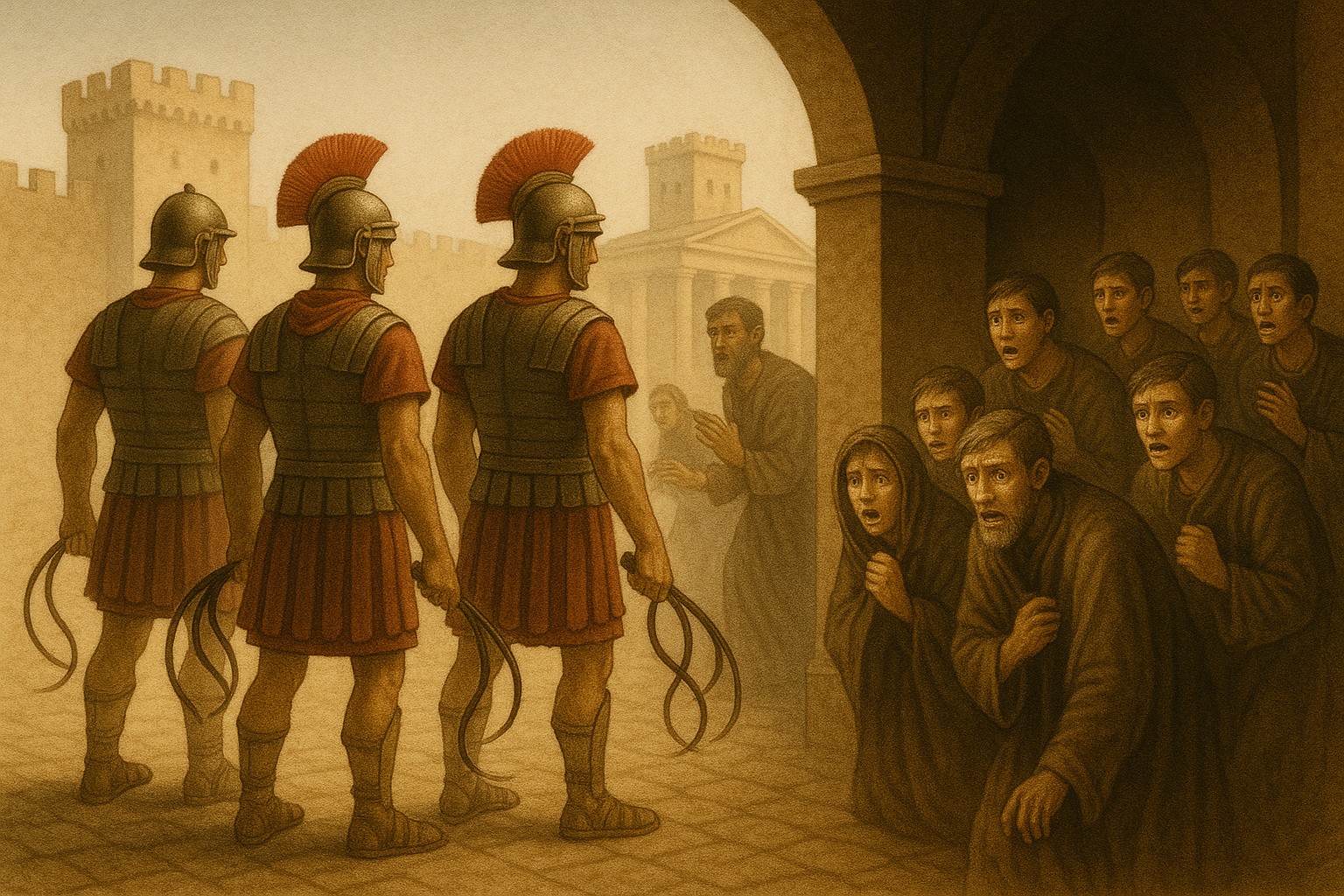
Finally, note that political cruelty is a boomerang. Nothing guarantees the demanders of cruelty that the cruel enforcers of their demand will always only target others. The brutes live among the people. The Roman legions are stationed in Rome.

******************************

The Roman legions in Rome, viewed by ChatGPT

The Roman legions in Rome, as viewed by ChatGPT (with some anachronisms)


Source link

Tags: CrueltyeconomyElementsPolitical
ShareTweetShare
Previous Post

Why Fall 2025 is the Ideal Time to Buy a House

Next Post

Ending a War That Never Should Have Started

Related Posts

edit post
Links 5/3/2026 | naked capitalism

Links 5/3/2026 | naked capitalism

by TheAdviserMagazine
May 3, 2026
0

Do you believe in guardian angels… pic.twitter.com/9J8NTjVWbJ — Science girl (@sciencegirl) April 21, 2026 New Lithium-Plasma Engine Passes Key Mars...

edit post
The Justice Department Indicts the Ministry of Love

The Justice Department Indicts the Ministry of Love

by TheAdviserMagazine
May 2, 2026
0

One of the problems with trying to police “hate” is that it gives the Thought Police an incentive to persecute...

edit post
Government Regulations Create Monopolies and Stifle Competition

Government Regulations Create Monopolies and Stifle Competition

by TheAdviserMagazine
May 2, 2026
0

From our freedom to use or transform our private property emerges the freedom to trade it with anyone we choose....

edit post
Two Important Graphs and Rick Rule

Two Important Graphs and Rick Rule

by TheAdviserMagazine
May 2, 2026
0

On the latest episode of Minor Issues, Mark Thornton opens with a detailed analysis of the gold correction. Is the...

edit post
Links 5/2/2026 | naked capitalism

Links 5/2/2026 | naked capitalism

by TheAdviserMagazine
May 2, 2026
0

The Canterbury Commute Dead Language Society (Micael T) We’ve Been Getting the Ancient Greeks All Wrong Hedgehog Review (Micael T)...

edit post
Iran War: Trump Leans Towards Another Attack on Iran as More Weapons Arrive; Further Confirmation of US Base Damage in Theater; More on War Cost; El Niño as Famine Multiplier

Iran War: Trump Leans Towards Another Attack on Iran as More Weapons Arrive; Further Confirmation of US Base Damage in Theater; More on War Cost; El Niño as Famine Multiplier

by TheAdviserMagazine
May 2, 2026
0

There was some hope yesterday after Vladimir Putin called Donald Trump to give an unusually explicit warning against attacking Iran...

Next Post
edit post
Ending a War That Never Should Have Started

Ending a War That Never Should Have Started

edit post
Axon Enterprise (AXON) Continued Its Robust Performance in Q2

Axon Enterprise (AXON) Continued Its Robust Performance in Q2

  • Trending
  • Comments
  • Latest
edit post
Florida Warning: With Senior SNAP Benefits Averaging 8/Month, Thousands Risk Losing Assistance in 2026

Florida Warning: With Senior SNAP Benefits Averaging $188/Month, Thousands Risk Losing Assistance in 2026

April 27, 2026
edit post
Tax Flight Accelerates In Massachusetts

Tax Flight Accelerates In Massachusetts

April 6, 2026
edit post
The Stevia Loophole Why Some Sweetened Drinks are Still SNAP-Legal While Others are Banned in Texas

The Stevia Loophole Why Some Sweetened Drinks are Still SNAP-Legal While Others are Banned in Texas

April 4, 2026
edit post
10 Cheapest High Dividend Stocks With P/E Ratios Under 10

10 Cheapest High Dividend Stocks With P/E Ratios Under 10

April 13, 2026
edit post
Exclusive: America’s largest Black-owned bank launches podcast with mission to unlock hidden shame holding back generational wealth

Exclusive: America’s largest Black-owned bank launches podcast with mission to unlock hidden shame holding back generational wealth

April 29, 2026
edit post
I Replaced My K Salary with 2 Real Estate Deals Per Year

I Replaced My $80K Salary with 2 Real Estate Deals Per Year

April 6, 2026
edit post
Building The Human Foundation Of The AI-Powered Enterprise

Building The Human Foundation Of The AI-Powered Enterprise

0
edit post
Chinese court rules firms can’t lay off workers on AI grounds

Chinese court rules firms can’t lay off workers on AI grounds

0
edit post
Two Important Graphs and Rick Rule

Two Important Graphs and Rick Rule

0
edit post
A tax guide for Canadians with disabilities

A tax guide for Canadians with disabilities

0
edit post
Crypto, AI Super PACs Flood Midterms As Poll Finds Most Americans Distrust Both Industries

Crypto, AI Super PACs Flood Midterms As Poll Finds Most Americans Distrust Both Industries

0
edit post
Israeli startups raised .3b in April

Israeli startups raised $1.3b in April

0
edit post
Chinese court rules firms can’t lay off workers on AI grounds

Chinese court rules firms can’t lay off workers on AI grounds

May 3, 2026
edit post
Gavin Newsom issues ‘final warning’ amid California’s dire housing crisis — what’s at stake for millions of residents

Gavin Newsom issues ‘final warning’ amid California’s dire housing crisis — what’s at stake for millions of residents

May 3, 2026
edit post
Crypto, AI Super PACs Flood Midterms As Poll Finds Most Americans Distrust Both Industries

Crypto, AI Super PACs Flood Midterms As Poll Finds Most Americans Distrust Both Industries

May 3, 2026
edit post
Monthly Dividend Stock In Focus: Permian Basin Royalty Trust

Monthly Dividend Stock In Focus: Permian Basin Royalty Trust

May 3, 2026
edit post
Israeli startups raised .3b in April

Israeli startups raised $1.3b in April

May 3, 2026
edit post
I spent a decade selling homes to the ultra-wealthy. What I saw explains the housing market’s nepo problem

I spent a decade selling homes to the ultra-wealthy. What I saw explains the housing market’s nepo problem

May 3, 2026
The Adviser Magazine

The first and only national digital and print magazine that connects individuals, families, and businesses to Fee-Only financial advisers, accountants, attorneys and college guidance counselors.

CATEGORIES

  • 401k Plans
  • Business
  • College
  • Cryptocurrency
  • Economy
  • Estate Plans
  • Financial Planning
  • Investing
  • IRS & Taxes
  • Legal
  • Market Analysis
  • Markets
  • Medicare
  • Money
  • Personal Finance
  • Social Security
  • Startups
  • Stock Market
  • Trading

LATEST UPDATES

  • Chinese court rules firms can’t lay off workers on AI grounds
  • Gavin Newsom issues ‘final warning’ amid California’s dire housing crisis — what’s at stake for millions of residents
  • Crypto, AI Super PACs Flood Midterms As Poll Finds Most Americans Distrust Both Industries
  • Our Great Privacy Policy
  • Terms of Use, Legal Notices & Disclosures
  • Contact us
  • About Us

© Copyright 2024 All Rights Reserved
See articles for original source and related links to external sites.

Welcome Back!

Login to your account below

Forgotten Password?

Retrieve your password

Please enter your username or email address to reset your password.

Log In
No Result
View All Result
  • Home
  • Financial Planning
    • Financial Planning
    • Personal Finance
  • Market Research
    • Business
    • Investing
    • Money
    • Economy
    • Markets
    • Stocks
    • Trading
  • 401k Plans
  • College
  • IRS & Taxes
  • Estate Plans
  • Social Security
  • Medicare
  • Legal

© Copyright 2024 All Rights Reserved
See articles for original source and related links to external sites.