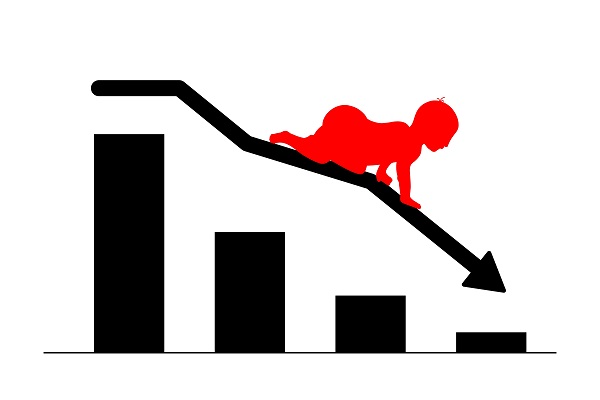
Russia is now advising psychological counseling for women who do not intend to have children, which is precisely the type of response governments default to when they refuse to confront economic reality. They search for cultural or emotional explanations when the issue is economical.
Russia’s fertility rate has fallen to roughly 1.4 children per woman, well below the 2.1 replacement level, and total births have declined to near post-Soviet lows at just over 1.2 million annually. This decline has been persistent, not cyclical, and the population is aging rapidly as deaths continue to exceed births. At the same time, the war has removed a significant portion of young men from the population.
The same pattern is unfolding across all developed economies. Europe’s fertility rate is now near 1.3. Spain and Italy are closer to 1.1. Germany is around 1.4. France, once the exception, has fallen sharply and recently recorded more deaths than births for the first time in decades. Japan has been below replacement for years and continues to contract. Even countries that implemented aggressive family subsidies, such as Norway and Hungary, have failed to reverse the trend.
Globally, fertility has collapsed from more than 5 children per woman in the 1960s to just above two today, and the developed world is already well below replacement. The common explanation offered by governments is psychological or social. They speak of changing values, delayed adulthood, or lifestyle preferences. That explanation collapses under scrutiny because it ignores the economic structure that determines behavior.
People do not make long-term commitments, such as having children, without confidence in their financial future. Children represent the largest long-term investment a household can make. When confidence declines, that investment is postponed or abandoned.
At the same time, dual-income households became the norm not by choice but by necessity. A single income no longer supports a family in most developed economies. This fundamentally changes having children because both parents must remain in the workforce to maintain financial stability. Long ago, children helped to secure a family’s financial future, but the opposite rings true today.
Russia’s situation simply reflects these dynamics in a more concentrated form. Economic uncertainty, war, sanctions, and structural inefficiencies amplify the same forces present elsewhere. When surveys show that a large percentage of women do not plan to have children in the near term, that is not a psychological condition. It is a rational response to economic instability amid war. Women in Russia must now face the harsh reality that their husbands will face a compulsory draft, and they will be left raising children alone.
Historically, birth rates rise during periods of expansion and confidence. The post-World War II baby boom occurred because housing was affordable, employment was stable, and future prospects were positive. The economic structure supported family formation. Today, the structure works in the opposite direction. Housing costs, taxation, childcare expenses, and job insecurity create an environment in which the cost of raising children exceeds the perceived benefits. Governments attempt to offset this with subsidies, but those programs do not address the core issue, whixh is the declining return on productive activity relative to cost.
This is why policies focused on incentives have failed. Hungary introduced substantial financial benefits for families. Norway expanded welfare support. France has long provided family subsidies. None of these measures reversed the long-term decline because they do not change the underlying economic equation.
The demographic consequences are significant. A declining birthrate leads to a shrinking workforce, increasing dependency ratios, and pressure on pension systems. Governments respond by raising taxes or increasing borrowing, which further reduces the net income available to working households. This creates a feedback loop that reinforces the decline.
When confidence in the future declines, long-term investments decline. Children are the most fundamental long-term investment in any society. The decline in birth rates is therefore not a social anomaly but a direct reflection of economic confidence. Russia proposing psychological counseling illustrates how far removed policy responses have become from reality. This is not a question of convincing people to want children. It is a question of creating an economic environment where having children is viable.