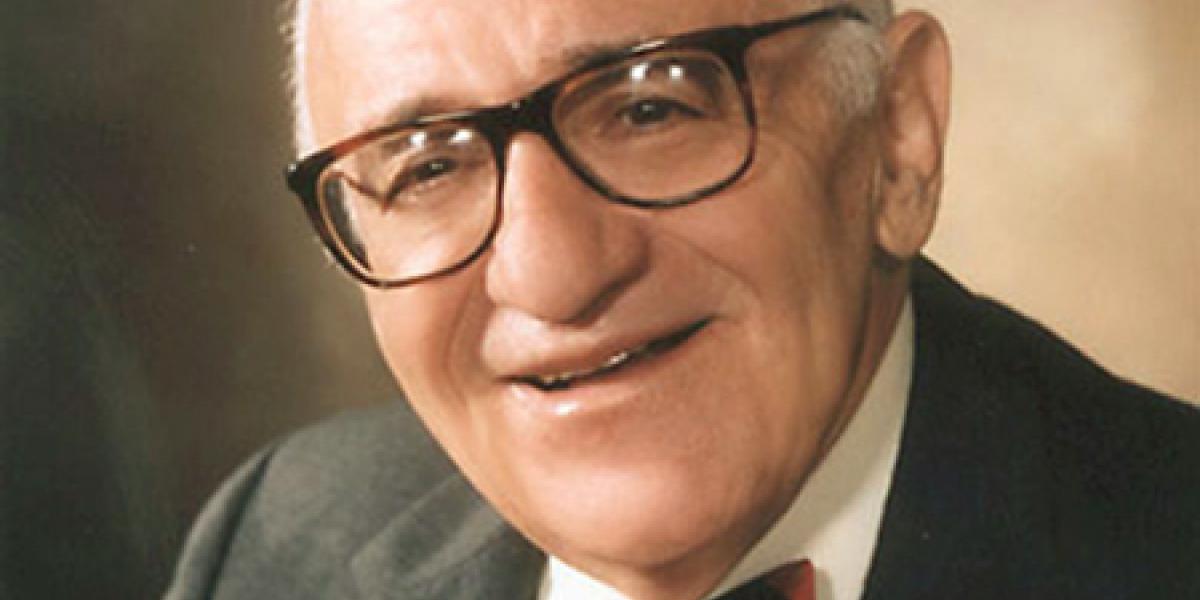
It is often observed that Rothbard’s political opinions were controversial, especially in his later years when he forged an alliance with paleo-conservatives. He defended states’ rights and saluted the heroes of the South—Jefferson Davis, Robert E. Lee, Stonewall Jackson, and Nathan Bedford Forrest—and that is certainly controversial. So is the fact that, as a student at Columbia, he joined the Strom Thurmond Society, and throughout his life he consistently opposed what he called phony civil rights.
But it does not suffice to characterize Rothbard’s political analysis as controversial. That would be to do him a grave disservice. It is also important to note that his views were always rooted in the defense of liberty, and that he never abandoned his principles. In his comment on how Alan Greenspan abandoned his principles in a bid to ingratiate himself with the establishment, David Gordon observes that,
In their attitude toward compromise, Greenspan is the polar opposite to Murray Rothbard. Rothbard could have tailored his views to win the favor of Arthur Burns, who was a family friend, but he refused to do so. He never abandoned his principles.
This is true not only of his economic principles, but also of his political principles. Rothbard’s political views were not merely random, reactionary, or contrarian. His aim was not simply to provoke controversy or inspire populism, in the manner of a shock jock. He did not speak loosely or thoughtlessly, with no concern for the ethical implications of what he said.
Rothbard certainly was known as a “happy warrior” with a delightfully witty and humorous turn of phrase, but it would be wrong to assume that this means he was some sort of political jester who attached no significance to fundamental principles of justice in his political analysis. Rather, his views were consistently grounded in the philosophical principles he outlined in The Ethics of Liberty.
In his introduction to that treatise, Hans-Herman Hoppe explains that Rothbard did not forget or abandon his principles when discussing specific political problems. His philosophy was not merely academic or theoretical, bearing no relation to his discussion of real-world problems.
Hoppe describes the Rothbard-Rockwell Report as “the main outlet of Rothbard’s political, sociological, cultural and religious commentary” during the years in which it was published, adding that the essential principles underpinning the analysis in RRR, “were already contained in his earlier treatise. In distinct contrast to Nozick, Rothbard did not change his mind on essential questions.”
Therefore, it is clear that Rothbard did not abandon his philosophical principles in his commentary on contemporary politics. On the contrary, Hoppe highlights the consistency of these principles in Rothbard’s thought:
Indeed, looking back over his entire career, it can be said that from the late 1950s, when he had first arrived at what would later become the Rothbardian system, until the end of his life, Rothbard did not waver on fundamental matters of economic or political theory. Yet owing to the long and intensive work in the history of economic and political thought, a different thematic emphasis became apparent in his later writings, most noticeably in the several hundred articles contributed during the last years of his life. Apart from economic and political concerns, Rothbard increasingly focused his attention on and stressed the importance of culture as a sociological prerequisite of libertarianism.
Hoppe explains that Rothbard did not see these principles as merely a set of take-it-or-leave-it suggestions, or merely a set of relevant factors that could usefully be deployed in resolving ethical problems. Nor is Rothbardian ethics merely “an analysis of the semantics of normative concepts and discourse” as had previously been the norm for discussions of ethics.
Rather, The Ethics of Liberty offers a systematic development of his political philosophy, which is based on an “axiomatic-deductive” methodology. The aims and methodology of The Ethics of Liberty are explained by Hoppe:
Libertarianism as developed in The Ethics of Liberty was no more and no less than a political philosophy. It provided an answer to the question of which actions are lawful and hence many not be legitimately threatened with physical violence, and which actions are unlawful and may be so punished.
The deep roots of Rothbard’s philosophy allowed him to remain steadfast when analyzing political problems. As Hoppe explains, Rothbard grounded his philosophy in “the notion of private property in the works of the late Scholastics and, in their footsteps, such ‘modern’ natural-rights theorists as Grotius, Pufendorf, and Locke,” in “old, inherited truths.”
Therefore, we must look to the philosophy of natural rights, to the principles of property and self-ownership, to understand the meaning of Rothbard’s conceptual framework—his “unapologetic use of the language of natural rights.”
Understanding Rothbard’s philosophy is not a simple matter of consulting the dictionary and debating our different views of what we think “property rights” should mean. The dictionary tells us that property means “the exclusive right to possess, enjoy, and dispose of a thing.” This is indeed the concept of property that undergirds the common law, but that, by itself, does not tell us what is just or ethical. That is indeed the whole point of Rothbard’s theory of ethics—he argues that there is more to justice than mere procedural fairness or efficient tradeoffs.
To highlight the importance of Rothbard’s political philosophy, Hoppe contrasts Rothbard as a “systematic thinker” with Robert Nozick as a conjectural, “unsystematic, associationist, or even impressionistic thinker.” Nozick was exploratory and “non-committal,” viewing his ideas more in the nature of tentative suggestions worth thinking about. By contrast, Rothbard’s political philosophy is not merely a set of “tentative conjectures and open questions.” Hoppe explains:
Ethics, or more specifically political philosophy, is the second pillar of the Rothbardian system, strictly separated from economics, but equally grounded in the acting nature of man and complementing it to form a unified system of rationalist social philosophy.
Rothbard was not merely indulging in general speculation over the nuances of words like “justice” and “liberty” with which all philosophers grapple in different ways. He did not regard his ethical principles as mere suggestions to which he was not particularly committed and might readily abandon if it proved to be politically expedient to do so. On the contrary, he set out principles by which we may ascertain what is “morally justified and correct,” and he held to those principles until his untimely death.
Hoppe emphasizes that Rothbardian principles stand the test of time precisely because they are based on a systematic foundation:
Even if modern academics, freed of the obligation of having to provide a justification for their activities, can engage in unsystematic and open-ended “conversation,” real men, and especially successful men, have to act and think systematically and methodically and such planning and future-oriented low-time-preference people also will not likely be satisfied with anything but systematic and methodical answers to their own practical moral concerns.
It follows that the search for an explanation for Rothbard’s political views must begin with an examination of his own philosophical principles. For example, Rothbard’s alliance with Southern conservatives, and his expressed admiration for John Randolph of Roanoke and John C. Calhoun, is not some kind of careless departure from his own principles—it is consistent with his principled defense of states’ rights. On the question of defending states’ rights, Hoppe observes,
And while every state, small or large, violates the rights of private-property owners and must be feared and combated, large central states violate more people’s rights and must be feared even more… Hence, a libertarian, as his second-best solution, must always discriminate in favor of local and against central government…
This does not, of course, mean that Rothbard was infallible or never to be criticized or disagreed with. That much should go without saying. Nor does it mean that his political philosophy contains no ambiguities and can only be interpreted in one way. What it does mean, as Hoppe points out, is that Rothbard’s principles must be taken seriously in understanding his political thought.
Rothbard’s philosophical principles cannot simply be dismissed as irrelevant to his political views, much less by means of ad hominem attacks directed at his personality. His system of ethics is foundational and fundamental to his political analysis. As Hoppe explains:
In accordance with the tradition of rationalist philosophy [Rothbard] merely insisted that axiomatic-deductive arguments can be attacked, and possibly refuted, exclusively by other arguments of the same logical status.