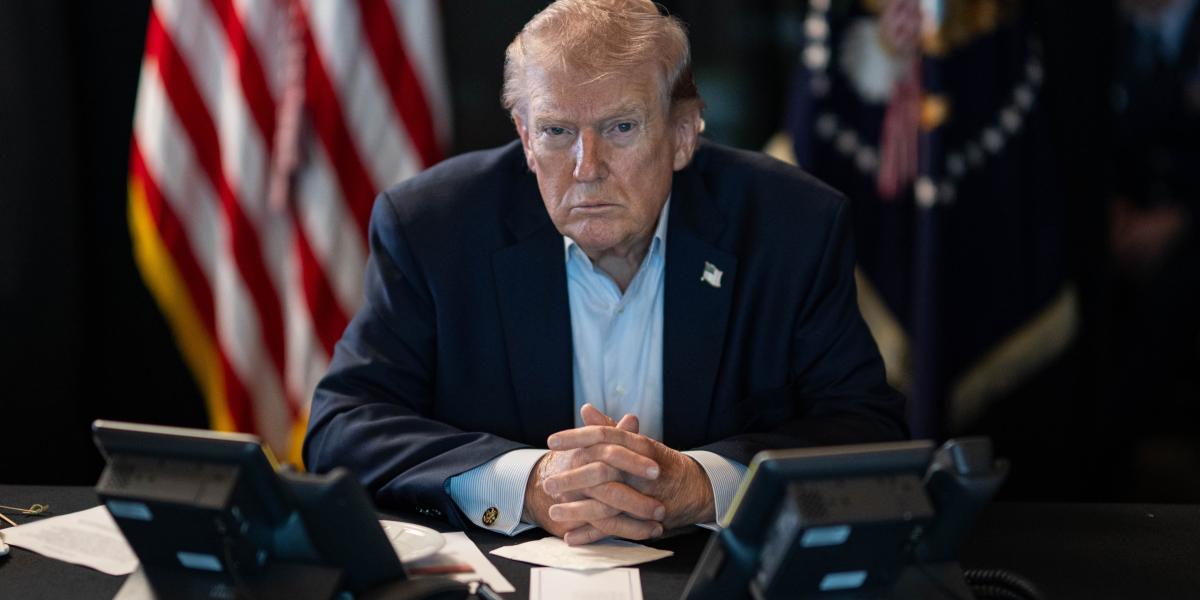
After Trump ordered this major joint US-Israeli air campaign on Iran a week and a half ago, several politicians, political commentators, and public figures heaped praise on the president for the “remarkable courage” he showed to finally take on the Iranian regime.
To capitalize on and utilize all the praise, the White House cobbled together and published a long document full of quotes celebrating how great Trump was for doing this. It included members of Congress like Tom Cotton, Lindsey Graham, Rick Scott, and David Rouzer lauding Trump for his courage and conviction in launching the strikes. It also featured commentators like Marc Thiessen, Roger Zakheim, Hugh Hewitt, and Miad Maleki commending Trump’s “historic vision,” or willingness to do what no other American president has for 47 years and remove the Iranian regime from power.
Additionally, perhaps the two most vocal media figures who had agitated for this war—Mark Levin and Ben Shapiro—leaned into the flattery in the hours after the strikes. Shapiro called Trump “the most courageous commander-in-chief in modern American history.” And Levin compared the president to Churchill and predicted we’d be talking about Trump “for centuries” as a result of his decision to launch this war.
All these characterizations already look a bit antiquated after Trump quietly dropped his initial stated goal of helping the Iranian people take over their government. But, especially as the price of oil has risen, the administration has continued to use this whole conflict to present Trump as a bold, decisive, and courageous president who is uncharacteristically willing to endure short-term economic, military, and political hardship in order do what is necessary to make the world a safer and more prosperous place for future generations in America and across the globe.
That is nonsense. Launching this war was not a courageous move, if anything it was the opposite.
For decades now, this country has been held hostage by an ever-expanding, wealth-draining, conflict-amplifying warfare state. It’s the result of a couple of historical factors that came together to ensure that it would not only exist but be very difficult to contain, much less cut back.
The first was the growth of the federal bureaucracy. Everyone knows that, in the early days of the country, the federal government looked very different. It was incredibly small and largely irrelevant to the daily lives of the American people, at least compared to today. And, notably, the people who worked for the federal government were almost entirely either elected or appointed directly by elected officials. But that has since changed.
The legal seeds for that transformation were planted in the late 1800s, when so-called “reformers” absurdly took advantage of the fact that one of the delusions of the deranged man who had killed President James Garfield was that he was about to be appointed as an ambassador to some European country to characterize him as a “disappointed office-seeker.” It was dangerous, these reformers reasoned, to have so many potential disappointed office-seekers every time an election happened, so better to do away with the offices to be sought.
The result of that campaign was the Pendleton Act of 1883, which put heavy limits on the changes elected executive officials could make to the unelected parts of the government. It created, in effect, a separate class of permanent bureaucrats that would continue to make up the so-called “civil service” regardless of who voters sent to DC.
Like most government powergrabs, this at first looked like a small—almost trivial—legal technicality that barely altered anything. But that changed as the world became more bureaucratic. As James Burnham and others have written extensively about, this bureaucratization was a broader trend that affected all parts of society in the early twentieth century.
But specifically when it came to the American federal government, the permanent bureaucratic “civil service” was dramatically built up by President Franklin Roosevelt, first with his various New Deal programs during the Depression and then as the entire nation was mobilized for war during WWII.
But remember, these bureaucracies were built up in a legal system that protected them from the changing attitudes of voters. Meaning that, as it expanded, the interest of the “civil service” had also shifted from advancing the ideologies of politicians and voters to protecting its own interests.
That is the second historical factor that is important to understand. The federal bureaucracy is not some massive group of selfless public servants who somehow operate outside the constraints of human nature—allowing them to be exclusively motivated by the “national interest.” They are people who, like anyone, are interested in their own professional status and job security.
Especially because the bulk of the federal bureaucracy was built up during periods of crisis or to face specific “national challenges,” when those problems eventually went away, the bureaucracy had to scramble to find new problems to justify its existence.
Focusing in on the foreign policy side of the bureaucracy, it should not surprise anyone that—whenever a major conflict or geopolitical rivalry simmered down or went away—there was always some new foreign villain who just so happened to appear right in time to ensure that the entire, colossal “national security” apparatus in DC was still necessary—be it Joseph Stalin, Saddam Hussein, or Vladimir Putin.
So, the institutional incentives and special legal status of the federal bureaucracy all but ensure that the war-making apparatus in DC only ever grows bigger. But there’s obviously more to the story. Because, as I alluded to last week, all this federal power has also—from the beginning—been offered up for sale to whatever interest groups have the money and lobbying ability to steer American foreign policy in a direction that benefits them.
Weapons companies and other “defense” contractors are, of course, very active in lobbying for Washington to expand into new theaters, help allied governments build up their stockpiles, and fund constant upgrades of older weapons systems. But, like the “national security” bureaucracy itself, the weapons industry’s interest in growth is pretty much a constant. As long as America’s war-making apparatus keeps growing and never shrinks, these groups will be happy.
To understand the specific directions and objectives of American foreign policy, you have to look at other interest groups. Groups that lobby, not for blind growth, but for the American government to do specific things abroad. Sometimes large corporations or ideological groups fall into this category, but most are foreign governments—because it’s hard to compete with a lobby that funds itself by taxing an entire population.
So, primarily by pouring money into the pockets of government officials, bankrolling DC “think tanks” that publish policy papers aligning with their objectives, and advertising and networking with media professionals to encourage sympathetic coverage, foreign lobbies, weapons companies, and—to a lesser but still significant extent—domestic industry and ideological interest groups work to steer Washington’s enormous warmaking apparatus to their own advantage.
This setup guarantees that, rather than serving the interest of the American people, Washington’s foreign policy is primarily—if not exclusively—aimed at serving the interest of foreign lobbies and domestic interest groups.
I take the time to lay all this out because it’s important to recognize that the problems with American foreign policy are deeply systemic. This whole massive warfare state—that is doing its best to avoid or prevent any kind of meaningful peace that would render it obsolete, primarily by stoking conflicts and launching wars that benefit specific lobbies—was not initially built up with noble intentions and then corrupted later by a few bad actors. It’s the predictable outcome of specific policies. Policies that can be repealed.
But repealing them isn’t easy. Not because it’s complicated or impossible to get voters to support. But because to do so you have to face down countless interest groups with deep pockets who together are making trillions of dollars off of American wars and a massive network of shadowy “national security” and intelligence officials—many of whom have, by the way, demonstrated a robust willingness to use violence against innocent people if it serves their ends.
In other words, because it takes courage.
As recent history has shown, any presidential candidate who meaningfully speaks out against the entire warfare state, will be framed as a crazy, dangerous, and overall unacceptable candidate by the establishment media and every other group profiting off the racket.
And if a president is in office and tries, in any meaningful way, to roll back any component of the warfare state the establishment will move heaven and earth to stop them and remove them from power—as Trump was subjected to in his first term after occasionally making some sane comments about foreign policy while also trying to repeal legal protections that make it harder to fire unelected bureaucrats.
Trump may have shown flashes of the kind of courage necessary to get us on a better path in his first term. But this war he launched with Iran makes it clear that he, like most presidents, has entirely given in to preserving and expanding this pivotal corner of the swamp he won his elections promising to drain.
Everything about this operation has been textbook Washington foreign policy. It was launched primarily to serve the geopolitical interests of the Israeli government—a foreign government that is exceptionally good at lobbying. It has locked in some massive revenues for the weapons companies we will be forced to pay to rebuild these depleting stockpiles. And it’s ensured that the massive military and intelligence bureaucracy in DC remains “necessary” at current levels for at least the near future.
To be fair, the Washington establishment has not been quite as thrilled about this war as they usually are. But that isn’t because it’s some subversive, anti-establishment endeavor. It’s because, from their perspective, Trump has, at most, charged ahead with it a bit faster than they find prudent.
And that, of course, is greatly understating the problem. Trump charged ahead with a remarkable lack of concern over interceptor stocks, global economic ramifications, the risk to American soldiers, and much much more.
But that is not courage. That is stupidity.
Our accelerating national decline—of which this colossal warfare state is a major contributor—absolutely requires courageous leaders who are uncharacteristically willing to endure short-term political and personal hardship in order to bring about a safer, more prosperous world for future generations. But that in no way describes who Trump is or what he’s done with this new war.