America’s Fatal Leap, 1991–2016By Paul W. SchroederVerso, 2025; 298 pp.
In this issue of The Misesian, we pay tribute to the great libertarian historian Ralph Raico, and in this review, I would like to discuss the views of another historian, one who was most definitely not a libertarian, but whose work Raico knew and respected.
Paul Schroeder (1927–2020) was generally regarded as the greatest American diplomatic historian specializing in Europe: The Transformation of European Politics, 1763–1848 (Clarendon Press, 1994), a long and densely argued book about the Concert of Europe, was his masterpiece. He was not a political activist; as Perry Anderson, to whom we owe a debt of gratitude for collecting the essays found in America’s Fatal Leap, says of Schroeder in the introduction, “He came late to any intervention in current politics, at the age of sixty-five. But when he did, he brought a depth of reflection on them like no other.”
Before we discuss his views, we must address a paradox. Why does Anderson, who is a Marxist (though also a historian of great range and power who has much to teach us, so long as his standpoint is always kept in mind), admire Anderson, whom he describes as someone of conservative temperament? The answer is not far to seek. The dominant theme is that Anderson’s work was “structure,” so he always sought a structural account of historical developments which, while recognizing the importance of contingent events, shows how the developments “fall out” of a system.
Schroeder was decidedly not a Marxist, but he too looked for system and structure. As he saw it, the European powers needed to solve, or at least ameliorate, a problem that threatened their existence. They were independent but closely packed together, and often had conflicting interests. In the seventeenth and eighteenth centuries, this situation led to frequent wars as expansionist states, such as the France of Louis XIV, sought to undermine the unstable peace arrangements made after the Treaty of Westphalia (1648). At the end of the eighteenth century and through the beginning of the nineteenth century, Napoleon’s insatiable ambition again threw Europe into turmoil.
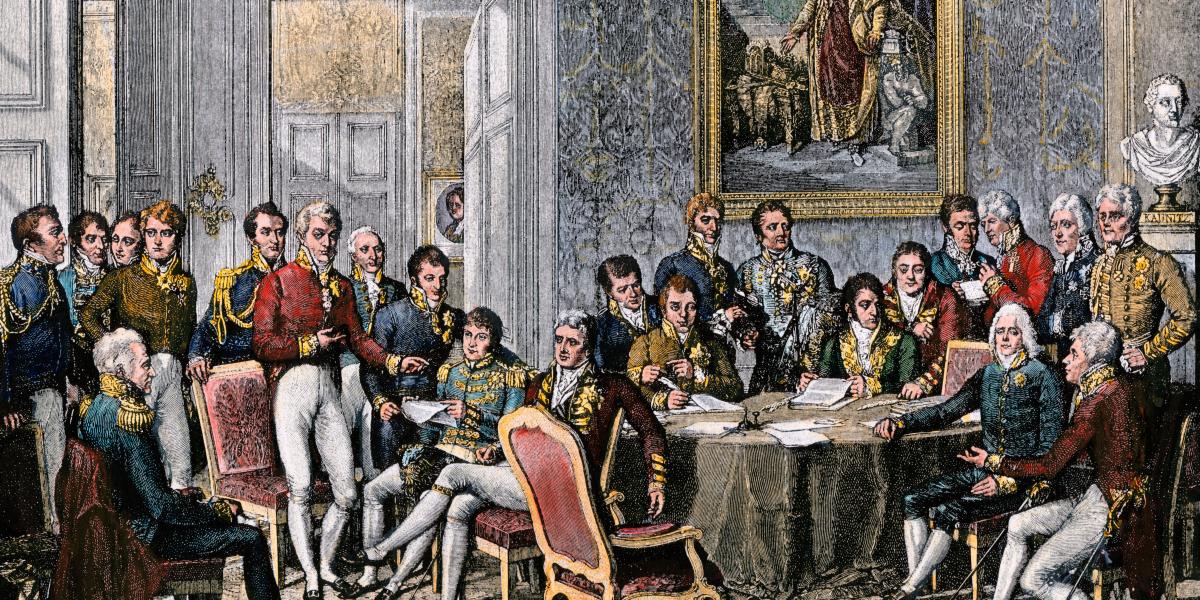
But the way the powers dealt with Napoleon’s defeat offered grounds for hope: The winning coalition included France in the peace settlement and did not seek punitive territorial acquisitions or indemnities. The Congress of Vienna established the Concert of Europe, which sought to resolve disputes between nations peacefully. As Schroeder commented: “The task is that of establishing practices, rules, and institutions that will enable a sizeable number of territorially contiguous, autonomous political units diverse in their nature, aims, and interests to co-exist as separate entities.”
Although wars were not altogether averted, the arrangement was in Schroeder’s view a remarkable success. It is false, he claimed, to say that because America engaged in fewer international wars than nineteenth-century Europe, the latter was more prone to war: “All this makes it possible to think of Europe as still bellicose while America was basically pacifistic — a plausible but very superficial picture. It is like concluding that because fewer automobile accidents occur on the highways of rural Nevada than the streets of Los Angeles or San Francisco, the Nevadans are safer, more law-abiding drivers.” Schroeder delighted in overturning conventional ideas about diplomatic history.
Why is the Concert of Europe relevant to contemporary American foreign policy? Schroeder’s answer is that problems need to be settled by an agreement of the powers concerned because unilateral action often backfires. Though wars cannot be avoided entirely, Schroeder’s position is that they are usually unjust and unnecessary.
Schroeder applied this view to the events of 9/11. He thinks it was a criminal blunder to declare a “war on terror” and to topple the Taliban for harboring al-Qaeda, and to then to overthrow Saddam Hussein. The panic that resulted from the destruction of the World Trade Center needed to be calmed rather than exacerbated by roiling an already aroused public. If one considered the matter calmly, Schroeder opined, it would be evident that terrorist attacks, while not to be dismissed entirely, were not a major problem for Americans.
But what to do about al-Qaeda? (And I have not said “What should we have done?” for a reason.) Schroeder’s response will not surprise you. He thought that the United States should encourage the concerned powers of the Middle East (including Iraq) to come together and devise a way to encourage the Taliban to surrender, to expel al-Qaeda, and to surrender Bin Laden to an international tribunal. To the objection that doing so might take a considerable time his answer was that this was precisely the point. Once people knew that such a process was in motion, panic would dissipate, and they would calm down.
Delay was for Schroeder not an expedient but a principle: “When the great American historian Charles A. Beard was asked at the end of his career what was the most important thing he had learned from history, he replied ‘That the mills of God grind slowly, but they grand exceeding small, and that chickens come home to roost.’ He was an agnostic, and so presumably meant only that that was the way history ultimately worked out, and that long-range systemic causes were the most important. Beard was right.”
As Schroeder saw it, the policy followed by the Bush administration and its successors played into the hands of Bin Laden. He had hoped that the 9/11 attack would provoke the United States into so violent a response that revolutionary movements in the Islamic states would unite not only to fight against America but also to oust the Islamic regimes he thought too moderate. Schroeder remarked: “Try not to get your worst enemies what they want but cannot achieve without your help; or, if you cannot help doing so, at least beware of the danger and try to limit it.”
Schroeder was a master of historical analogies, and he compared the policy he attributed to Bin Laden to the aims of Gavrilo Princip in assassinating Archduke Franz Ferdinand: “Princip’s act was . . . directed against his own fellow revolutionaries and sympathizers; it was intended to force them to do what they were not willing to do—follow the ideology of pan-Serbism and the slogan of ‘Union or Death’ to its logical, and mad, conclusion.”
I should note that Schroeder did not challenge the conventional account that Osama bin Laden’s al-Qaeda bore exclusive responsibility for the terrorist attack, and I shall leave it as an exercise for readers who do not believe this, or at least doubt it—for example, by accepting the theories of David Ray Griffin and others who argue that the attacks were an “inside job” of the Bush administration—to work out how this affects Schroeder’s analysis of American policy.
Schroeder was outraged by the abuse of prisoners at Abu Ghraib and other atrocities that resulted from the American occupation of Iraq. The lies of President Bush and Secretary of Defense Rumsfeld, and their efforts to pass the blame on to subordinate officials, disgusted him. The failure of the American public and Congress to demand a thorough investigation and ouster of the guilty parties manifested a deep-seated flaw in the American character.
Once more Schroeder drew a compelling historical analogy, this time with the efforts of the French army general staff to cover up the forgeries that led to the conviction of Captain Alfred Dreyfus on false charges of German espionage. He displayed his outrage in this powerful passage: “The nineteenth-century Danish philosopher Søren Kierkegaard wrote in an essay that the sign of malfunctioning of the digestive system was the inability to become nauseated or to vomit when eating spoiled food, and that the remedy was to take an emetic.”
Few diplomatic historians have the historical knowledge and the power of analysis evident in Paul Schroeder’s work.