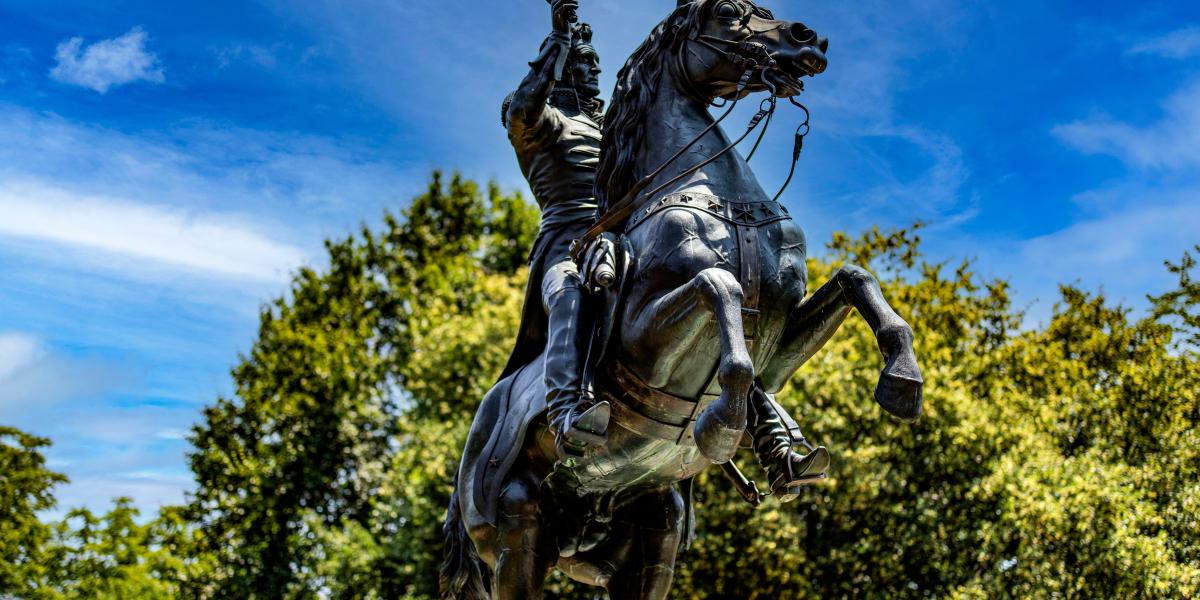
The 250th anniversary of the Declaration of Independence and America’s formal secession from Great Britain will be a fruitful year for studying American history. Scholars will look back on America’s successes and failures and what they mean for the 21st century. After all, we must remember what caused the American economy to thrive and bring prosperity to millions. In this spirit, this article discusses how the United States’ other founding fathers—the Jacksonian Democrats—laid the free-market infrastructure vital for the Industrial Revolution.
The Jacksonian Democrats of the 1830s and 1840s are often forgotten, misunderstood, or downplayed. But the Democratic Party, constructed by the most important libertarian politico of all time—Martin Van Buren—profoundly influenced the contours of the early American economy and set the stage for its rapid growth.
To understand this, it is crucial to study the economic and political history of early America according to how many contemporaries thought of their struggles—as part of a great battle between liberty and power, or between those in favor of a small government that did not provide special privileges to various groups and those in favor of a larger government that disbursed monopoly grants and other forms of cronyism. The Jacksonian movement belonged to the former category. In the late 1820s, Van Buren desired to revitalize Jeffersonian laissez faire principles by producing a “substantial reorganization of the old Republican Party” and center it around the charismatic General Andrew Jackson. Old Hickory agreed with Van Buren and viewed his election in 1828 as a mandate to slash the state (May 15, 1830): “the people expected reform retrenchment and economy in the administration of this government. This was the cry from Maine to Louisiana.”
What were the Jacksonians up against? What system of special privileges did they pledge to combat? They were fighting the American System of Henry Clay, the leader of the (soon to be named) Whig Party. The American System referred to the neo-Hamiltonian program established in the late 1810s and 1820s. It championed a central bank to inflate the money supply and expand credit to favored bankers, manufacturers, transportation companies, and politicians; a protective tariff to make foreign manufactured goods more expensive to the benefit of select domestic textile, iron, and other interests; and lavish federal and state subsidies, public debts, and monopolistic charters to privilege transportation promoters, debt jobbers, and land speculators.
In other words, the American System was a crony racket hoisted upon the American people under the guise of the public interest. To provide one example, the Tariff of 1816 included a twenty-five cent minimum valuation on cotton textiles. This provision—lobbied for by Francis Cabot Lowell of the Boston Manufacturing Company—instituted a minimum duty of 6.25 cents a yard on any imported textile. This blatantly regressive tax drastically raised the actual tariff rate on cheap imported cloth, which helped generate annual dividends of 19 percent for the Boston Manufacturing Company while disproportionately burdening America’s poorest consumers.
Beginning in Jackson’s presidency, over the next two decades the Democrats dismantled the American System and made a serious dent in the disbursement of government privileges. It was by no means a linear or flawless decrease in government intervention, but it was by far the most significant institutional move to the free market in the country’s history.
In the monetary sphere, the Jacksonians eliminated the central bank, “the corrupting monster,” and replaced it with the Independent Treasury. Jackson’s famous veto blasted the Second Bank of the United States’s monopoly federal charter and took “a stand against all new grants of monopolies and exclusive privileges.” The Independent Treasury, which came later in the presidencies of Van Buren and James K. Polk, separated the federal government from the state banks. The Treasury would keep its money in its own vaults and operate on a hard money (specie) basis.
On the state level, after the Panic of 1837 Jacksonians either sought to constrain governmentally-privileged state banks, such as through higher reserve ratios and requiring banks to resume specie payments, or pushed for genuine free banking laws that made it easier to open banks (and not the Whig version that mandated minimum capital requirements and tied the supply of bank notes to government debt). Although the policies the Jacksonians proposed and their struggles with the Whigs differed in each state, the proclamation of Virginia’s Hugh Garland, who wanted “to divorce [banks] entirely from all connection with the government, state and federal—to tear asunder that unnatural connection which has been injurious and corrupting,” captured the spirit of the Jacksonian bank movement.
The Jacksonians also slashed protective tariffs and moved the economy closer to free trade. During the Nullification Crisis, when South Carolina threatened secession over the tariff, Congressmen Polk and other Democrats close to Jackson supported the Verplanck bill, which proposed sharply reducing tariff rates and eliminating the minimum valuation on cotton textiles. Though the Verplanck bill was not the option taken at the time, Jacksonians continued to fight Whigs protectionism until Polk secured the Walker Tariff in 1846.
The Walker Tariff marked an important milestone. With Great Britain’s repeal of the Corn Laws in the same year, transatlantic reformers had succeeded in burying the policy of protectionism. The Cincinnati Enquirer could boast that “the simultaneous triumph of free trade in the United States and Great Britain, whose citizens and subjects comprehend one-sixth of the human race, is the greatest event of our age.”
Jacksonians finished the job by shackling governments’ abilities to subsidize and regulate. Jackson’s veto of the Maysville Road bill in 1830 set the precedent for the federal government to be less involved in financing internal improvements. His use of tariff revenue to pay off the national debt also portended a permanently smaller federal debt burden. Jacksonians’ efforts crystallized in the mid-1840s after the Panic of 1837 when they set the federal government’s spending and indebtedness on downward trajectories.
On the state level, in response to the crushing burden of governments’ debts in the aftermath of the panic, Whigs proposed higher taxes and federal debt assumption. In sharp contrast, Democrats pushed for a combination of default and repudiation. Then, at various state-level constitutional conventions, Jacksonians restricted states’ abilities to borrow and invest in corporations. At these conventions general incorporation laws were also passed, which “were at the core of laissez faire and of Jacksonian thought. The goal was to remove the government from involvement in the formation of corporations by making the benefits of forming a corporation available to all.” General incorporation laws severely restricted the scope of the old charter system of legislature-granted licenses and thereby made it much easier for entrepreneurs to start businesses.
It is important to point out that the Jacksonians’ wholesale demolition of the American System was not without its flaws. In many cases they initially struggled with the appropriate reform after getting rid of a government privilege. For instance, after the Bank veto the Jackson administration decided not to pursue the Independent Treasury but instead shifted the federal money out of the central bank and into multiple state banks. While beneficial for promoting decentralization, like the central bank the so-called pet banks bribed politicians with loans. Or, to provide another example, many Democrats initially opposed only federal subsidies and privileges to banks and other corporations and gleefully provided state largesse in the 1830s. It was not until the failure of these policies and the financial bankruptcies wrought by the Panic of 1837 that Democrats increased the scope and intensity of their laissez faire reforms. “We must,” Churchill C. Cambreleng wrote to Van Buren, “once in ten years be whipped into our principles.”
Despite these and other imperfections, there can be no doubt that the overall ideological thrust of the Jacksonians’ economic program was in favor of liberty and against power and that they succeeded in implementing free market policies. Though the Jacksonian coalition was fatefully sundered by the controversy over Texas annexation and the Mexican War in the mid-1840s, their reforms lived on.
Crucially, the Jacksonians’ dismantling of the American System resulted in a great burst in industrialization and living standards. The economy entered modernity, transitioning from the farm to the city, from artisanal shops to factories, and from canals and turnpikes to railroads. The causal connection between the end of the American System and the Industrial Revolution that began before the Civil War cannot be overstated. To provide a brief overview:
The end of federal regulation of banks and a reduction in privileged state banking monopolies encouraged greater competition and efficiency. The losses of bank failures were very small, around $1.9 million, and the problems that occurred were largely from continued government restrictions, such as prohibitions on interstate banking that reduced banks’ abilities to diversify their investments.
The move to free trade lowered the costs of several crucial inputs the US imported, such as British iron rails for the burgeoning railroad industry. Cheaper inputs, greater competition, and abundant resources caused manufacturing as a share of overall output to actually grow. From 1839 to 1859 manufacturing as a share of commodity output grew from 17 percent to 32 percent.
Restraining the spending and debts of governments and encouraging easier business formation led to more scarce factors of production and savings being allocated toward producing the goods and services that Americans desired. In the new railroad industry, for instance, private funds provided seventy-five percent of the investment by 1860.
It is instructive to compare the two eras, the American System of 1820 to 1840 and the post-American System of 1840 to 1860. In the former, real gross domestic product per capita and real wages for common workers increased by 1 percent and 1.7 percent a year, respectively. But in the second period they grew noticeably faster, by 1.7 percent and 2 percent a year. It was a clear improvement and a sign that America was charging ahead into modernity. And for this accomplishment the overall credit should go to the libertarian Jacksonian movement and the policies they enacted and inspired.
The Jacksonians’ dismantling of the American System provides two valuable lessons for America’s next 250 years. First, the right ideological underpinning and political organization can lead to a meaningful reduction in the size of government. Second, embracing free market policies encourages greater growth and prosperity.
As we reflect on America’s past to better shape its future, we should keep in mind the continual effort required to achieve and maintain freedom. As President Jackson observed:
You must remember, my fellow-citizens, that eternal vigilance by the people is the price of liberty, and that you must pay the price if you wish the secure the blessing. It behooves you, therefore, to be watchful in your states as well as in the federal government.