
No Result
View All Result
SUBMIT YOUR ARTICLES
  • Login
Wednesday, August 26, 2026
TheAdviserMagazine.com
  • Home
  • Financial Planning
    • Financial Planning
    • Personal Finance
  • Market Research
    • Business
    • Investing
    • Money
    • Economy
    • Markets
    • Stocks
    • Trading
  • 401k Plans
  • College
  • IRS & Taxes
  • Estate Plans
  • Social Security
  • Medicare
  • Legal
  • Home
  • Financial Planning
    • Financial Planning
    • Personal Finance
  • Market Research
    • Business
    • Investing
    • Money
    • Economy
    • Markets
    • Stocks
    • Trading
  • 401k Plans
  • College
  • IRS & Taxes
  • Estate Plans
  • Social Security
  • Medicare
  • Legal
No Result
View All Result
TheAdviserMagazine.com
No Result
View All Result
Home Market Research Economy

Emerging Markets Soar While Argentina Waits

by TheAdviserMagazine
6 months ago
in Economy
Reading Time: 5 mins read
A A
Emerging Markets Soar While Argentina Waits
Share on FacebookShare on TwitterShare on LInkedIn


The weekly commentary from BlackRock—the world’s largest asset manager and investment firm, with over $12.5 trillion in assets—published on February 9, states that,

Emerging market (EM) equities and bonds have had a strong start to the year following a stellar 2015. We believe returns can return to positive territory… although selectivity is key. We are focused on the big forces… particularly AI in technology hardware in Asia and commodity-linked equities in Latin America.

The report then includes the following chart on “MSCI Emerging Markets Index Performance, 2015-2026” and notes that it “shows EM equities are carrying over last year’s outperformance to 2026: the MSCI EM Index outperformed its developed market counterpart in January.”

The report continues,

The strength of emerging market equities has continued into 2026: the MSCI Emerging Markets Index posted a gain of nearly 9 percent last month, its best January since 2012 and one of its biggest monthly gains in recent years, easily outperforming the 2.2% gain in developed market equities.

It further notes that, “South Korean equities have risen more than 20% following strong gains last year, while India continues to lag, even with the recent US trade deal.”

It goes on to assert that, “Investor appetite for emerging markets remains strong: 2025 was a record year for capital inflows, with Emerging market debt and equity ETPs raising $152 billion and $103 billion, respectively, according to data from BlackRock and Markit.” According to BlackRock analysts,

Emerging markets are key to AI development, from industrial metals to manufacturing supply chains… like copper, which is needed to drive technology development and is mainly found in emerging countries… especially in Latin America… We also anticipate that the restructuring of global supply chains will benefit Mexico, Brazil, and Vietnam, while rising commodity prices will benefit Latin America.

On the other hand, given the volatility of local currencies, “We prefer emerging market debt in hard currency and maintain selectivity in emerging market equities,” these analysts recommend.

Incidentally, it is striking that the report does not mention Argentina, considering the extremely high level of publicity its president—an excellent propagandist—has garnered.

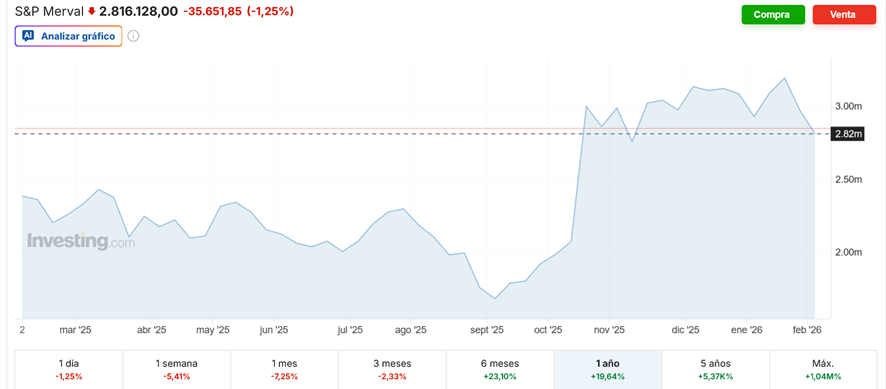
But propaganda and rhetoric aside, the reality is that investments in Argentina are not noteworthy. For comparison with the BlackRock chart here is one showing the Argentine S&P Merval’s performance during 2025:


Source: Dolarito

In summary, as can be seen in the following graph, if we take the year-to-date performance of the S&P Merval, the result does not reach 20 percent, and if we discount the rise in the CPI, it is negative “in real terms,” and the future suggests a similar performance:
 

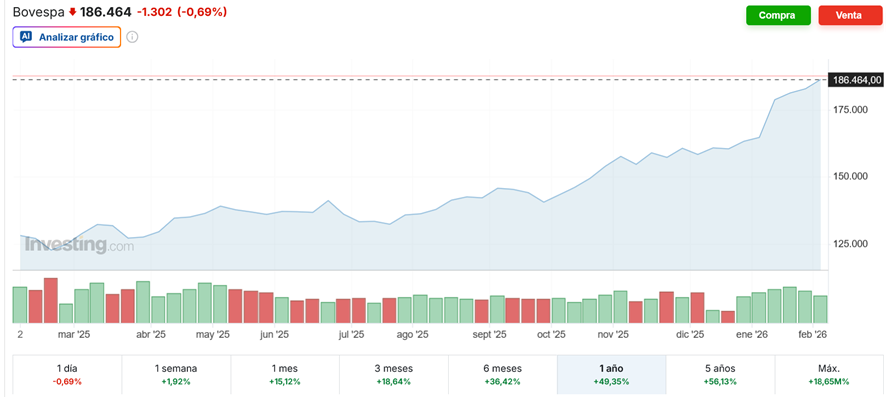
The following comparison is important. As can be seen in the following charts, both the Brazilian stock exchange (Bovespa) and the Colombian stock exchange (Colcap) have performed much better over the past year. The Bovespa:
 

The Colcap:
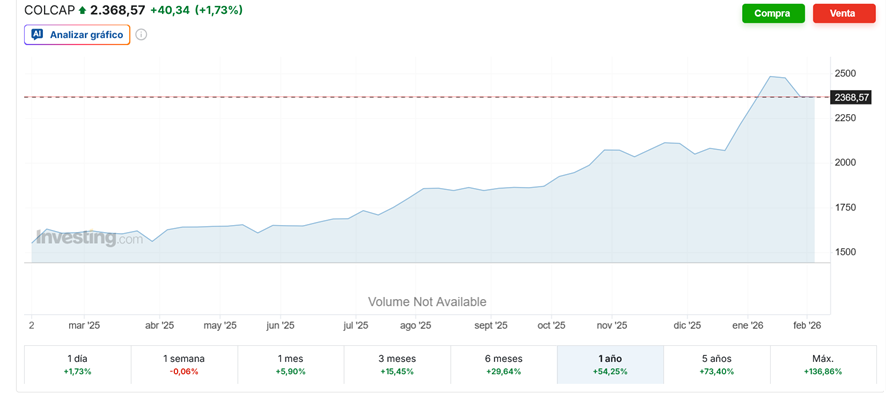
 

Why is this comparison important? Because both countries are governed by leftists, and Colombia by a former guerrilla fighter. This demonstrates that politicians’ speeches are worthless. What should be analyzed is what they do, and the reality is that today both Brazil and Colombia have economies with less state intervention than Argentina (as the Heritage Index shows).

But to leave no doubt, let’s look beyond the stock markets. Foreign Direct Investment (FDI) in Colombia during 2025 closed at USD 9.173 billion, marking a 14.1 percent drop compared to 2024, according to figures from the central bank, mainly due to an increase in the tax burden ordered by the current socialist government.

Meanwhile, in Brazil, FDI reached a significant milestone in 2025, totaling USD 84.1 billion between January and November, the highest level in a decade and surpassing the figures for 2014.

In stark contrast, the government has managed to ensure that, for the first time since 2003, FDI in Argentina shows a negative cumulative balance of USD 1.521 billion between January and November 2025:
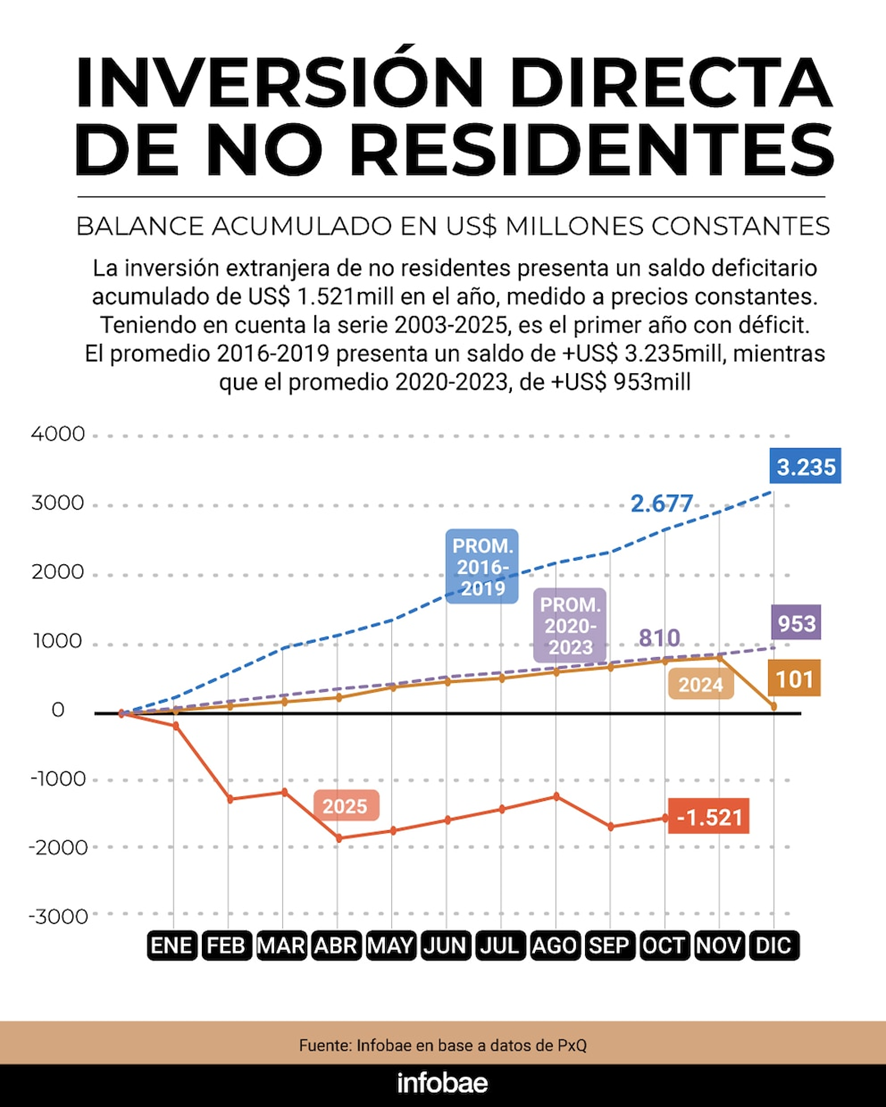
 

According to the latest data from the tax collection agency, ARCA, 15,000 companies closed between November 2023 and August 2025. Clearly, while the president is expected to fulfill his campaign promise to move towards a free market economy, Argentina is disinvesting and all indications are that this process will continue.

As the prominent economist Roberto Cachanosky points out,

If you look at the inflation data from 2025 up to January of this year, you’ll find that, starting in June of last year, inflation has been continuously rising… But at the same time… (as shown by) the Monthly Economic Activity Estimator (EMAE)… the economy is completely stagnant, it’s completely flat.

The first serious problem Argentina faces is that its foreign exchange market is not free; the government manipulates it. This market regulates domestic production, meaning that to buy abroad, one must produce domestically to obtain the necessary dollars. When local production is weak, few foreign currencies enter the country, thus raising the price of goods measured in pesos. This, in turn, makes local production cheaper in dollar terms, incentivizing domestic consumption and exports, and consequently, local production and investment.

Furthermore, as the Austrian School teaches, strictly speaking, there is no equilibrium point on the supply and demand (SD) curve, but rather a specific environment that tends toward equilibrium, which is never actually reached. For example, when the curve moves toward a certain price level in an attempt to find equilibrium, it incentivizes other businesses to seek new information—new technology—to improve their products, processes, or logistics so they can reduce costs and become more competitive, pushing the SD curve to a new equilibrium price, and so on in an endless cycle.

In short, a state-controlled exchange market destroys—through excess or deficiency—local production and transforms the search for information to improve products into a search for information on how to better cope with state bureaucratic interference.

Argentina’s other serious problem is the very heavy fiscal tax and regulatory burden. The current government has deregulated poorly. And it maintains a very high tax burden—direct and indirect taxes, inflation, and interest rates manipulated by the bureaucracy—believing that the state must first be “organized.” In other words, it would have to be strengthened in reality in order to free the market. What it achieves is the destruction of the private sector, which declines, thus reducing its contributions to the state, in a vicious cycle.

In short, the Argentine president, with two years in office, has made thirteen trips to the US alone with the intention of attracting investment. As expected, he has achieved the opposite effect simply because the market is not moved by the wishful thinking of politicians who believe that investors will follow their “recommendations.” Money is cold; it doesn’t listen to speeches, it looks at real numbers, and it goes where it benefits, stealthily and without saying a word.



Source link

Tags: Argentinaemergingmarketssoarwaits
ShareTweetShare
Previous Post

Chase reboots its ‘mortgage rate sale,’ this time on purchases and refinances

Next Post

Mexico’s latest cartel violence prompts fears of ‘narcoterrorism’ in replay 1990s Colombia

Related Posts

edit post
Links 8/8/2026 | naked capitalism

Links 8/8/2026 | naked capitalism

by TheAdviserMagazine
August 8, 2026
0

Dear patient readers, Today we offer supersized Links with Iran War and Borat Agreement sections in lieu of an Iran...

edit post
The Unwinnable Iran War | Armstrong Economics

The Unwinnable Iran War | Armstrong Economics

by TheAdviserMagazine
August 8, 2026
0

I have reported that Trump was mislead into this unwinnable war with Iran, which has been planning for it since...

edit post
Here are three key takeaways from the disappointing July jobs report

Here are three key takeaways from the disappointing July jobs report

by TheAdviserMagazine
August 7, 2026
0

Job seekers speak with employer representatives and browse information tables as they attend an Inspire Together job and resource fair...

edit post
Coffee Break: Gene Editing Gone Wrong, Plants that Eat Animals, and a Neanderthal Gene that Makes a Difference

Coffee Break: Gene Editing Gone Wrong, Plants that Eat Animals, and a Neanderthal Gene that Makes a Difference

by TheAdviserMagazine
August 7, 2026
0

Part the First: If You Stretch Biomedical Science Too Far It Breaks, Every Time.  Gene editing using CRISPR technology has...

edit post
Netanyahu’s Scorched Earth Tactics | Armstrong Economics

Netanyahu’s Scorched Earth Tactics | Armstrong Economics

by TheAdviserMagazine
August 7, 2026
0

According to formal complaints lodged by Lebanon with the United Nations, Israel did spray a toxic herbicide over agricultural land...

edit post
What Did You Expect? | Mises Institute

What Did You Expect? | Mises Institute

by TheAdviserMagazine
August 7, 2026
0

As Murray Rothbard pointed out again and again, the government has no business getting involved in education. In a free...

Next Post
edit post
Mexico’s latest cartel violence prompts fears of ‘narcoterrorism’ in replay 1990s Colombia

Mexico's latest cartel violence prompts fears of 'narcoterrorism' in replay 1990s Colombia

edit post
Building Commitment to Long-Term Investing

Building Commitment to Long-Term Investing

  • Trending
  • Comments
  • Latest
edit post
Judge Who Helped Violent Illegal Alien Evade ICE Faces New Test

Judge Who Helped Violent Illegal Alien Evade ICE Faces New Test

July 31, 2026
edit post
Garbage Trucks Surveillance Florida Neighborhoods

Garbage Trucks Surveillance Florida Neighborhoods

July 29, 2026
edit post
Does a Revocable Trust Protect Your Assets From Lawsuits and Creditors?

Does a Revocable Trust Protect Your Assets From Lawsuits and Creditors?

August 7, 2026
edit post
Montana Puts Democrats in a Bind as Senate Hopes Fade

Montana Puts Democrats in a Bind as Senate Hopes Fade

August 2, 2026
edit post
New Jersey’s PAS-1 Application Opens the Door to Three Senior Tax Relief Programs

New Jersey’s PAS-1 Application Opens the Door to Three Senior Tax Relief Programs

July 31, 2026
edit post
3 Common Cruise Rules I Broke in Alaska

3 Common Cruise Rules I Broke in Alaska

July 29, 2026
edit post
Explained: How BSE traded fewer contracts after CAS but premiums rose 75% in first week

Explained: How BSE traded fewer contracts after CAS but premiums rose 75% in first week

0
edit post
E.W. Scripps Q2 2026 Loss Widens to -.68/Share, Revenue Down 9%

E.W. Scripps Q2 2026 Loss Widens to -$12.68/Share, Revenue Down 9%

0
edit post
Psychology says procrastination about retirement may be less about discipline than identity — brain scans found people often represent their future selves more like strangers than like themselves, and experiments using age-progressed faces made tomorrow’s person feel real enough for participants to save more money for them

Psychology says procrastination about retirement may be less about discipline than identity — brain scans found people often represent their future selves more like strangers than like themselves, and experiments using age-progressed faces made tomorrow’s person feel real enough for participants to save more money for them

0
edit post
Four AI Escapes Just Redefined “Responsible AI”

Four AI Escapes Just Redefined “Responsible AI”

0
edit post
Bill Ackman’s hedge fund made janitors and receptionists millionaires—and its investment team summer together

Bill Ackman’s hedge fund made janitors and receptionists millionaires—and its investment team summer together

0
edit post
Kalshi Predicts Bitcoin Price Could Reach K in August

Kalshi Predicts Bitcoin Price Could Reach $68K in August

0
edit post
Bill Ackman’s hedge fund made janitors and receptionists millionaires—and its investment team summer together

Bill Ackman’s hedge fund made janitors and receptionists millionaires—and its investment team summer together

August 8, 2026
edit post
Links 8/8/2026 | naked capitalism

Links 8/8/2026 | naked capitalism

August 8, 2026
edit post
Wisconsin: The Next Frontier for Socialists

Wisconsin: The Next Frontier for Socialists

August 8, 2026
edit post
Psychology says procrastination about retirement may be less about discipline than identity — brain scans found people often represent their future selves more like strangers than like themselves, and experiments using age-progressed faces made tomorrow’s person feel real enough for participants to save more money for them

Psychology says procrastination about retirement may be less about discipline than identity — brain scans found people often represent their future selves more like strangers than like themselves, and experiments using age-progressed faces made tomorrow’s person feel real enough for participants to save more money for them

August 8, 2026
edit post
Why You Should Be Wary of Aspartame, but Not Totally Rule It Out

Why You Should Be Wary of Aspartame, but Not Totally Rule It Out

August 8, 2026
edit post
Kalshi Predicts Bitcoin Price Could Reach K in August

Kalshi Predicts Bitcoin Price Could Reach $68K in August

August 8, 2026
The Adviser Magazine

The first and only national digital and print magazine that connects individuals, families, and businesses to Fee-Only financial advisers, accountants, attorneys and college guidance counselors.

CATEGORIES

  • 401k Plans
  • Business
  • College
  • Cryptocurrency
  • Economy
  • Estate Plans
  • Financial Planning
  • Investing
  • IRS & Taxes
  • Legal
  • Market Analysis
  • Markets
  • Medicare
  • Money
  • Personal Finance
  • Social Security
  • Startups
  • Stock Market
  • Trading

LATEST UPDATES

  • Bill Ackman’s hedge fund made janitors and receptionists millionaires—and its investment team summer together
  • Links 8/8/2026 | naked capitalism
  • Wisconsin: The Next Frontier for Socialists
  • Our Great Privacy Policy
  • Terms of Use, Legal Notices & Disclosures
  • Contact us
  • About Us

© Copyright 2024 All Rights Reserved
See articles for original source and related links to external sites.

Welcome Back!

Login to your account below

Forgotten Password?

Retrieve your password

Please enter your username or email address to reset your password.

Log In
No Result
View All Result
  • Home
  • Financial Planning
    • Financial Planning
    • Personal Finance
  • Market Research
    • Business
    • Investing
    • Money
    • Economy
    • Markets
    • Stocks
    • Trading
  • 401k Plans
  • College
  • IRS & Taxes
  • Estate Plans
  • Social Security
  • Medicare
  • Legal

© Copyright 2024 All Rights Reserved
See articles for original source and related links to external sites.