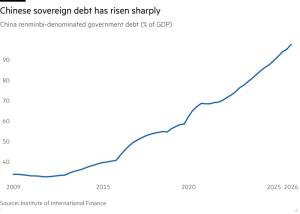
In many emerging and tropical economies, the Austrian business cycle does not appear as a temporary deviation from equilibrium, it becomes a permanent condition. Chronic fiscal deficits, unstable legal frameworks, and recurring monetary expansion are not exceptional responses to extraordinary crises, they are structural features of the political order itself. As a result, the familiar cycle of artificial boom, malinvestment, and correction never fully resolves; it merely reshapes itself, extending its distortions across time.
This persistent imbalance affects not only prices and production, but also the behavior of savers, investors, and families attempting to preserve the value of their accumulated work.
Debt Without Credibility
In such economies, government debt no longer functions as a bridge between present needs and future productivity. It becomes a political instrument, rolled over indefinitely, and increasingly detached from any realistic capacity for repayment through growth.
Sovereign bonds may still offer attractive nominal yields, in fact, they often must. High interest rates are not a reward for prudence, but compensation for institutional mistrust. Investors are not merely pricing time preference, but political risk, legal uncertainty, and the likelihood of future rule changes.
This creates a dangerous illusion: the belief that high-yield public debt represents genuine capital protection. In reality, the bondholder becomes a silent partner in an unstable fiscal structure, exposed not only to inflation but to the gradual erosion of contractual certainty.
Inflation Is Not an Accident
From an Austrian perspective, inflation is not a random disturbance, a technical miscalculation, or an unfortunate side effect of policy; it is the mechanism by which unsustainable fiscal arrangements remain viable.
In tropical economies, inflation operates as a silent tax. It redistributes wealth away from savers and fixed-income earners toward debtors, political intermediaries, and those closest to the source of new money. Even when official inflation targets appear under control, purchasing power continues to erode through credit expansion, regulatory distortions, and fiscal improvisation.
The saver may earn in nominal terms while losing in real, institutional, and temporal terms. This is not a failure of individual strategy, but a systemic outcome of monetary manipulation.
The False Comfort of Domestic Protection
Faced with instability, many individuals respond rationally, at least initially, by seeking refuge in government bonds indexed to inflation or offering elevated fixed returns. On paper, the strategy appears sound: protect against price increases, earn above-market yields, and rely on sovereign guarantees. In practice, this approach rests on a fragile assumption: that the same political authority responsible for fiscal disorder will preserve the rules governing its own obligations.
In such systems, one often goes to sleep under one fiscal regime and wakes up under another. Tax rules change, exemptions disappear, reporting requirements expand, and new forms of digital oversight are introduced overnight, often justified as technical or emergency measures.
The result is rarely overt confiscation. Instead, it is gradual expropriation through instability, where the value of contracts remains nominally intact while their real meaning dissolves.
When Offshore Becomes Financial Engineering
As confidence in domestic institutions erodes, individuals increasingly seek protection through international diversification. Offshore structures, foreign accounts, and dollar-based strategies are often presented as rational responses to inflation and fiscal instability. In many cases, however, this response reflects a misdiagnosis of the problem.
Diversification can reduce exposure to specific risks, but it cannot substitute for institutional stability. Assets held abroad may be denominated in stronger currencies and governed by more predictable legal systems, yet they often remain fully integrated into international reporting frameworks and subject to regulatory reinterpretation by the country of origin.
What emerges is not sovereignty over capital, but layered dependence. Legal complexity increases, intermediaries multiply, and costs accumulate, while the underlying uncertainty remains unresolved.
The issue, therefore, is not the use of international structures per se, but the belief that financial engineering can compensate for institutional decay. When offshore arrangements are treated as comprehensive solutions rather than limited tools, they risk becoming substitutes for—rather than responses to—the deeper problem.
From an Austrian perspective, this represents a category error. The erosion of predictability cannot be repaired by portfolio allocation alone. It requires stable rules, credible constraints on political power, and respect for property across time.
The Currency Misdiagnosis
A common mistake is to frame the problem as a weakness of the local currency versus the strength of the dollar or other foreign units. This is a superficial diagnosis. Currency depreciation is a symptom, not the disease.
The deeper issue is institutional unpredictability: unstable property rights, mutable fiscal rules, and the absence of credible long-term constraints on political power. Without these, no currency—domestic or foreign—can fully preserve wealth.
Economic calculation depends on stable rules. Where rules dissolve or mutate unpredictably, rational planning becomes impossible, regardless of the currency denomination.
From Yield to Predictability
The deepest error in chronically-unstable economies is the systematic confusion between return and preservation.
Yield is a numerical outcome; preservation is an institutional condition. When legal rules are unstable, fiscal frameworks mutable, and monetary constraints absent, no promised return can compensate for the erosion of predictability. Capital accumulation is not merely a financial process, it is an intertemporal moral arrangement that depends on trust in rules that extend beyond the present political cycle.
Ludwig von Mises repeatedly emphasized that economic calculation presupposes a stable monetary framework and respect for property. Without these foundations, prices lose their coordinating function and savings lose their meaning.
In tropical and peripheral economies, the destruction of predictability precedes the destruction of value. Individuals may still accumulate nominal gains, but they lose the capacity to plan, to transmit wealth across time, and to rely on continuity. The future becomes increasingly subordinated to the fiscal needs of the present.
Under such conditions, sophisticated financial strategies offer only partial relief. Portfolio diversification, inflation-indexed bonds, and international structures may mitigate specific risks, but they cannot restore the fundamental prerequisite of economic civilization: stable expectations grounded in credible institutions. What ultimately collapses in these systems is not currency alone, but trust in continuity.
Conclusion
In emerging and tropical economies, inflation is not an episodic failure of policy, it is the operating logic of a political order that finances itself by compressing the future into the present. Debt monetization, regulatory improvisation, and fiscal ambiguity are not accidents, they are survival mechanisms.
As a result, savers are pushed into a false dilemma: They must choose between domestic instruments that promise protection while quietly eroding it, and international solutions that increase complexity without restoring sovereignty over time.
When protection itself becomes a product of financial engineering, the individual is no longer escaping the cycle, he is merely paying a premium to remain within it.
The Austrian insight remains as relevant as ever. Wealth is not preserved by yield, sophistication, or complexity, it is preserved by predictability, by stable rules, and by institutional restraint. Where these are absent, no financial innovation can substitute for the loss.
Until such economies confront the political roots of monetary expansion and fiscal indiscipline, capital preservation will remain an individual struggle against a systemic current. And the true cost will not be measured only in lost purchasing power, but in the gradual erosion of the very conditions that make long-term human cooperation possible.