

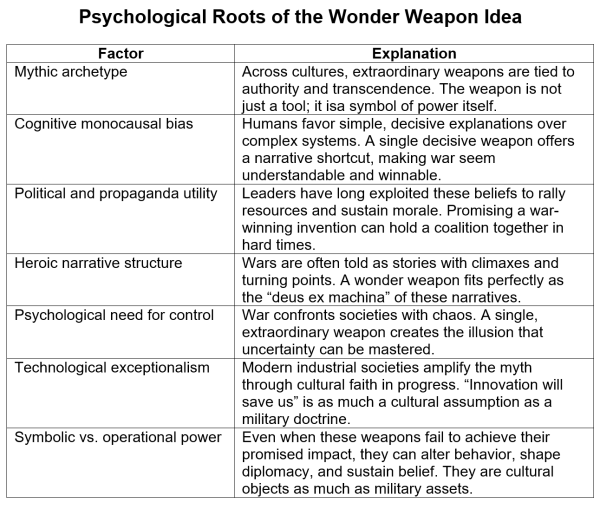
In every era of armed conflict, soldiers, rulers, and societies have dreamed of the one decisive weapon that would end the struggle. From the thunderbolts of gods to hypersonic missiles, this belief in “wonder weapons” has proven remarkably resilient. The technologies change, but the pattern endures: a new weapon appears, is heralded as revolutionary, and becomes woven into political and propaganda narratives, regardless of its actual battlefield performance. This article explains the wonder weapons phenomenon and describes its manifestation in the war in Ukraine.
Ancient Origins and Psychological Basis
Long before modern warfare, human societies told stories of weapons of divine power: Zeus’s thunderbolt, Thor’s hammer, King Arthur’s Excalibur. These objects did not merely harm enemies; they conferred legitimacy and divine favor upon their wielders. Greek fire, the Byzantine Empire’s famous incendiary weapon, was not just feared for its destructive capacity. Its secrecy and spectacular effects made it seem almost supernatural. Siege engines, early chemical mixtures, and innovative armor often acquired reputations far beyond their technical reality. The psychological appeal of invincible weapons was enormous. Mythic weapons represented power condensed into an object, something both awe-inspiring and controllable.
Gunpowder and the Age of Mechanical Superweapons
The arrival of gunpowder in medieval Europe created one of the first modern wonder weapon narratives. Early cannons were seen as “thunder weapons” that could crush ancient walls with divine force. At the Fall of Constantinople in 1453, the Ottoman use of massive bombards had both material and psychological effects. The roar of the guns became legend. Leonardo da Vinci’s unrealized designs of tanks, rotary guns, and giant crossbows show how deeply faith in the decisive invention had taken root by the Renaissance. But a pattern was already emerging: new technologies promised to transform war, yet the underlying dynamics of logistics, strategy, and human adaptation remained.
Industrial Age and the Birth of Mass Destruction
The 19th century industrial revolution brought ironclads, rapid-fire artillery, the Maxim gun and chemical warfare. Each of these was heralded as potentially making war impossible or one-sided. In practice, they changed tactics but did not eliminate the enemy. Early chemical warfare in WWI is an instructive case: its first appearances terrified soldiers and populations alike, but rapid adoption of countermeasures, such as protective masks and dispersal, blunted its effectiveness. The myth of unstoppable new technology collided with the reality of adaptive human opponents.
Germany and the Cult of Wunderwaffen in WWII
In the final years of WWII, Nazi Germany threw its hopes into wunderwaffen (miracle weapons). Guided missiles, jet and rocket-powered aircraft, and other fantastical late-war projects were promoted as tools that could avert defeat. In reality, these systems were strategically insignificant, but their propaganda effect was immense. Not only did the wunderwaffen propaganda reassure Germans; it was also intended to deter and unsettle the Allies. The faith in wonder weapons reached its fever pitch at a moment of extreme psychological need.
The most famous German WWII wunderwaffen were the so-called Vergeltungswaffen (vengeance weapons). These systems, the V-1 and V-2 missiles, represented a historic leap in weapon technology: they were the world’s first operational cruise and ballistic missiles. But their story also illustrates the full arc of the wonder-weapon lifecycle: from shocking introduction to rapid adaptation, countermeasures, and eventual strategic irrelevance.
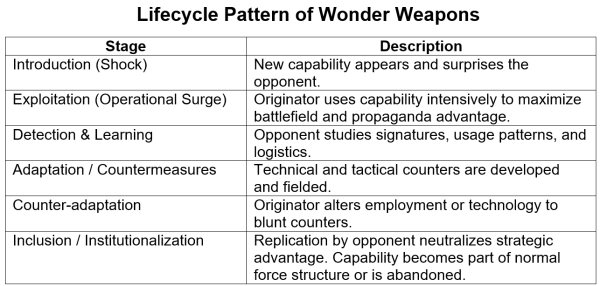
The V-1, essentially an early jet-powered cruise missile, was designed for long-range bombardment of cities without risking bomber aircraft. The V-2, developed under the direction of Wernher von Braun, was even more advanced; it was a supersonic, ballistic missile for which no effective defense existed. When first deployed against London in 1944, these weapons represented a stunning technological shock. The V-2 arrived without warning or interception.
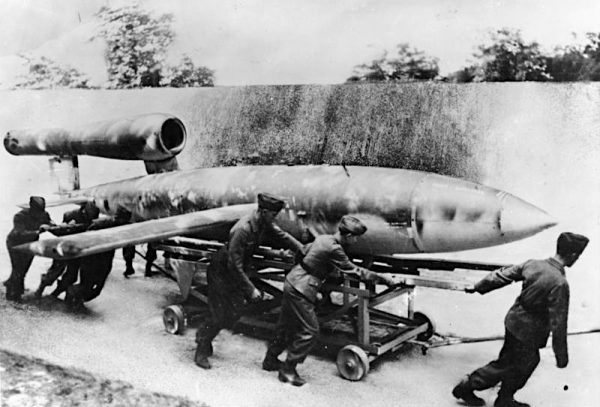
V-1 moving to launch position
Berlin’s leadership viewed the V-weapons as potential war-changers: they could deliver psychological and physical punishment on Allied cities at relatively low cost in manpower, bypassing air superiority limitations. The V-1 campaign inflicted significant damage on London and Antwerp, while the V-2 introduced an entirely new threat: a weapon against which there was no defense. The Nazi regime used these weapons heavily in propaganda, portraying them as proof that Germany still possessed the means to turn the war around.
The Allies quickly adapted: radar detection and fighter interceptions improved, barrage balloons were repositioned, and anti-aircraft batteries achieved growing success against the subsonic V-1s. The V-2 could not be countered directly, but Allied forces applied strategic countermeasures instead: massive bombing campaigns against launch sites, production facilities, and transport infrastructure. Intelligence operations, including the deception of German targeting through false reports of impacts, further blunted the weapons’ effectiveness.
Despite their technological sophistication, the V-weapons failed to alter the course of the war. Their guidance systems were too crude for precision strikes, their warheads too small to break Allied morale, and their production too resource-intensive to match conventional bombing effectiveness. Each missile delivered only a fraction of the destructive power of a heavy bomber raid, at far greater cost. The German wonder weapons thus became a strategic dead end: capable of terror, but not decisive results.
While strategically ineffective for Germany, the V-weapons shaped postwar military and technological development profoundly. The V-2 became the direct precursor to modern ICBMs, laying the groundwork for the Cold War missile and space programs. The V-weapons perfectly illustrate the limits of technological silver bullets in warfare. They entered the conflict too late, lacked the scale or precision to achieve strategic effect, and triggered rapid countermeasures. Yet their technological legacy endured, demonstrating how wonder weapons can fail operationally yet thrive through replication and institutionalization elsewhere.
The Atomic Bomb: A Real Wonder Weapon
The Manhattan Project produced the first weapon that genuinely fit the myth’s promise. The atomic bomb ended a global war and created a new strategic reality. Yet even nuclear weapons carried symbolic weight beyond their destructive capacity. Their power to shape the Cold War came as much from belief and fear as from their operational use. Nuclear deterrence was sustained by ritual, signaling, and the carefully managed aura of absolute power. In that sense, the most effective wonder weapon in history fulfilled both material and psychological roles.
High-Tech Weaponry in the Information Age
Since the end of the Cold War, the wonder weapon narrative has attached itself to stealth aircraft, cyberwarfare, precision-guided munitions, missile defense, and most recently, AI-enabled and hypersonic systems. The stealthy F-117 Nighthawk and B-2 bombers were marketed not just as warplanes but as harbingers of a new era of invisible war machines. The rhetoric of “shock and awe” echoed ancient myth: victory through spectacular technological dominance. Today, hypersonic missiles and autonomous weapons are described in almost magical terms: unstoppable, transformative, decisive. Yet history teaches that no technology remains decisive for long. Countermeasures arise, technology is copied, and warfare remains complex and uncertain.
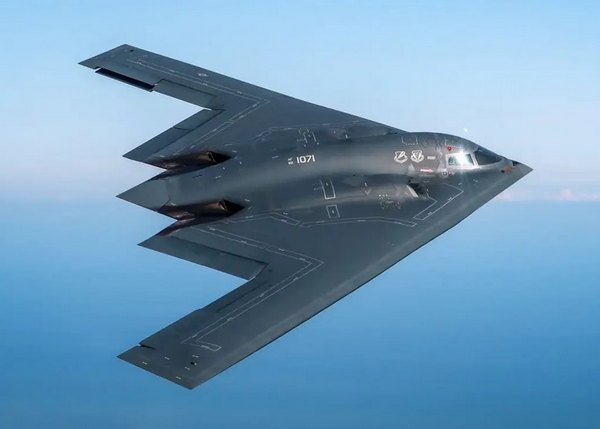
B-2 Stealth Bomber
Wonder Weapons in the Ukraine War
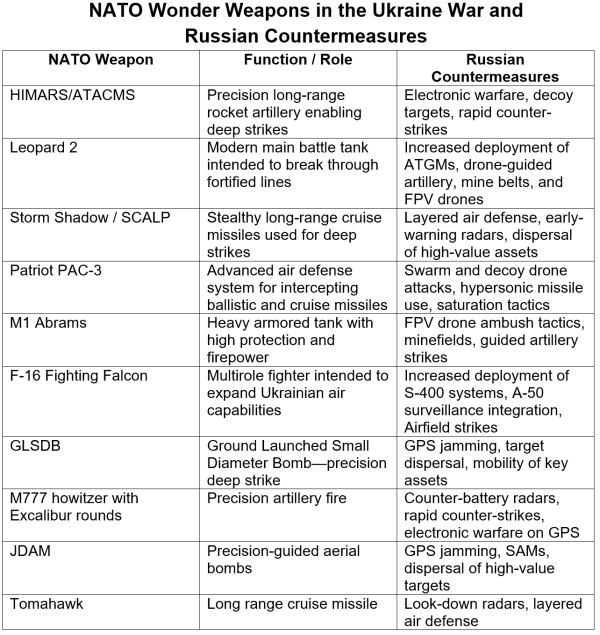
The U.S. has supported Ukraine in its war with Russia by supplying massive economic and military assistance. The material assistance has taken the form of increasingly powerful weapons systems. Each of these weapons has been represented as a “game changer” by advocates of military backing for Ukraine, but the results have fallen short of expectations as Russia has adapted to each challenge and largely neutralized the battlefield effects of the new weapons. Most recently, Ukraine has sought, so far unsuccessfully, to secure U.S. Tomahawk long-range cruise missiles. It is doubtful that use of this missile would affect the outcome of the conflict any more than the preceding western weapons have. Nonetheless, chatter over the Tomahawks has dominated news coverage of the Ukraine war for weeks. The power of the wonder weapon idea remains strong.
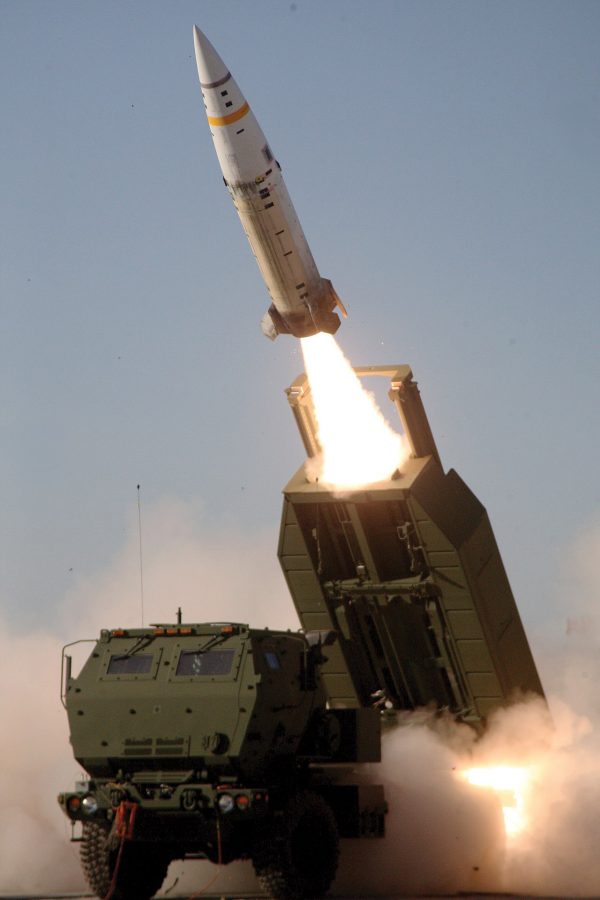
ATACMS missile launch
Conclusion
The story of wonder weapons is not just about military technology. It is a mirror of human beliefs: our tendency to mythologize tools, to condense hope and fear into objects, and to dream of certainty in the face of war’s chaos. Although the most decisive factors in armed conflict remain strategy, logistics, morale, and adaptation, the faith in decisive technology endures because it is psychologically and culturally compelling. As the Ukraine war grinds on, the failed promises of past wonder weapons will fade from memory, but fresh faith will emerge in the next promised miracle weapon. In the U.S., the current eager pursuit of weaponized AI and a “Golden Dome” missile shield confirms the enduring allure of wonder weapons.

























