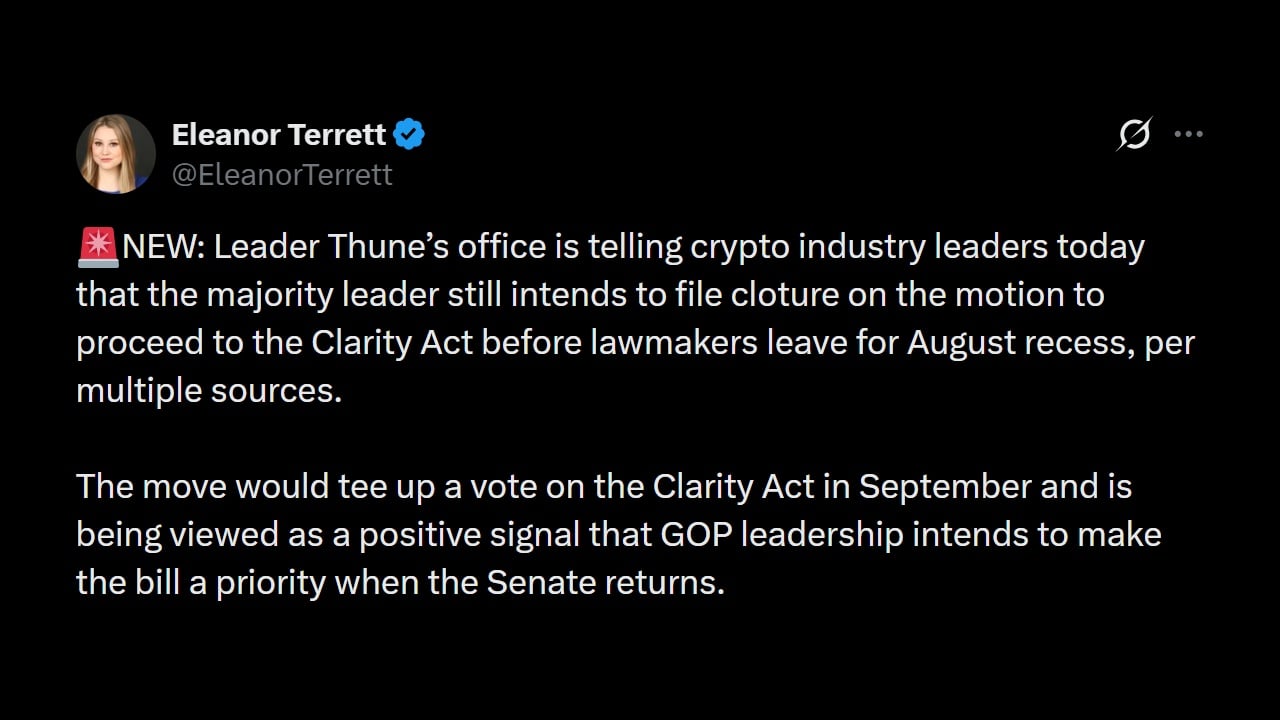
Washington is about to take a serious swing at crypto’s most stubborn problem: who, exactly, is supposed to police the market when a token trades like a commodity, is sold like a security, and moves through software that insists it isn’t a company at all. The Digital Asset Market Clarity Act of 2025 (better known on Capitol Hill and in boardrooms as the CLARITY Act) has already cleared the House, and Senate lawmakers are now lining it up for a January markup that will determine whether the bill becomes a durable rulebook or another ambitious draft that buckles under its own edge cases.
For anyone trying to understand what’s actually at stake, two provisions do most of the heavy lifting. One is a carve-out that tells a long list of decentralized finance activities that aren’t intermediaries and shouldn’t be regulated as such simply for operating code, nodes, wallets, interfaces, or liquidity pools. The other is a preemption clause that would treat “digital commodities” as “covered securities,” a phrase that sounds like legal trivia until you realize it is designed to shut down a sprawling patchwork of state-by-state requirements that crypto firms have been tiptoeing around for years.
The bill’s promise is straightforward: end the turf war between the SEC and the CFTC, clarify when secondary trading is and is not “the same” as a securities offering, and create a registration path for the venues that actually handle crypto liquidity. The risk is also straightforward: the hardest problems in crypto regulation are practical: what counts as “DeFi” in the messy world of front ends, admin keys, and governance capture; and what’s left of investor protection once federal law starts pushing state securities regulators out of the way.
The DeFi carve-out
If you want the simplest description of the CLARITY Act’s stance toward DeFi, it’s this: Congress is trying to stop regulators from treating infrastructure like an exchange.
In the bill’s DeFi exclusion, a person is not made subject to the Act merely for doing the kinds of things that keep blockchains and DeFi protocols alive: compiling and relaying transactions; searching, sequencing, or validating; operating a node or oracle service; offering bandwidth; publishing or maintaining a protocol; running or participating in a liquidity pool for spot trades; or providing software (wallets included) that lets users custody their own assets.
Those verbs are not incidental. They map directly onto the activities that, in practice, have been the regulatory choke points in DeFi’s growth: who is “in the middle” of a trade, who “facilitates” it, who “controls” it, and who can be pressured to impose compliance obligations that the protocol itself cannot fulfill.
In recent years, the US legal system has often solved that puzzle by looking for something legible, like an incorporated team, a foundation, a front-end operator, and then arguing that the legible entity is effectively the business. The CLARITY Act’s DeFi language is an attempt to reverse that logic and draw a bright line: software distribution and network operation are not, by themselves, the regulated business of running a market.
There’s an important catch, and it’s not hidden in the margins. The carve-out doesn’t touch anti-fraud and anti-manipulation authority. The bill explicitly says the exclusion does not apply to those powers, meaning the SEC and the CFTC still retain the ability to pursue deceptive conduct even if the actor claims to be “just software,” “just a relayer,” or “just a front end.”
That distinction between being regulated as an intermediary and being reachable for fraud sounds clean, but it’s exactly where the fights tend to live. The market-structure question is: should DeFi builders and operators be required to register, surveil markets, and run compliance programs like traditional venues? The enforcement question is: when something goes wrong (when a token launch is deceptive, when a pool is manipulated, when insiders dump into retail), who can regulators realistically bring to court, and under what theory?
The bill, as written, tries to narrow the first question while keeping the second one alive. But it also creates new boundary disputes that senators will have to confront in markup.
Consider “providing a user-interface that enables a user to read and access data” about a blockchain system. That language offers a safe harbor for a basic interface, yet DeFi’s commercial reality is that many front ends are not passive dashboards; they route orders, choose default settings, integrate blocklists, and shape liquidity migration. Where does “UI” end and “operating a trading venue” begin? The bill does not fully answer that. It mostly tells regulators they cannot assume that running a UI makes you an intermediary, and leaves the hard cases to future rules, enforcement, and whatever standards courts choose to adopt.
Now consider liquidity pools. The carve-out mentions operating or participating in a liquidity pool for executing spot trades. That is a broad statement in a world where liquidity provision can be permissionless, highly levered through external incentives, and occasionally steered by governance votes dominated by insiders. It is also a statement that could be read, by critics, as Congress giving DeFi a wide lane without first demanding a credible answer for retail protections: disclosure, conflict-of-interest controls, MEV mitigation, and redress when something breaks.
The CLARITY Act gestures at those concerns elsewhere, including studies and reports on DeFi, and it embeds a general modernization agenda. But studies are not guardrails, and the political conflict is unlikely to fade: senators who want the U.S. to “win” crypto innovation tend to view DeFi’s disintermediation as the point; senators who worry about consumer harm tend to view disintermediation as a way to dodge accountability. The carve-out is where those worldviews collide.
The preemption gambit
The CLARITY Act’s state-law move is brutally simple: it would treat a “digital commodity” as a “covered security.”

Covered securities are a category under federal law that limits states’ ability to impose their own registration or qualification requirements on certain offerings. In plain English, it is a federal override meant to prevent fifty different versions of the same rulebook from strangling a national market. That matters because, outside of the biggest, most compliance-heavy firms, crypto has been forced to operate in a world where state securities administrators can still demand filings, impose conditions, or pursue actions that feel disconnected from whatever the SEC and CFTC are doing in Washington.
The bill also includes a rule of construction that preserves certain existing state authorities over covered securities and securities: language that serves as a reminder that “preemption” is never absolute in practice, especially when fraud is alleged.
Why does this matter now? Because market structure is not just about which federal agency wins. It is about whether the regulated perimeter becomes workable for the businesses that are supposed to comply. A crypto exchange can spend years negotiating federal expectations and still be exposed to state-by-state uncertainty that affects listings, products, and distribution. Custodians can be told to build a compliance system that satisfies one regulator, only to find that a separate state interpretation makes the same activity risky. Even token issuers that are trying to transition from “fundraising mode” to “decentralized network mode” can run into state scrutiny that treats every sale as an evergreen securities problem.
CLARITY’s preemption clause is designed to reduce that chaos, but it comes with an unavoidable trade-off: it narrows the role of state securities regulators at a time when many consumer advocates argue that state enforcement is one of the few tools that reliably moves quickly against scams and abusive practices. To its supporters, a unified market needs unified rules. To its critics, preemption can look like a promise of clarity that arrives by weakening the nearest line of defense for retail investors.
This is also where the bill’s definitional architecture becomes more than academic. The preemption clause hinges on the term “digital commodity.” CLARITY attempts to build a classification system that separates (1) the investment contract that may have been used to sell tokens from (2) the tokens themselves once they are trading in secondary markets. The House committee’s own section-by-section summary describes the bill’s intent: digital commodities sold pursuant to an investment contract should not be treated as investment contracts themselves, and certain secondary trades should not be treated as part of the original securities transaction.
If that architecture holds, the preemption clause has teeth: it applies to the thing Congress wants treated like a commodity. If the architecture fails and courts or regulators decide that large swaths of tokens are still securities all the way down, then the preemption clause becomes less of a clean override and more of another contested boundary.
That’s why the January markup matters even beyond the headline “SEC vs CFTC.” Markup is where senators will decide whether to tighten definitions, narrow safe harbors, add conditions for DeFi, or modify the reach of preemption to reassure state regulators and consumer advocates. It is also where senators will have to address the unresolved questions the bill itself tees up.
One unresolved question is whether the “DeFi” category is being defined by technology or by business reality. The carve-out is broad enough to protect core infrastructure, but it can also be read broadly enough that sophisticated operators could attempt to launder traditional intermediary functions through a set of formal claims: “we only provide a UI,” “we only publish code,” “we only participate in pools.” The bill keeps anti-fraud authority alive, but anti-fraud is not the same thing as a licensing regime, and it is not a substitute for a stable set of operational rules.
Another unresolved question is how quickly “clarity” becomes real in markets. The House committee summary notes that the SEC and CFTC are required to promulgate required rules within set timeframes, generally within 360 days of enactment unless otherwise specified, while other provisions have delayed effective dates tied to rulemaking. In other words, even if the bill passes, the market still lives through a rulemaking year, and the interim period is where enforcement risk tends to be highest because firms are moving while the bureaucracy is writing.
And then there is the more human unresolved question: whether Washington can keep this bipartisan long enough to finish the job. The House vote was lopsided enough to signal momentum. But senators have been negotiating market structure for years, and the closer it gets to becoming law, the more each edge case turns into a constituency fight: DeFi versus investor protection, federal uniformity versus state authority, and the quiet power struggle between agencies that are not eager to surrender turf.
The CLARITY Act, at its core, is Congress trying to replace a decade of improvisation with a map.
The DeFi carve-out is Congress saying the map should not treat infrastructure as the middleman. The preemption clause is Congress saying the map should not fracture into fifty competing versions. Whether those two choices become a coherent rulebook or a fresh set of loopholes and lawsuits depends on what senators do when they sit down in January and start editing the words that will decide, for the next cycle, what “crypto regulation” actually means.