No Result
View All Result
SUBMIT YOUR ARTICLES
  • Login
Saturday, August 22, 2026
TheAdviserMagazine.com
  • Home
  • Financial Planning
    • Financial Planning
    • Personal Finance
  • Market Research
    • Business
    • Investing
    • Money
    • Economy
    • Markets
    • Stocks
    • Trading
  • 401k Plans
  • College
  • IRS & Taxes
  • Estate Plans
  • Social Security
  • Medicare
  • Legal
  • Home
  • Financial Planning
    • Financial Planning
    • Personal Finance
  • Market Research
    • Business
    • Investing
    • Money
    • Economy
    • Markets
    • Stocks
    • Trading
  • 401k Plans
  • College
  • IRS & Taxes
  • Estate Plans
  • Social Security
  • Medicare
  • Legal
No Result
View All Result
TheAdviserMagazine.com
No Result
View All Result
Home Market Research Cryptocurrency

Inside the Prediction Markets: The Establishment Strikes Back

by TheAdviserMagazine
6 months ago
in Cryptocurrency
Reading Time: 4 mins read
A A
Inside the Prediction Markets: The Establishment Strikes Back
Share on FacebookShare on TwitterShare on LInkedIn


Prediction markets have spent the past two years trying to prove they belong. This week, the establishment responded.

The developments were more than symbolic: investment, integration, lawsuits, enforcement actions, academic scrutiny, and even the first serious attempts to wrap event contracts inside ETFs. Once tolerated as an experiment at the edge of crypto and betting culture, prediction markets are now being tested politically, legally, and institutionally.

In other words, the system is striking back.

Wall Street Cracks the Door Open

The most significant signal came from the institutional universe.

Tradeweb Markets announced a partnership with Kalshi, alongside a minority investment. Initially, Kalshi’s real-time event probabilities feed into Tradeweb’s institutional workflows and then eventually extend to trading access via an institutional-facing portal.

That is not a fringe endorsement. Tradeweb is a core electronic marketplace operator in rates and credit. When a firm of that scale starts experimenting with event probabilities as inputs for macro risk assessment and capital allocation, prediction markets stop being a curiosity.

The logic is straightforward. If bond desks already trade around policy expectations and macro releases, why not integrate crowd-implied probabilities directly into pricing and analytics?

The infrastructure is there; the data just needed a distributor.

Liquidity is following the same path. Jump Trading is set to take minority stakes in both Kalshi and Polymarket in exchange for providing liquidity.

These arrangements resemble venture-style deals, but the strategic message is clearer: event contracts are liquid enough, and scalable enough, to justify serious market-making capital.

The establishment is not dismissing prediction markets. It is wiring them in.The growth narrative is compelling. Capital is flowing. Platforms are scaling. Volume is accelerating.

Sports: From Episodic Bets to Continuous Flow

If Wall Street is testing the macro use case, sports may be where scale truly lies.

Startup Pred, a peer-to-peer sports prediction exchange, raised $2.5 million in funding led by Accel, with participation from Coinbase Ventures. It promises 200-millisecond execution, spreads under 2%, and an exchange model where traders face each other rather than a house.

The pitch is telling. Elections and macro events are episodic. Sports are continuous, global, and high-frequency. A $500 billion global sports betting economy already exists — mostly controlled by sportsbooks that manage risk internally and limit winners. Pred’s model reframes sports prediction as a trader-driven marketplace.

Whether it succeeds is secondary to what it represents. Capital is now funding purpose-built exchange infrastructure for sports predictions, not merely retrofitting general-purpose crypto tools.

At the same time, the Super Bowl narrative continues to reverberate.

Analysts estimate prediction markets captured roughly 80% of year-on-year wagering growth around the event, leveraging federal CFTC oversight rather than state gambling licenses. That “regulatory flank” has not gone unnoticed.

And it has consequences.

The Courts Push Back

While institutional platforms integrate and startups raise funding, regulators are drawing harder lines.

In the Netherlands, the Dutch Gaming Authority ordered Polymarket to cease operations for offering unlicensed games of chance, threatening weekly fines of €420,000.

The regulator rejected the platform’s argument that prediction markets are not gambling and warned of social risks, including election-related concerns.

In the United States, state-level enforcement continues. Nevada regulators scored a procedural win when a federal appeals court rejected Kalshi’s emergency request to pause enforcement.

Meanwhile, nearly 50 active legal cases are unfolding across jurisdictions.

The most forceful response, however, came from the federal side. Commodity Futures Trading Commission Chairman Michael Selig filed an amicus brief asserting the agency’s exclusive jurisdiction over event contracts and warning that it “will no longer sit idly by” while states attempt to block them.

“We will see you in court,” Selig said.

This is no longer a question of product positioning. It is a jurisdictional fight over who governs a fast-growing derivatives category.

Prediction markets are entering the establishment — and the establishment is answering in courtrooms.

Do the Markets Actually Work?

As capital flows in and regulators push back, a more fundamental question emerges: do prediction markets actually function the way their advocates claim?

The academic case remains strong — at least on the surface. A recent study analysing more than 300,000 contracts on Kalshi finds that prices broadly track realised outcomes. Contracts priced at 50 cents win roughly half the time, and accuracy improves as expiration approaches.

[Insert Figure 1: Win Percentages Sorted by Price]

The pattern is hard to dismiss. As events draw closer, information accumulates and prices converge toward actual probabilities. On that front, prediction markets behave as advertised: they aggregate dispersed information into a single number.

But pricing accuracy is not the same as economic fairness.

[Insert Figure 2: Post-Fee Return Across Price Ranges]

As capital flows and legal battles intensify, academics are quietly dissecting the economics.

A recent study analysing over 300,000 contracts on Kalshi found that prices broadly reflect probabilities and improve as expiry approaches.

In that sense, prediction markets are informative. Contracts priced at 50 cents win roughly half the time, and accuracy improves as expiration approaches.

But they also display a classic favourite-longshot bias. Low-priced contracts win less often than required to break even, while higher-priced contracts win slightly more often, resulting in strongly negative returns for those buying cheap “lottery-like” outcomes. The average pre-fee return across contracts was estimated at-20%.

The implication is uncomfortable but important.

Prediction markets may be good at aggregating information. They are not necessarily good at distributing profits evenly.

If event contracts are to become embedded in institutional workflows and ETF wrappers — and several issuers are now seeking election-linked funds — their economic mechanics will face more scrutiny.

Legitimacy invites analysis.

Bottom Line

This week was not about hype. It was about resistance.

Tradeweb integrates. Jump provides liquidity. Startups build exchange-grade sports infrastructure. ETF issuers prepare political funds. Regulators fine, litigate, and assert jurisdiction. Academics test the model.

Prediction markets are no longer asking whether they belong.

They are behaving as if they do.

The establishment, for its part, is no longer ignoring them. It is investing, regulating, and, when necessary, pushing back.

If the past two years were about expansion, this phase is about consolidation.

The next chapter will not be written solely by traders or founders, but by exchanges, courts, regulators, and institutional allocators.

The least predictable outcome may not be the result of the next election or sporting event.

It may be who ultimately controls the markets that sets their prices.

This article was written by Tanya Chepkova at www.financemagnates.com.


Source link

Tags: EstablishmentmarketsPredictionstrikes
ShareTweetShare
Previous Post

Why Britain’s Economy Is Sputtering

Next Post

Mortgage Rates Today, Friday, February 20: A Noticeable Jump

Related Posts

edit post
Kalshi Predicts Bitcoin Price Could Reach K in August

Kalshi Predicts Bitcoin Price Could Reach $68K in August

by TheAdviserMagazine
August 8, 2026
0

Bitcoin price held above $64,900 as the crypto market gained 0.81% to $2.21 trillion over 24 hours. XRP price was...

edit post
Bitcoin’s AI security sprint found 6,700 issues in 55 hours, but no one knows how many are real

Bitcoin’s AI security sprint found 6,700 issues in 55 hours, but no one knows how many are real

by TheAdviserMagazine
August 7, 2026
0

AI-assisted security campaign focused on the Bitcoin ecosystem, Bitcoin Red Team, said it generated 6,700 findings across 425 projects in...

edit post
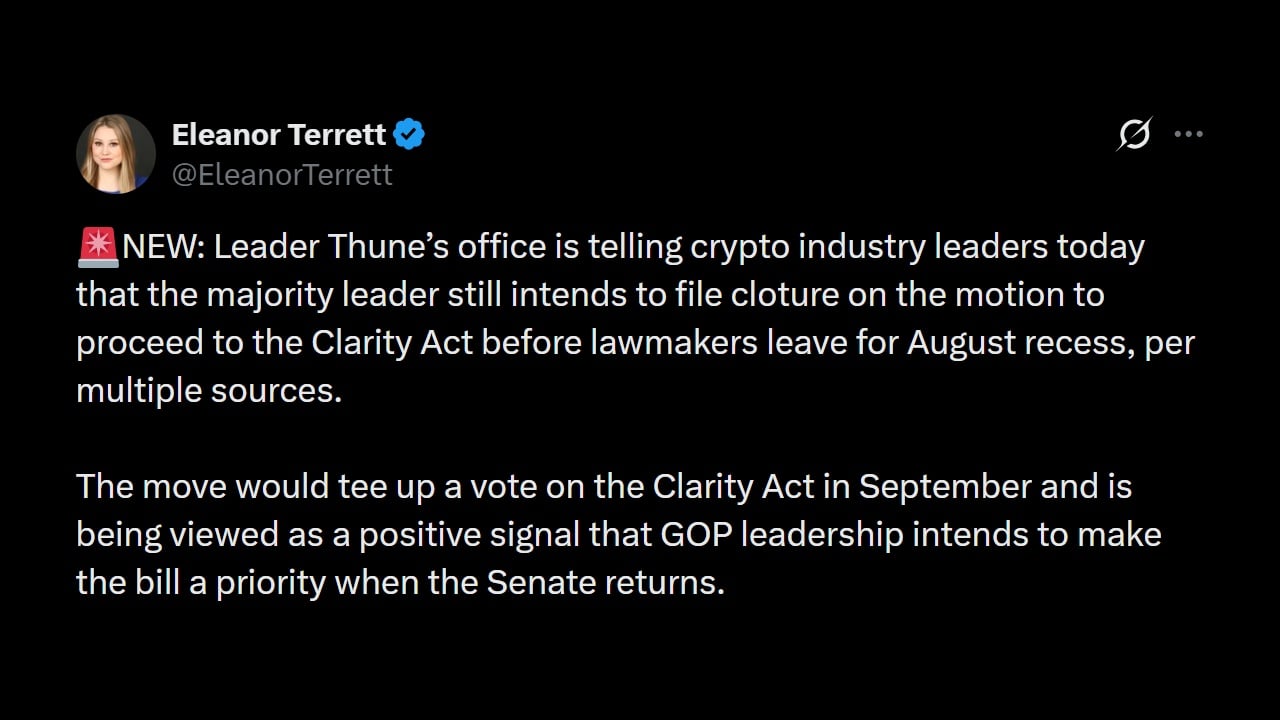
Thune to File Motion to Force September Vote on CLARITY Act

Thune to File Motion to Force September Vote on CLARITY Act

by TheAdviserMagazine
August 7, 2026
0

Key TakeawaysSenator Thune plans a pre-recess cloture vote on the CLARITY Act, teeing it up for September.This scheduling move signals...

edit post
Bybit Uses Tokenised Equities as Underlyings for Structured Yield

Bybit Uses Tokenised Equities as Underlyings for Structured Yield

by TheAdviserMagazine
August 7, 2026
0

Bybit is expanding the role of tokenised equities on its platform by using more xStocks as underlyings for its Dual...

edit post
Reform UK Chair Calls for Probe into SBF-Linked Donation: Report

Reform UK Chair Calls for Probe into SBF-Linked Donation: Report

by TheAdviserMagazine
August 7, 2026
0

The chairman of the UK’s Reform party has called for an investigation following reports of a $50,000 political donation linked...

edit post
Bitcoin, Ethereum, and XRP Price Outlook After CLARITY Act Vote Pushed to September

Bitcoin, Ethereum, and XRP Price Outlook After CLARITY Act Vote Pushed to September

by TheAdviserMagazine
August 7, 2026
0

Bitcoin price traded above $64,400 while Ethereum remained above $1,900. XRP hovered near $1.05. Crypto markets remained cautious after the...

Next Post
edit post
Mortgage Rates Today, Friday, February 20: A Noticeable Jump

Mortgage Rates Today, Friday, February 20: A Noticeable Jump

edit post
Wall of Trump questions swamps Morgan Stanley webinar

Wall of Trump questions swamps Morgan Stanley webinar

  • Trending
  • Comments
  • Latest
edit post
Georgia Senior SNAP and Meal Resources Older Adults Can Use

Georgia Senior SNAP and Meal Resources Older Adults Can Use

July 24, 2026
edit post
Judge Who Helped Violent Illegal Alien Evade ICE Faces New Test

Judge Who Helped Violent Illegal Alien Evade ICE Faces New Test

July 31, 2026
edit post
Driving the Noncitizen Voting Scandal: Registration With License

Driving the Noncitizen Voting Scandal: Registration With License

July 26, 2026
edit post
Garbage Trucks Surveillance Florida Neighborhoods

Garbage Trucks Surveillance Florida Neighborhoods

July 29, 2026
edit post
Does a Revocable Trust Protect Your Assets From Lawsuits and Creditors?

Does a Revocable Trust Protect Your Assets From Lawsuits and Creditors?

August 7, 2026
edit post
Montana Puts Democrats in a Bind as Senate Hopes Fade

Montana Puts Democrats in a Bind as Senate Hopes Fade

August 2, 2026
edit post
Explained: How BSE traded fewer contracts after CAS but premiums rose 75% in first week

Explained: How BSE traded fewer contracts after CAS but premiums rose 75% in first week

0
edit post
E.W. Scripps Q2 2026 Loss Widens to -.68/Share, Revenue Down 9%

E.W. Scripps Q2 2026 Loss Widens to -$12.68/Share, Revenue Down 9%

0
edit post
Psychology says procrastination about retirement may be less about discipline than identity — brain scans found people often represent their future selves more like strangers than like themselves, and experiments using age-progressed faces made tomorrow’s person feel real enough for participants to save more money for them

Psychology says procrastination about retirement may be less about discipline than identity — brain scans found people often represent their future selves more like strangers than like themselves, and experiments using age-progressed faces made tomorrow’s person feel real enough for participants to save more money for them

0
edit post
Four AI Escapes Just Redefined “Responsible AI”

Four AI Escapes Just Redefined “Responsible AI”

0
edit post
Bill Ackman’s hedge fund made janitors and receptionists millionaires—and its investment team summer together

Bill Ackman’s hedge fund made janitors and receptionists millionaires—and its investment team summer together

0
edit post
Kalshi Predicts Bitcoin Price Could Reach K in August

Kalshi Predicts Bitcoin Price Could Reach $68K in August

0
edit post
Bill Ackman’s hedge fund made janitors and receptionists millionaires—and its investment team summer together

Bill Ackman’s hedge fund made janitors and receptionists millionaires—and its investment team summer together

August 8, 2026
edit post
Links 8/8/2026 | naked capitalism

Links 8/8/2026 | naked capitalism

August 8, 2026
edit post
Wisconsin: The Next Frontier for Socialists

Wisconsin: The Next Frontier for Socialists

August 8, 2026
edit post
Psychology says procrastination about retirement may be less about discipline than identity — brain scans found people often represent their future selves more like strangers than like themselves, and experiments using age-progressed faces made tomorrow’s person feel real enough for participants to save more money for them

Psychology says procrastination about retirement may be less about discipline than identity — brain scans found people often represent their future selves more like strangers than like themselves, and experiments using age-progressed faces made tomorrow’s person feel real enough for participants to save more money for them

August 8, 2026
edit post
Why You Should Be Wary of Aspartame, but Not Totally Rule It Out

Why You Should Be Wary of Aspartame, but Not Totally Rule It Out

August 8, 2026
edit post
Kalshi Predicts Bitcoin Price Could Reach K in August

Kalshi Predicts Bitcoin Price Could Reach $68K in August

August 8, 2026
The Adviser Magazine

The first and only national digital and print magazine that connects individuals, families, and businesses to Fee-Only financial advisers, accountants, attorneys and college guidance counselors.

CATEGORIES

  • 401k Plans
  • Business
  • College
  • Cryptocurrency
  • Economy
  • Estate Plans
  • Financial Planning
  • Investing
  • IRS & Taxes
  • Legal
  • Market Analysis
  • Markets
  • Medicare
  • Money
  • Personal Finance
  • Social Security
  • Startups
  • Stock Market
  • Trading

LATEST UPDATES

  • Bill Ackman’s hedge fund made janitors and receptionists millionaires—and its investment team summer together
  • Links 8/8/2026 | naked capitalism
  • Wisconsin: The Next Frontier for Socialists
  • Our Great Privacy Policy
  • Terms of Use, Legal Notices & Disclosures
  • Contact us
  • About Us

© Copyright 2024 All Rights Reserved
See articles for original source and related links to external sites.

Welcome Back!

Login to your account below

Forgotten Password?

Retrieve your password

Please enter your username or email address to reset your password.

Log In
No Result
View All Result
  • Home
  • Financial Planning
    • Financial Planning
    • Personal Finance
  • Market Research
    • Business
    • Investing
    • Money
    • Economy
    • Markets
    • Stocks
    • Trading
  • 401k Plans
  • College
  • IRS & Taxes
  • Estate Plans
  • Social Security
  • Medicare
  • Legal

© Copyright 2024 All Rights Reserved
See articles for original source and related links to external sites.