

The most dangerous stablecoin scam probably looks nothing like what most people picture. There’s no anonymous founder, no Discord full of bots, no promise of returns that defy basic economic logic.
Instead, it has a professional ticker, institutional branding, and a name that tens of millions of people have trusted with their savings for generations. That’s the premise at the center of a regulatory alert Hong Kong’s monetary authority issued this week, and it deserves considerably more attention than a fraud warning typically receives.
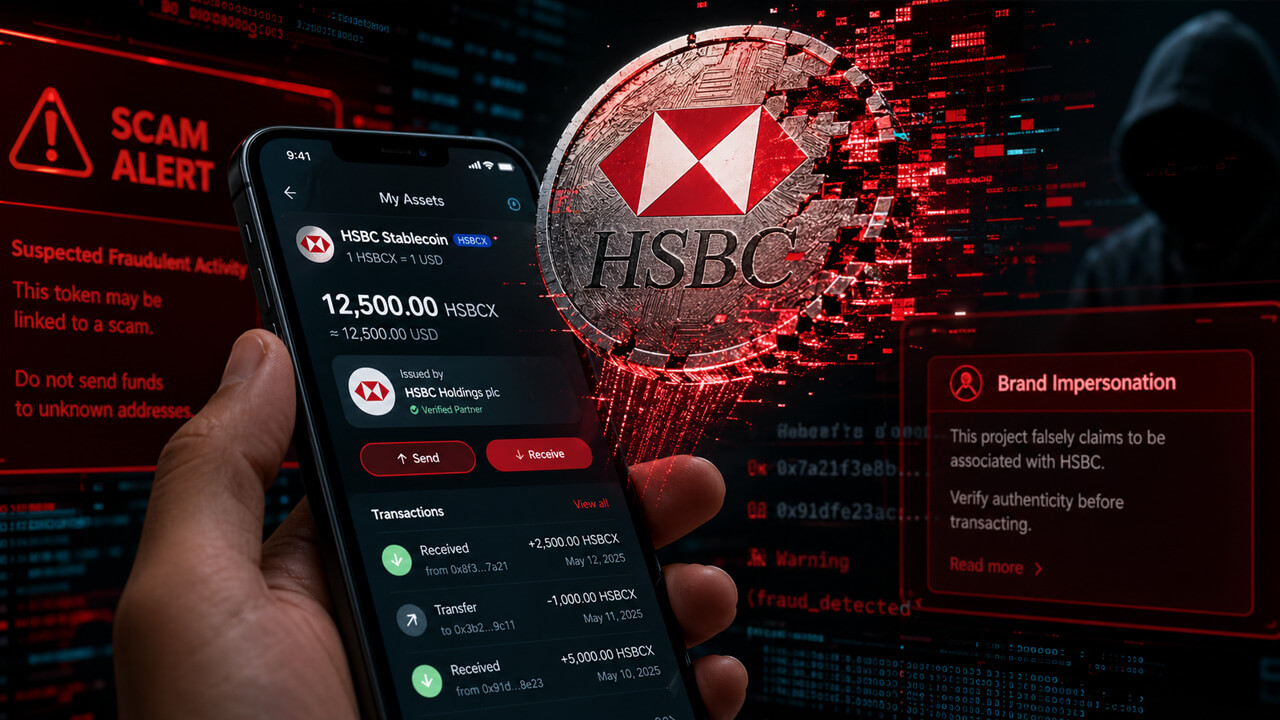
On April 28, the HKMA warned the public that tokens carrying the tickers “HKDAP” and “HSBC” had appeared in the market without being issued by or associated with any licensed stablecoin issuer, and that both licensed issuers had confirmed they hadn’t released any regulated stablecoins yet.
The institutional gravity those names carry in the minds of ordinary consumers, built over more than a century of banking history, was the vehicle for the deception, and that’s a fundamentally different kind of scam from anything the stablecoin market has had to contend with before.
The HSBC scam that doesn’t need to promise anything
To understand why this is so structurally different from ordinary token fraud, it helps to know what HSBC and Anchorpoint Financial actually represent in this context.
On April 10, the HKMA granted its first stablecoin issuer licences to the two institutions under the Stablecoins Ordinance, which took effect in August 2025. From a pool of 36 applicants, only these two were approved, a roughly 5.6% approval rate that shows just how demanding the regime was at launch.
CryptoSlate covered the passage of the enabling legislation in May 2025 and the activation of the licensing regime that August. The framework was built around credibility as its central premise: full reserve backing, identity-verified wallets, and ongoing disclosure requirements embedded from the outset.
HSBC plans to launch a Hong Kong dollar-denominated stablecoin in the second half of 2026, fully backed at all times by high-quality liquid assets held in segregated accounts, integrated into its PayMe platform and the HSBC HK Mobile Banking App. PayMe alone serves over 3.3 million users, giving the bank an immediate retail distribution channel the moment the product goes live.
Anchorpoint, a joint venture backed by Standard Chartered, Animoca Brands, and HKT, is targeting a phased rollout of its HKDAP token from the second quarter of 2026, with each token backed 1:1 by high-quality HKD-denominated reserves. CryptoSlate reported on the formation of the Anchorpoint joint venture and its early HKMA filing as the licensed HKD stablecoin competition first took shape.
As of the HKMA’s April 28 alert, neither product has reached a single consumer. The fake tokens appeared in a window that the real ones hadn’t filled yet. Crypto scams usually depend on psychological pressure: extravagant promises, manufactured urgency, and the gradual erosion of a target’s skepticism.
But bank-name fraud is completely different. The institutional gravity is already established in the public mind; the scammer simply rents it. A consumer who’d scroll past an unknown token might pause at one bearing the HSBC name, an institution with US$3.2 trillion in assets and a 160-year operating history.
They probably won’t think to check whether the licensed stablecoin has actually launched yet, because the licensing announcement was real, widely covered, and entirely legitimate, and that genuine legitimacy does most of the scammer’s work for them.
Why is Hong Kong particularly exposed?
The HKMA had flagged this risk category as early as July 2025, warning publicly that any entity claiming licensed status was misrepresenting itself and that transacting with unlicensed stablecoins would be done entirely at the user’s own risk.
The regulators anticipated the problem well in advance. The fraudulent tokens appeared on schedule anyway, which tells you something important about the limits of legal deterrence when the underlying incentive structure is this favorable to scammers.
Under Hong Kong’s Stablecoins Ordinance, violators face fines of up to HK$5 million and possible prison sentences of seven years for unauthorized issuance or false claims of licensed status. The penalties are severe, and the framework is sophisticated on almost every dimension.
What makes Hong Kong’s situation particularly delicate is that the territory’s entire digital asset strategy rests on public confidence in exactly the kind of regulatory credential these scammers are imitating. A
The city has been building out a regulated digital asset ecosystem with considerable ambition and consistency: spot ETFs in 2024, stablecoin licensing in 2025, and ongoing work on derivatives frameworks and tokenized capital structures. The whole architecture depends on the public understanding that “licensed” carries a specific, verifiable guarantee that separates legitimate products from the rest of the market.
The HKMA granted licences to Anchorpoint and HSBC specifically because they demonstrated the capability to manage risks properly, with credible use cases and development plans, in addition to meeting the relevant licensing requirements under the Ordinance.
HKMA chief executive Eddie Yue framed the milestone as an important step toward digital assets that could address real pain points in economic activity and support Hong Kong’s position as a serious financial centre.
Fake HSBC tokens undermine that positioning before the real product has reached a single user, which is a particularly costly form of reputational damage in a jurisdiction whose value proposition depends so heavily on being seen as a trustworthy, well-governed hub.
There’s also a timing vulnerability here. Both HSBC and Anchorpoint are still in preparatory phases, completing technology testing, implementing risk management systems, and building compliance infrastructure before any regulated token goes to market.
The HKMA expects regulated stablecoins in Hong Kong to launch around the mid to second half of 2026. The gap between getting a license and actually launching a stablecoin is a period of heightened exposure: the institutional legitimacy is already public knowledge, and the consumer-facing verification tools aren’t yet in use.
The authentication problem that scales
For HSBC and Anchorpoint, this is a preview of a challenge that’ll only intensify as bank-issued stablecoins become more common globally. In traditional finance, a banking brand conveys something legally specific: regulatory oversight, consumer protections, a named institution with audited balance sheets, and supervisory accountability.
In crypto markets, a token ticker is a string of characters that anyone can replicate and distribute within minutes. That asymmetry persists even within the most rigorous licensing regimes in the world, because those regimes bind institutions while the imitation operates purely on names.
Standard Chartered CEO Bill Winters said Hong Kong’s push into stablecoins and tokenized deposits could “lay the foundation for a new era of digital trade settlement.” That’s quite ambitious, and it depends heavily on consumers being able to distinguish the real product from imitations in a market where that distinction isn’t always obvious.
Banking brands that took generations to build can be cloned in a token name in minutes, which means the authentication infrastructure around bank-branded tokens has to be treated as a core product requirement alongside reserves and compliance frameworks, not as an afterthought addressed after launch.
That means wallet-level verification of authentic tokens, public registries kept current and accessible, coordination with exchanges to flag unauthorized use of institutional names, and sustained consumer education that makes checking a licensed issuer’s register feel as natural as checking an FDIC badge on a bank’s website.
The HKMA already maintains a public register of licensed stablecoin issuers, and the legal framework is designed to refer consumers there as the first point of verification. The harder institutional work is making that register something ordinary people actually consult before transacting, rather than a compliance tool that operates in the background.
The broader implication extends well beyond Hong Kong. As more jurisdictions develop regulated stablecoin frameworks and more financial institutions enter the space, the menu of credible names available for imitation grows alongside the legitimate market.
The global stablecoin market was sitting at roughly $315 billion in total market capitalization at the time of the HKMA’s warning, dominated almost entirely by dollar-denominated tokens from Tether and Circle.
Bank-branded alternatives are still a small and largely unlaunched category. The scammers, it seems, are already treating them as the next opportunity.