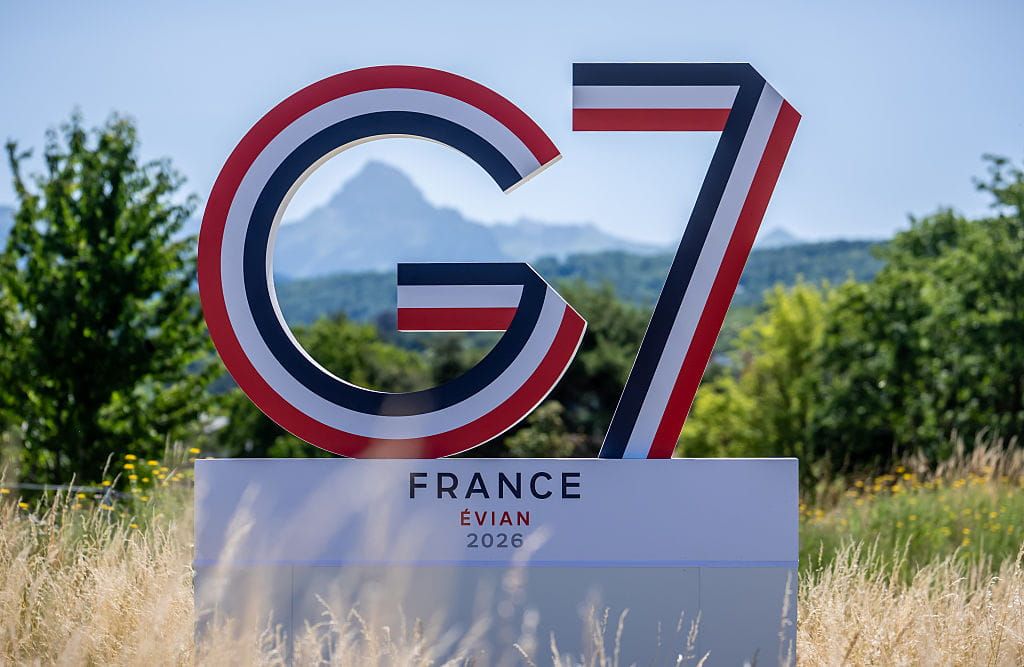
The G7 summit is underway in Évian-les-Bains, France, where leaders from three continents are trying to figure out just how to extricate themselves from a dependent relationship with the world’s most powerful nation. Or at least that is the theory. The reality might be something more akin to a doomed quest for relevance in an age that has been dominated by President Donald Trump.
G7 Beyond America?
As trust and faith in governments worldwide continue to slide, and the popularity of presidents and prime ministers sinks to historic lows, the embattled leaders all have one thing in common: They want to appear strong. Yet, despite the chorus of media decrying the end of “strong man” politics (presumably in favor of something more Trudeau-esque), the Group of Seven patriarchs and matriarchs are determined to cast an aura of strength. And the way to do that, apparently, is to cut ties with Trump.
Washington, DC’s most prominent publication posted the headline “At G-7, allies plan for a world less reliant on the U.S.” The authors encourage the US president to prepare for allies who are “increasingly willing to tell him no.” And they are correct, but not, perhaps, for the reasons they explain:
“An increasing number of leaders are exploring what a world looks like when America is no longer willing — or no longer expected — to lead every international response.”
But here’s the cold, hard fact: A significant percentage of these folks “reluctantly” putting themselves forward as leaders of international response are failing in their respective homefronts in ways that make Trump’s current approval hiatus look positively resplendent. They are failing to manage their own countries’ affairs to the point where it is not just their careers that are on the verge of collapse but also the very political ideologies they represent.
Let’s consider just where some of the G7 members are politically right now.
UK in Crisis
The United Kingdom and Prime Minister Sir Keir Starmer are in equal turmoil. Riots on the streets, attempted beheadings, stabbings, and police forces in disgrace over handcuffing a dying teen because he was called racist. This is the backdrop to Starmer’s attempts at playing the statesman. After winning a landslide victory just two years ago, he is now considered the least popular PM since such records began. Additionally, even his own party members in parliament are in the process of trying to remove him from office. A single by-election on June 18 may see the abrupt end of his premiership.
From a whopping majority in 2024, the Labour Party now regularly places third in opinion polling behind the Conservative Party in second place, and Nigel Farage’s Reform UK, which has placed first in more than 300 consecutive surveys. It is not just his own political legacy that Sir Keir has sunk but also his party’s 100-year history as one of the top two political outfits in the nation.
A Bloodless Revolution in France
President Emmanuel Macron of France is term-limited and will not be able to run again for the top spot in 2027. His party, however, might not survive his presidency.
Polling so far in 2026 paints a grim picture for Macron’s Renaissance, barely registering in a number of surveys and, notably, falling behind Marine La Pen’s National Rally (Rassemblement National). While La Pen herself is currently unable to stand for any election due to what she claims is a biased conviction, her party continues to go from strength to strength. National Rally deputy Jordan Bardella is consistently hitting 35%, putting him almost 16 points clear of his closest competitor.
While this is just first-round voting intention, it seems that Macron’s chaotic tenure, which saw him lose six prime ministers, has tainted his party, his ideology, and to a large extent French belief in the professional-class politicians.
Who’s on Top in Germany?
German Chancellor Friedrich Merz is a staple of international parlays. As well as the top job in his country, he is also leader of his party, the Christian Democratic Union (CDU). But Germany might not be quite as united behind his cause for globalism as such prominent appointments suggest.
In fact, Merz relies on the support of two other parties to maintain his grip: the Christian Social Union (CSU) and the Social Democratic Party (SPD). Between them, they command in the polls roughly 31%. Not quite the iron grip of power one would expect. Which makes the Alternative for Germany’s (AfD) 29% all the more notable.
It is only through rainbow coalitions and power-sharing that Merz can keep the “far right” AfD from government, and with his personal approval rating hovering at a mere 15%, it doesn’t seem as if his star is on the ascent.
Oh, Canada
Soaring to power on a wave of anti-Trumpism, Canadian PM Mark Carney appears to have hit the skids. While his personal popularity remains high (around 55%), there are some major warning signs on the horizon.
As Liberty Nation News’ Andrew Moran recently explained, Canada is in recession after two straight quarters of negative growth, with unemployment at 7%, and as for stagflation:
“A wide array of metrics – business investment, capital formation, entrepreneurship, and more – show the same drop or flatlining during the [Justin] Trudeau years. The only upward movement in the charts has been in home prices and the number of newcomers.”
Quite the downturn from his “elbows out” campaign of just last year.
More America or Less?
That leaves Japan and Italy, Sanae Takaichi and Georgia Meloni, both of whom have been described as “far right” by the very media now suggesting the G7 is ready and willing to move away from an America-centric position. And while both leaders may want to exert sovereign control, when they are part of a group such as this exact one, it will almost always be a case of the bigger, stronger nation taking the leading role.
On one side of the equation, we have three political leaders who could rightly be described as nationalist in tendency and, on the other, four leaders who have embraced the globalist agenda, been rejected by their electorates, and are on the brink of taking their parties into the abyss with them.
Who do they think is going to end up as the leading voice of the G7?




-1024x683.jpg "Democrats Coy About Possible Trump Impeachment as Midterms Loom")