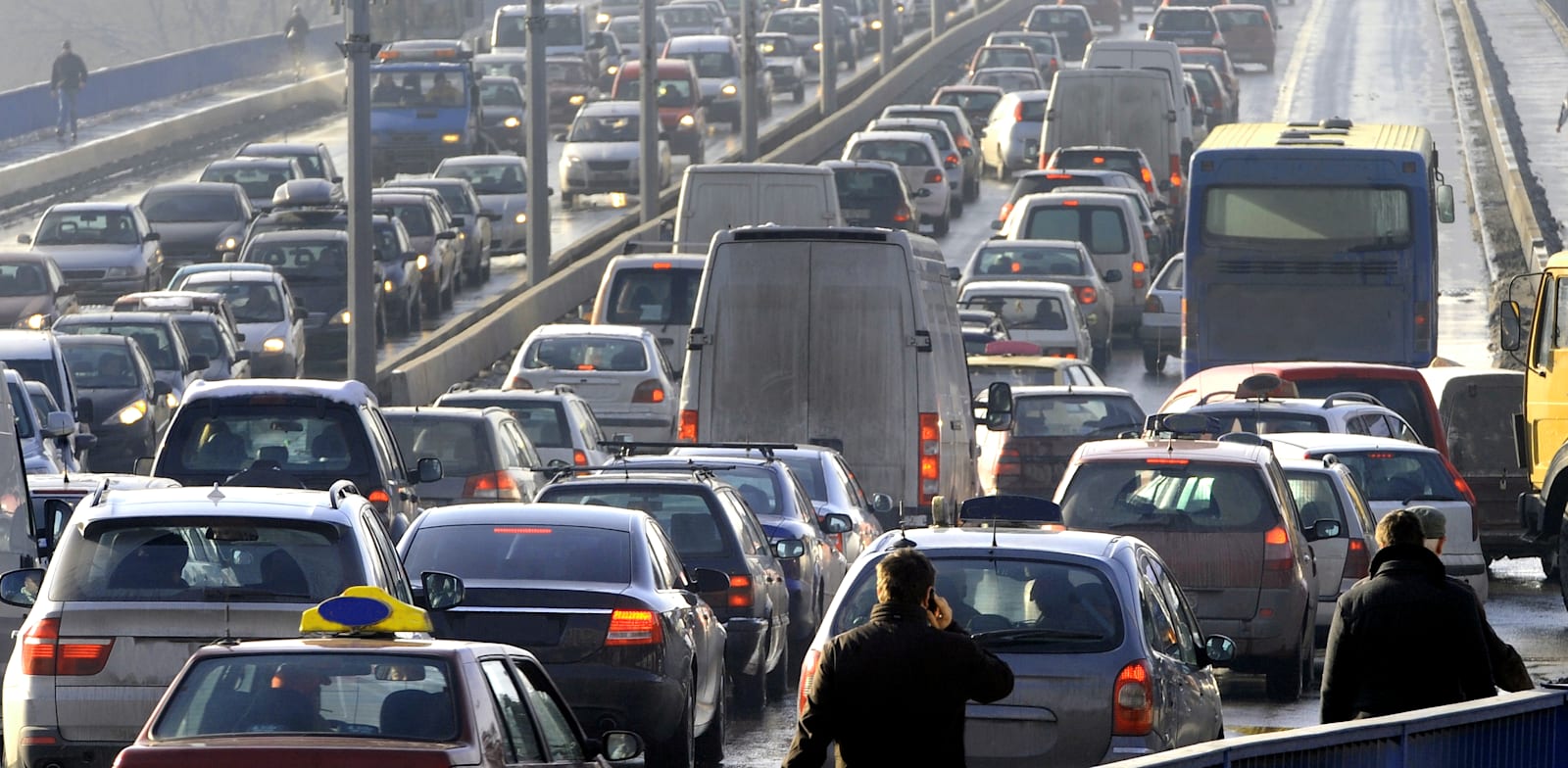
Israel continues to widen roads and add new lanes, but traffic congestion in metropolitan areas is not easing – and in some cases is even getting worse. A new study by the Bank of Israel Research Division points to one of the main reasons for this: As road capacity increases in urban areas, more households choose to own an additional vehicle and use cars more.
The study examined changes in the road network in Israel between 2015 and 2019 using detailed administrative data on some 3.2 million Israelis, along with data on car ownership, mileage, and spatial data on the road network in Israel.
The study delves into the phenomenon of “induced demand” – a situation in which road expansion initially eases traffic congestion, but at the same time encourages more people to use cars or purchase cars, so that traffic jams gradually return.
The analysis shows that almost any additional capacity on urban roads is quickly eaten up by increased car use. According to the study, expanding the capacity of the road network by 10% in urban areas leads to an increase of about 7.5% in the total number of trips in those areas. The effect is particularly pronounced in the metropolitan centers of Tel Aviv, Jerusalem, Haifa and Beersheva, where the additional roads are likely to almost completely neutralize the positive effect of expanding the infrastructure on reducing congestion.
While in urban areas, expanding road capacity was accompanied by an increase in trips, in non-urban areas the effect was much smaller – only about 1.2%.
Difficulty keeping up with increase in demand for cars
One of the key findings of the study concerns the mechanism that produces the increase in mileage. Contrary to the common assumption that drivers simply drive more when roads are widened, the Bank of Israel found that most of the change comes from purchasing decisions by households. According to the study, the increase in mileage stems mainly from an increase in the number of cars owned by households, and not from a major increase in the volume of use by existing car owners.
The group that stood out in the study is young families with low to medium income levels (income of NIS 5,000-7,500 per adult) who choose to purchase a second car following improved road accessibility.
According to the study, this pattern is particularly significant in Israel, where the rate of car ownership is still low relative to other countries with a similar income level, alongside an exceptionally high population growth rate. The meaning, according to the researchers, is that the potential for growth in the number of cars in Israel is still far from being exhausted – and therefore road expansion alone has difficulty keeping up with the rate of increase in demand for car travel.
Published by Globes, Israel business news – en.globes.co.il – on May 12, 2026.
© Copyright of Globes Publisher Itonut (1983) Ltd., 2026.