by Dennis Crouch
The UK Supreme Court this morning unanimously revived Tesla’s challenge to the royalty charged by the Avanci 5G licensing platform, and held along the way that the Delaware Court of Chancery is not an available forum for the dispute. Tesla, Inc. v. InterDigital Patent Holdings, Inc., [2026] UKSC 27 (27 July 2026). Lord Hamblen and Lord Kitchin wrote jointly, with Lord Sales, Lord Briggs, and Lord Burrows agreeing. The judgment reverses a divided Court of Appeal and adopts Lord Justice Arnold’s dissent on essentially every point. The forum ruling is the piece likely to interest American readers most. Tesla’s parent, both InterDigital entities, and Avanci are all US companies, the defendants offered to submit to Chancery in Del., but the Court still concluded that Delaware was unavailable, reasoning that a US court would probably not set a FRAND rate for UK patents.
The UK Supreme Court: Created by the Constitutional Reform Act 2005 and sitting since October 2009, it took over the judicial work of the House of Lords and is the final court of appeal for civil cases from England and Wales, Scotland, and Northern Ireland. It has twelve justices, styled Lord or Lady rather than Justice, and most appeals are heard by panels of five. Permission to appeal is normally decided on the papers by a panel of three, and the court below may also grant it. The Court of Appeal refused Tesla permission here; the Supreme Court granted it.
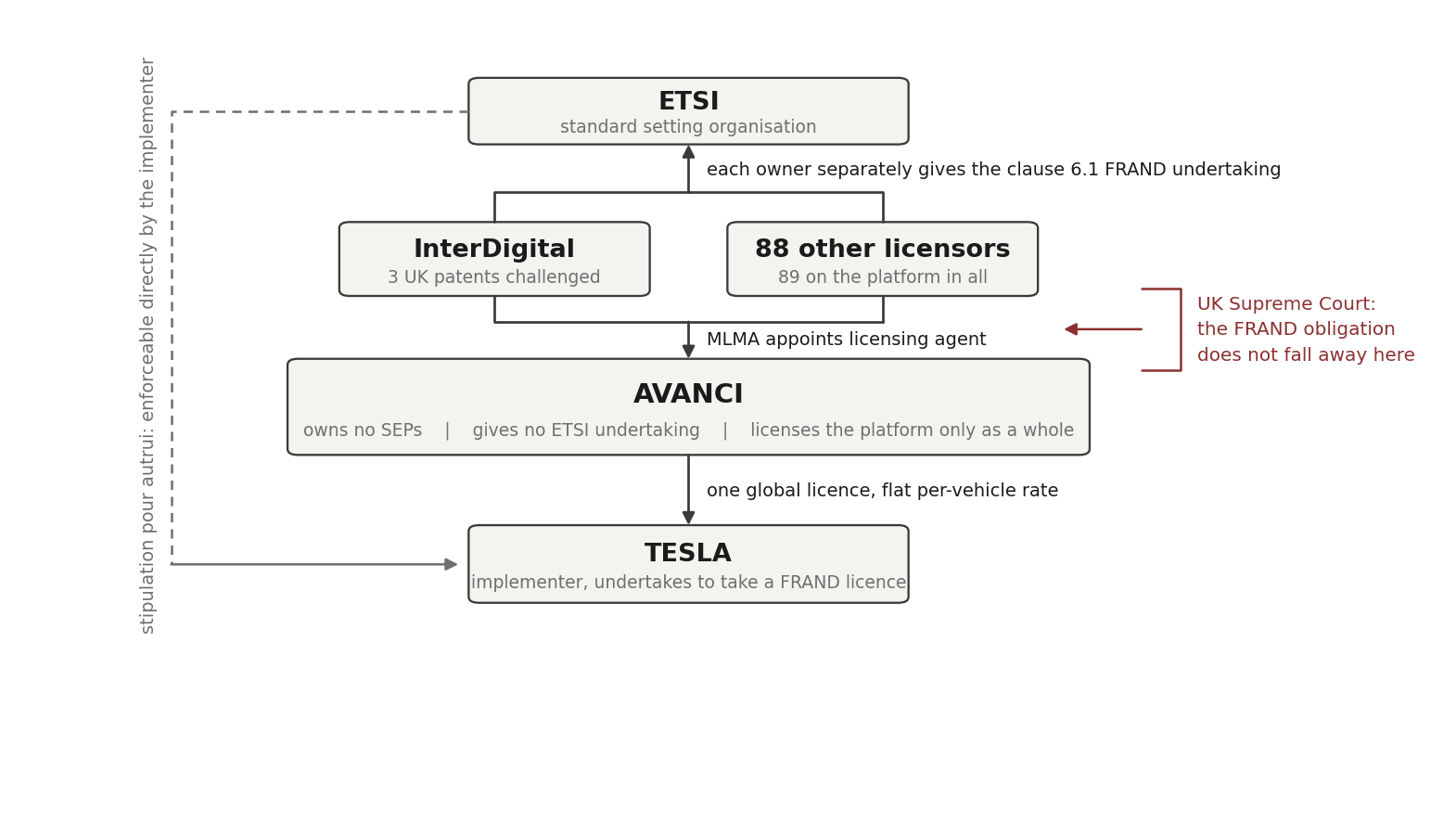
Avanci owns no standard essential patents. Rather, it runs a patent pool, which it calls a platform, acting as licensing agent for 89 companies that do (including InterDigital). Each of those companies has promised ETSI, the European body that writes the 5G specification, to license its essential patents on fair, reasonable and non-discriminatory terms. Avanci offers vehicle makers one global license covering the whole pool at a flat per-vehicle rate (the judgment’s illustration uses $32), and it has no contractual authority to license any subset.
To the Court of Appeal majority, each owner promised to license its own patents on FRAND terms and promised nothing at all about the price of the bundle. Tesla was therefore suing on a promise nobody had made. The Supreme Court disagreed, holding that Tesla has a real prospect of showing that a patent owner stays bound by its commitment when it licenses collectively, and a real prospect of showing that the only FRAND license of InterDigital’s UK patents in the pool is the pool license itself, at a rate the court sets.