New Internal Revenue Service data for taxA tax is a mandatory payment or charge collected by local, state, and national governments from individuals or businesses to cover the costs of general government services, goods, and activities. year 2023 shows the US federal income tax system continues to be progressive, as high-income taxpayers pay the highest average income tax rates. Average tax rates for all income groups were consistent with 2022 rates and remained below rates prior to the 2017 Tax Cuts and Jobs Act (TCJA).
In 2023, taxpayers filed 153.1 million tax returns, reported earning nearly $15.2 trillion in adjusted gross incomeFor individuals, gross income is the total of all income received from any source before taxes or deductions. It includes wages, salaries, tips, interest, dividends, capital gains, rental income, alimony, pensions, and other forms of income.
For businesses, gross income (or gross profit) is the sum of total receipts or sales minus the cost of goods sold (COGS)—the direct costs of producing goods(AGI), and paid $2.1 trillion in individual income taxes.
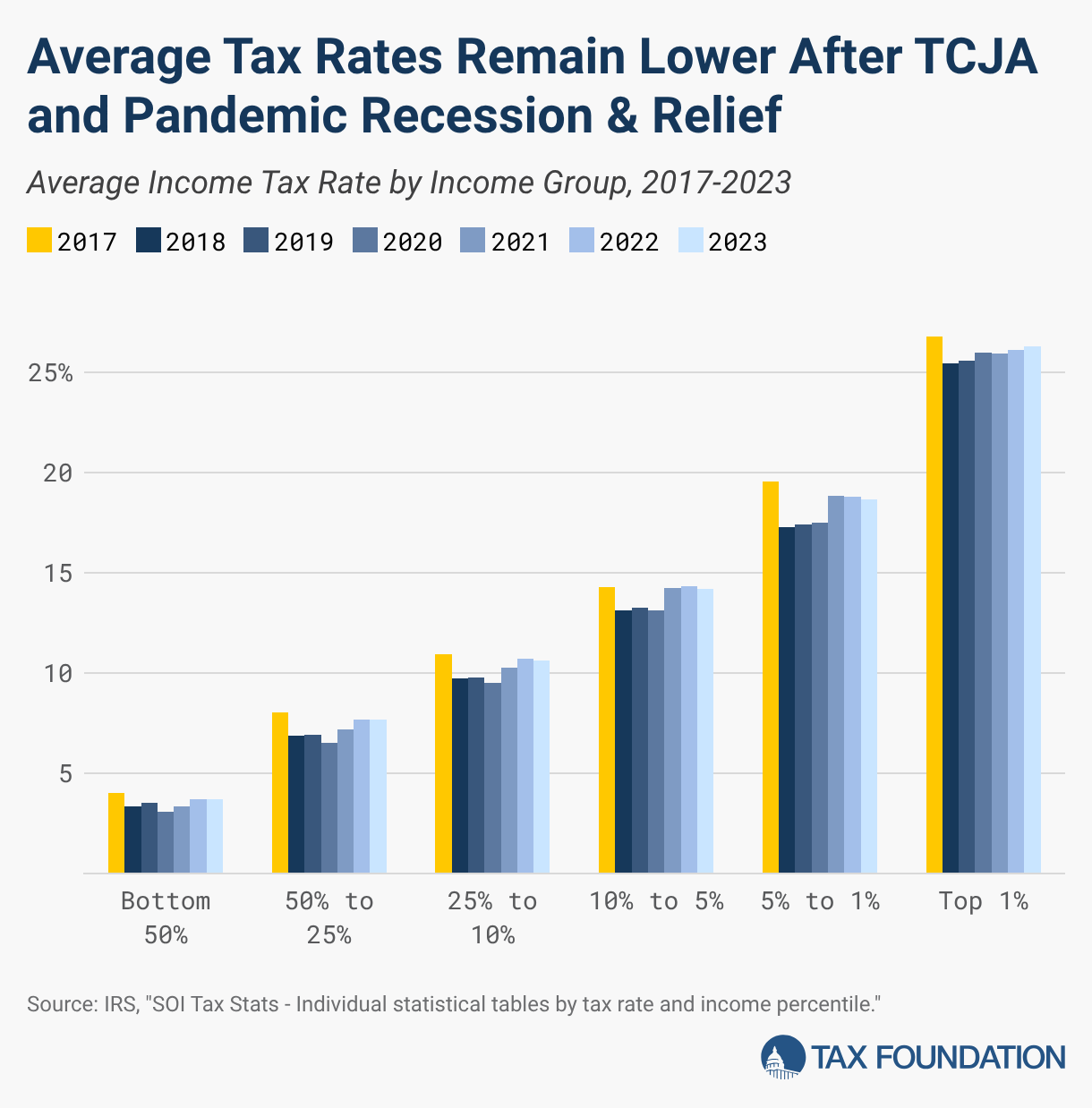
The average income tax rate in 2023 was 14.1 percent. The top 1 percent of taxpayers paid a 26.3 percent average rate, seven times higher than the 3.7 percent average rate paid by the bottom half of taxpayers.
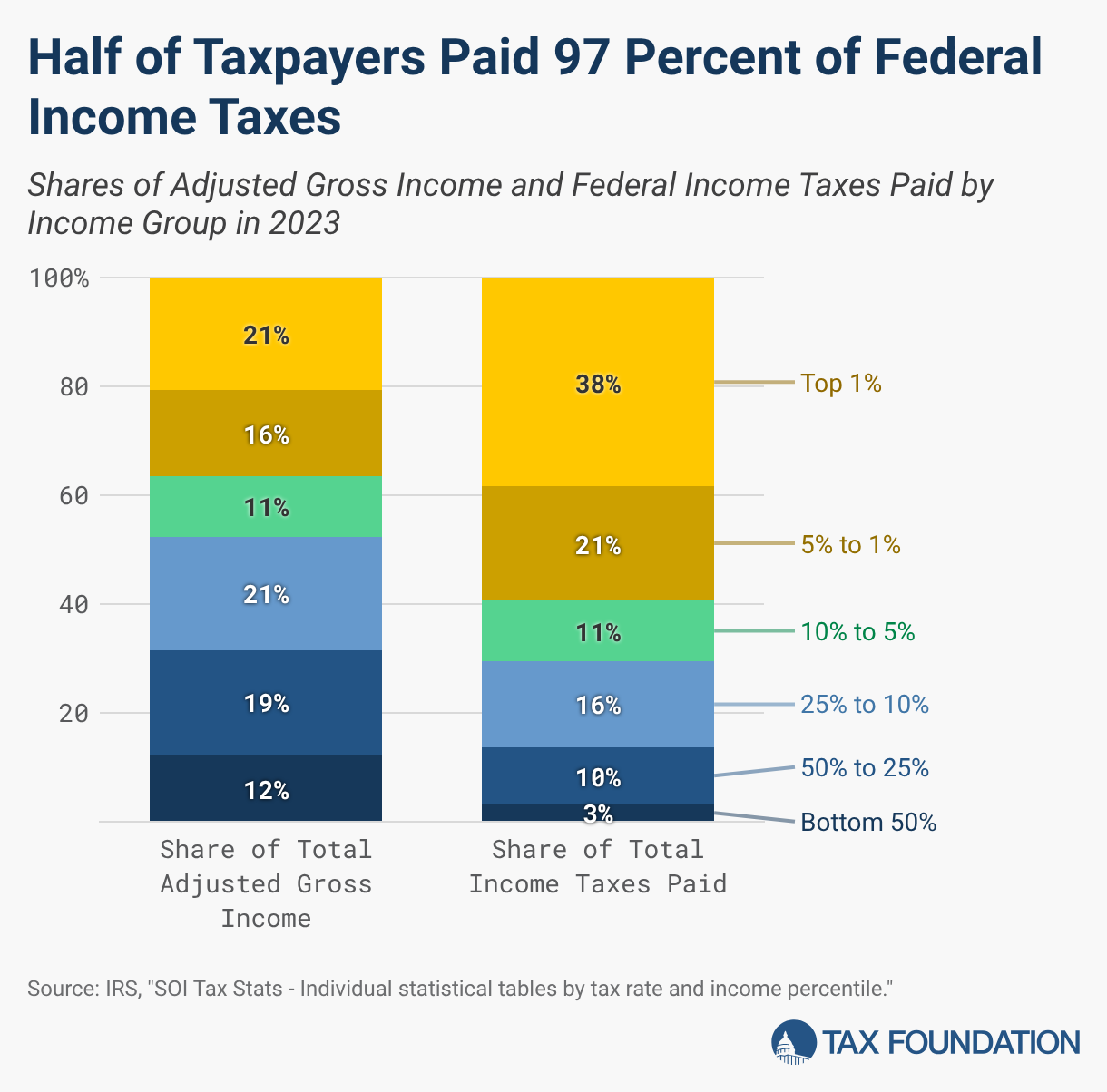
The top 1 percent’s income share fell for the second consecutive year from 22.4 percent in 2022 to 20.6 percent in 2023, and its share of federal income taxes paid fell from 40.4 percent to 38.4 percent.
The top 50 percent of all taxpayers paid nearly 97 percent of all federal individual income taxes, while the bottom 50 percent paid the remaining 3 percent.
Reported Income and Taxes Paid Rose in Tax Year 2022
Taxpayers reported nearly $15.2 trillion in AGI on 153.1 million tax returns in 2023, an increase of $445 billion in AGI across almost 725,000 fewer returns compared to 2022. Total income taxes paid remained nearly the same, rising only $8 billion (0.4 percent) to $2.14 trillion. The average individual income taxAn individual income tax (or personal income tax) is levied on the wages, salaries, investments, or other forms of income an individual or household earns. The U.S. imposes a progressive income tax where rates increase with income. The Federal Income Tax was established in 1913 with the ratification of the 16th Amendment. Though barely 100 years old, individual income taxes are the largest source rate eased down from 14.5 percent in 2022 to 14.1 percent in 2023.
Because the Office of Management and Budget (OMB) classifies the refundable part of tax credits as spending, the IRS does not include it in tax share figures. The result overstates the tax burden of the bottom half of taxpayers.
Table 1. Summary of Federal Income Tax Data, Tax Year 2023
Top 1%Top 5%Top 10%Top 25%Top 50%Bottom 50%All Taxpayers
Number of Returns1,530,7647,653,82215,307,64438,269,11176,538,22276,538,222153,076,443
Average Tax Rate26.2682%22.9749%20.9116%17.7736%15.5698%3.7326%14.1109%
Average Income Taxes Paid$537,908.52$166,136.08$98,821.48$48,363.21$27,104.12$913.41$14,008.76
Adjusted Gross Income ($ millions)3,134,6295,534,6367,233,90210,413,28113,323,8631,873,00715,196,869
Share of Total Adjusted Gross Income20.6268%36.4196%47.6013%68.5225%87.6751%12.3250%
Income Taxes Paid ($ millions)823,4111,271,5761,512,7241,850,8172,074,50169,9112,144,411
Share of Total Income Taxes Paid38.3980%59.2972%70.5426%86.3089%96.7399%3.2601%
Income Split Point$675,602$272,209$187,608$105,604$53,801$53,801
Note: Table does not include dependent filers. “Income split point” is the minimum AGI for tax returns to fall into each percentile. Total income tax was the sum of income tax after credits (including the subtraction of net premium tax credit repayment, the earned income credit, American opportunity credit, health coverage tax credit, recovery rebate, qualified sick and family leave credit, additional child tax credit, and the regulated investment credit) limited to zero plus net investment income tax from Form 8960 and the tax from Form 4970, Tax on Accumulation Distribution of Trusts. It does not include any refundable portions of the credits.
Source: IRS, “SOI tax stats – Individual statistical tables by tax rate and income percentile,” https://www.irs.gov/statistics/soi-tax-stats-individual-statistical-tables-by-tax-rate-and-income-percentile.
High-Income Taxpayers Paid the Highest Average Income Tax Rates
The bottom half of taxpayers, or taxpayers making under $53,801, faced an average income tax rate of 3.7 percent. Average income tax rates rise as household income increases. For instance, taxpayers with AGI between the 10th and 5th percentiles ($187,608 and $272,209) paid an average income tax rate of 14.2 percent—nearly four times the rate paid by taxpayers in the bottom half.
The top 1 percent of taxpayers (AGI of $675,602 and above) paid the highest average income tax rate of 26.3 percent—seven times the rate faced by the bottom half of taxpayers. The average income tax rate declines slightly for taxpayers in the top 0.001 percent (the 1,531 returns reporting more than $78.6 million in AGI), falling to 23.6 percent in 2023—still more than six times the average rate for the bottom half of taxpayers.
High-Income Taxpayers Paid the Majority of Federal Income Taxes
In 2023, the bottom half of taxpayers earned 12.3 percent of total AGI and paid 3.3 percent of all federal individual income taxes. The top 1 percent earned 20.6 percent of total AGI and paid 38.4 percent of all federal income taxes.
In all, the top 1 percent of taxpayers (1.5 million tax returns) accounted for nearly as much income taxes paid as the bottom 95 percent combined (145 million tax returns). The top 1 percent of taxpayers paid $823 billion in income taxes while the bottom 95 percent paid $872 million.
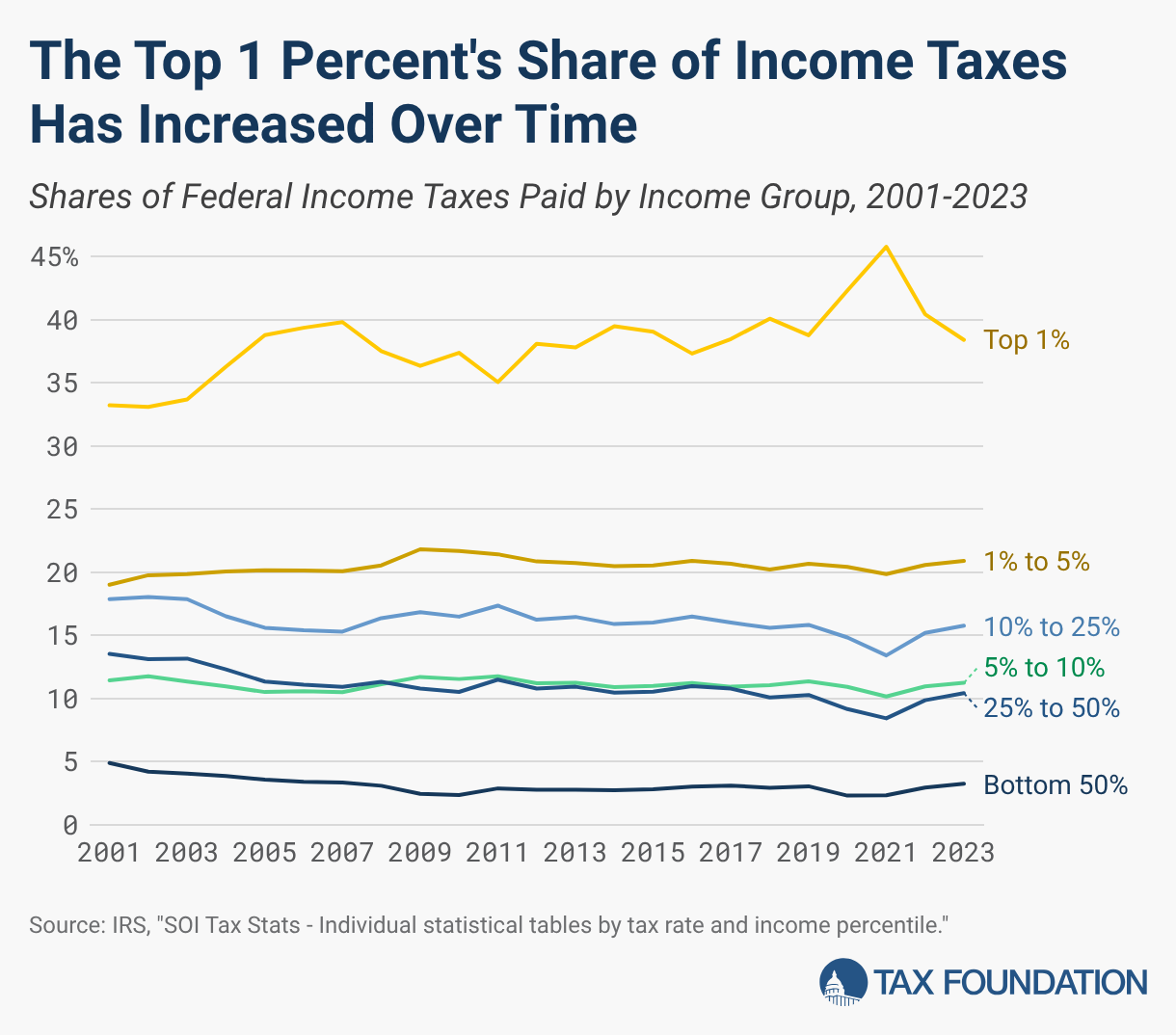
The share of income taxes paid by the top 1 percent increased from 33.2 percent in 2001 to 38.4 percent in 2023. While the share has generally been increasing over the period, 2020 and 2021 are outlier years largely because of significant changes in income and tax policy during the coronavirus pandemic, with the share peaking at 45.8 percent in 2021. Over the same period, the share of income taxes paid by the bottom 50 percent of taxpayers fell from 4.9 percent in 2001 to 3.3 percent in 2023.
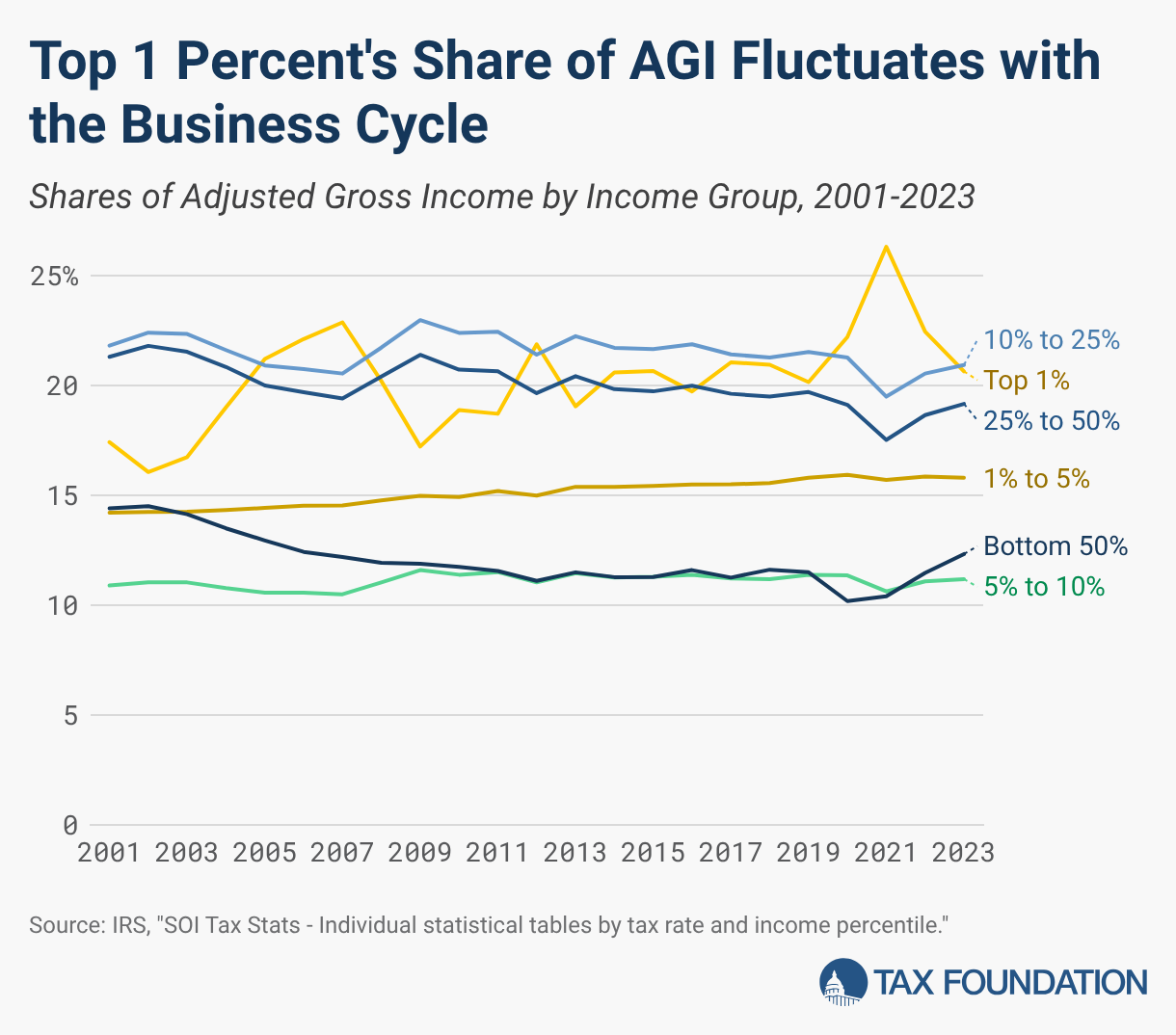
The share of adjusted gross income reported by the top 1 percent grew from 17.4 percent in 2001 to 20.6 percent in 2023, similar to pre-pandemic levels. The AGI share of the top 1 percent tends to fluctuate over the business cycle, rising and falling to a greater extent than income reported by other groups. This was particularly the case in 2021 as capital gains realizations increased sharply to reach their highest level in 40 years. The share of AGI reported by the bottom 50 percent of taxpayers fell from 14.4 percent in 2001 to 12.3 percent in 2023, generally declining through 2020 before recovering slightly in recent years to the highest level since 2006.
The Tax Cuts and Jobs Act Reduced Average Tax Rates Across Income Groups
The 2023 tax year was the sixth since the TCJA made many significant, but temporary, changes to the individual income tax code to lower tax rates, widen brackets, increase the standard deductionThe standard deduction reduces a taxpayer’s taxable income by a set amount determined by the government. Taxpayers who take the standard deduction cannot also itemize their deductions; it serves as an alternative. and child tax credit, and more. The changes lowered tax burdens, on average, for taxpayers across all income levels. Tax years 2020 and 2021 also show the effects of pandemic-related relief administered through the tax code. Although average tax rates have increased over the last few years as the economy has grown, they remain below their pre-TCJA (2017) levels across all income groups. The One Big Beautiful Bill Act (OBBBA), enacted in July 2025, extended the temporary changes of the TCJA, but that new law does not affect the tax year 2023 data in this report.
Appendix
For data prior to 2001, all tax returns that have a positive AGI are included, even those that do not have a positive income tax liability. For data from 2001 forward, returns with negative AGI are also included, but dependent returns are excluded. The unit of analysis is the tax return. In the figures prior to 2001, some dependent returns are included. Under other units of analysis (like the US Treasury Department’s Family Economic Unit), these returns would likely be paired with parents’ returns.
Income tax after credits (the measure of “income taxes paid” above) does not account for the refundable portion of tax credits, such as the EITC. If the refundable portion were included, the tax share of the top income groups would be higher, and the average tax rate of the bottom income groups would be lower. The refundable portion is classified as a spending program by the Office of Management and Budget (OMB) and therefore is not included by the IRS in these figures.
The only tax analyzed here is the federal individual income tax, which is responsible for more than 25 percent of the nation’s taxes paid (at all levels of government). Federal income taxes are much more progressive than federal payroll taxes, which are responsible for about 20 percent of all taxes paid (at all levels of government), and are more progressive than most state and local taxes.
AGI is a fairly narrow income concept and does not include income items like government transfers (except for the portion of Social Security benefits that is taxed), the value of employer-provided health insurance, underreported or unreported income (most notably that of sole proprietors), income derived from municipal bond interest, net imputed rental income, and others.
These figures represent the legal incidence of the income tax. Most distributional tables (such as those from the Congressional Budget Office (CBO), the Tax Policy Center, Citizens for Tax Justice, the Treasury Department, and the Joint Committee on Taxation (JCT) assume that the entire economic incidence of personal income taxes falls on the income earner.
Download Data
Stay informed on the tax policies impacting you.
Subscribe to get insights from our trusted experts delivered straight to your inbox.
Subscribe
Share this article