
Updated for tax year 2026.
If you recently started an LLC or small business, you’ve probably heard you can write off a vehicle for tax purposes. And that’s true! But the process isn’t as simple as buying a car and calling it a business expense. Whether you use your car a few days a week for client meetings or drive for business full-time, there are multiple ways to write off car-related expenses depending on how you use the vehicle, how you purchased it, and how well you keep records.
In this guide, we’ll break down how the IRS handles business vehicle tax deductions, explain your tax write-off options, and walk you through choosing the best method for your situation. We’ll also get into depreciation rules, Section 179, bonus depreciation, and how to claim it all using TaxAct®.
Who can write off a car as a business expense?
Not every vehicle qualifies for a tax deduction, and not every business owner can claim one. The IRS has clear rules about who can write off a car purchase or ongoing vehicle expenses — it all starts with how the vehicle is used.
You can generally claim a vehicle deduction for your LLC or other business type if:
You’re a sole proprietor, part of a partnership, or operating as an LLC, S corp, or corporation.
You’re self-employed or earn business income through freelance, contract work, gig work, or owning a small business.
The vehicle is used for business purposes, such as driving to client meetings, hauling equipment, or making deliveries.
But here’s the catch: The IRS only lets you deduct the business-use portion of the car. For example, if you use it 80% for business purposes and 20% for personal use, you can only deduct 80% of the eligible vehicle expenses.
Now that we’ve covered who qualifies, let’s dive into how the deduction works.
When can you write off taxes on a car?
You can only write off your car on your federal tax return if you’re using it for actual business purposes, not just cruising to the office every morning.
Here are some examples of what counts as qualifying business travel for an auto deduction:
Driving to meet with clients
Heading out to visit job sites
Making deliveries for your small business
Traveling between different office locations
Does my commute count toward business miles?
Regular commuting — the drive from your home to your main office — isn’t considered business mileage. The IRS treats that as a personal expense, even if you take work calls the whole way there.
However, if your home is your primary place of business — say, you’re a self-employed consultant working out of a home office — and you drive to meet clients or visit worksites, your travel could qualify for a business mileage deduction.
How to write off a car for business tax deductions
How you deduct your vehicle and any related expenses depends on your chosen deduction method. The IRS gives you two options: the standard mileage rate or the actual expense method.
Standard mileage vs. actual expenses: What’s the difference?
1. Standard mileage rate
This method is simpler than calculating actual expenses. To figure your deduction, simply multiply the business miles you drove during the tax year by the IRS standard mileage rate for businesses.
For 2025, the standard mileage rate is 70 cents per mile.
For 2026, the standard mileage rate is 72.5 cents per mile.
This flat rate includes most of your car expenses — depreciation, gas, maintenance, and other typical vehicle expenses. You can’t deduct those items separately under this method.
However, you can still deduct some additional costs not built into the standard mileage rate, including:
Car registration fees and property taxes
Parking and tolls
Auto loan interest paid
When the standard mileage rate isn’t allowed
You can’t use the standard mileage rate if you:
Standard mileage rate example
Say you drove 15,000 business miles in 2026. Here’s how you would calculate your deduction using the standard mileage method:
15,000 miles x $0.725 (the 2026 standard mileage rate) = $10,875 deduction
Need help crunching the numbers? Our Mileage Reimbursement Calculator makes it easy to estimate your deduction using the standard mileage rate.
Tax tip: To use the standard mileage rate in future years, you must use it in the first year of business use. If you claim actual expenses in the first year, you’re stuck with it — you can’t switch to the standard method later. However, starting with the standard mileage rate allows you to switch between methods in future years (unless you’re leasing the car).
2. Actual expense method
This method takes more work but can sometimes yield a bigger deduction depending on your circumstances.
To calculate your deduction using actual expenses, you’ll need to track and add up everything it costs to operate the car. This can include:
Gas and oil costs
Insurance
Garage rent
Repairs and maintenance
Depreciation (if you own the vehicle) or lease payments
Section 179 deduction
Registration fees and taxes
Parking and tolls
Auto loan interest paid on car payments
Once you’ve calculated the total cost of everything, multiply it by your business-use percentage.
Actual expenses example
Let’s say your total vehicle expenses were $12,000 in 2026. You drove 20,000 miles, and 15,000 (or 75%) of those were for business purposes, just like the example we used for the standard mileage rate.
Your business miles determine your business use percentage, which determines your deduction percentage. Here’s how you would calculate your deduction:
$12,000 actual expenses x 75% (business use percentage) = $9,000 deduction
Tax tip: If you want to use Section 179 expensing or bonus depreciation (more on these below) in the first year you placed the vehicle in service, you must use the actual expenses method and cannot switch to the standard mileage rate in future years.
Which method is better?
Neither deduction method is inherently better than the other — it all depends on your situation. As you can see from the examples we used, even though the business miles were the same in both examples, the standard mileage rate resulted in a larger deduction.
How to choose: standard mileage rate vs. actual expenses
If you drive a lot of business miles and your car is relatively inexpensive to maintain, the standard mileage rate might be easier and just as valuable (or more valuable!).
If your car is new, expensive, or used mostly for business, the actual expense method (including claiming Section 179) might give you a higher deduction, but it requires more meticulous recordkeeping.
For both methods, you’ll need to track your business vs. personal use by keeping a business mileage log.
Still not sure which method is better for you? Don’t be afraid to consult a CPA or tax professional for advice!
Claiming section 179 and bonus depreciation for your business vehicle
What is the section 179 deduction?
Section 179 allows small business owners and self-employed taxpayers to deduct the cost of qualifying business vehicles in the first year they’re placed in service, instead of spreading that depreciation over several years. This can result in significant tax savings, but only if your vehicle qualifies.
Who qualifies for section 179?
To qualify for the Section 179 depreciation deduction, the vehicle must be:
New or used (but new to you)
Purchased and put into service during the same tax year
Used more than 50% of the time for business purposes
Section 179 deduction vs. bonus depreciation
Bonus depreciation (also called the special depreciation allowance) is another accelerated form of depreciation. Both can help you write off vehicle costs faster, but they work differently:
Bonus depreciation was originally capped at 40% for 2025 and 20% for 2026, but the Working Families Tax Cuts (One Big Beautiful Bill) restored 100% bonus depreciation for qualifying property acquired after Jan. 19, 2025, and placed in service before Jan. 1, 2030.
For heavy SUVs and many commercial vehicles over 6,000 pounds GVWR, that can mean deducting the full business-use portion of the vehicle’s cost in the first year. However, light passenger vehicles still have a separate first-year deduction cap, even when bonus depreciation applies. We’ll go over what this means below.
Bonus depreciation eligibility requirements
To qualify for bonus depreciation, you must meet all the following tests:
You acquired the car after Jan. 19, 2025, with no binding written contract in place before Jan. 20, 2025 (for 100% bonus depreciation under the One Big Beautiful Bill).
You bought the car either new or used.
You placed the car in service in your trade or business during the tax year.
You used the car more than 50% of the time for business purposes during the tax year.
Can I take section 179 and bonus depreciation in the same year?
Yes, as long as you meet the requirements for both. However, you must take Section 179 deductions before taking bonus depreciation. For example, you can deduct the cost up to the annual limit with Section 179 and then use bonus depreciation on the remainder.
Deduction limits based on vehicle type
The IRS categorizes vehicles into three types for Section 179: light, heavy, and other. The gross vehicle weight rating (GVWR) determines these categories, and each type has different deduction limits.
Vehicle deduction limits change slightly from year to year. Here’s a quick comparison of the 2025 and 2026 thresholds for business vehicles:
The sections below further explain the differences between light vehicles, heavy SUVs, and other commercial vehicles.
Light vehicles (under 6,000 pounds GVWR)
Includes many passenger cars, such as sedans, crossover SUVs, and compact pickups.
These vehicles face the strictest first-year deduction limits of any category (see the table above for current caps).
You can use Section 179 first, then bonus depreciation on any remaining basis, but the total first-year deduction cannot exceed the total cap shown in the table.
If you use the car for both business and personal driving, reduce the limits in the table based on your business-use percentage.
Heavy SUVs and other vehicles (6,001 to 14,000 pounds GVWR)
Includes many full-size SUVs, as well as some cargo vans and heavy-duty pickups.
Heavy SUVs have a Section 179 cap (see table), but unlike light vehicles, they are not subject to the separate total first-year cap that applies to passenger cars.
After claiming Section 179 up to the SUV limit, the remaining basis may qualify for 100% bonus depreciation with no additional dollar cap (assuming the vehicle otherwise qualifies).
Tax tip: Some heavy pickups, cargo vans, and other commercial vehicles in this weight range are not subject to the heavy SUV Section 179 cap. Vehicles with a cargo bed of at least six feet, seating for more than nine passengers behind the driver, or certain enclosed commercial designs may qualify for a larger first-year deduction.
Other vehicles (special-use or over 14,000 pounds GVWR)
Includes shuttles, delivery vans with long cargo areas, hearses, and vehicles with no seating behind the driver.
These vehicles generally aren’t subject to the special Section 179 limits that apply to passenger vehicles and heavy SUVs.
You may be able to deduct the full business-use portion of the vehicle’s cost in the first year through Section 179 and bonus depreciation (subject to the overall annual Section 179 deduction limit and other IRS eligibility rules).
You can find the full list of depreciation limits for vehicles in IRS Publication 463.
Tax tip: If you don’t deduct the full cost of a qualifying vehicle in the first year using Section 179 or bonus depreciation, you can usually recover the remaining cost over time through regular depreciation deductions.
Section 179 calculation example
Let’s say you bought a used car in May 2026 for $40,000. The vehicle’s GVWR is 3,500 pounds (light vehicle), and you use it 60% for business. Here’s how the Section 179 deduction would work:
First, figure out the business-use cost:
$40,000 purchase price × 60% business use = $24,000 business-use cost.
Next, apply the 2026 Section 179 limit based on your business-use percentage:
At 60% business use, your maximum Section 179 deduction is $7,380 (60% × $12,300 section 179 limit).
Your total first-year deduction (including bonus depreciation) is capped at $12,180 (60% × $20,300 total limit).
Since your business-use cost ($24,000) exceeds the total first-year cap, you can claim:
Section 179 deduction: $7,380
Bonus depreciation: $4,800 ($12,180 total cap − $7,380 section 179 cap)
Total first-year deduction: $12,180
But remember, the remaining $11,820 of your business-use cost ($24,000 − $12,180) isn’t lost! You can generally recover it over future tax years using regular depreciation deductions.eduction = $1,560), you can take bonus depreciation if your vehicle meets the requirements. If not, you can carry forward the remaining $1,560 to depreciate in future years starting in 2025.
Using IRS Form 4562 to claim vehicle deductions
If you claim Section 179 or bonus depreciation, you must file IRS Form 4562 with your income tax return. This form covers depreciation and amortization for business assets.
TaxAct makes this part easy — you’ll enter your vehicle details during our tax preparation software’s guided interview, and it’ll automatically generate Form 4562 and attach it to your return.
Business vehicle recordkeeping tips
No matter which deduction method you choose, keeping detailed and accurate vehicle records is important. That includes:
A mileage log (with date, destination, purpose, and total miles driven)
Receipts for gas, insurance, repairs, and other expenses
Odometer readings at the start and end of the year
Purchase or lease agreements if you’re depreciating the vehicle
Remember, the IRS won’t just take your word for it. You’ll need this documentation to back up your deduction if you happen to get audited. If you need help, IRS Publication 463 has a section on how to prove vehicle expenses.
How to write off a business vehicle with TaxAct
No matter which method you choose, TaxAct’s tax preparation software walks you through claiming a vehicle deduction step-by-step.
Here’s how you can enter vehicle expenses when e-filing with us:
Dashboard (Online)
From within your TaxAct return, click Income. On smaller devices, click the menu at the top left corner of your screen, then make your selection.
Expand the Business & Self Employed section.
Click Add beside Self-Employment/Gig Work (Schedule C) as shown below.
Continue with the interview process to enter your information. You will eventually be prompted to choose your expenses and pick the actual or standard method for your vehicle.
Classic
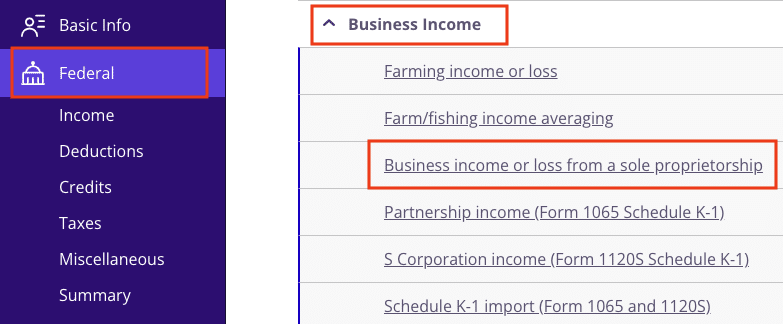
From within your TaxAct return, click Federal. On smaller devices, click the menu at the top left corner of your screen, then make your selection.
Click the Business Income drop-down, then click Business income or loss from a sole proprietorship.
Click Add Schedule C as shown below.
Continue with the interview process to enter your information. You will eventually be prompted to choose your expenses and pick the actual or standard method for your vehicle.
Business vehicle deduction FAQs
The bottom line
If you understand how your vehicle is used for business purposes, choose the right deduction method, and keep detailed records, you’ll be in a great spot to lower your taxable income and maximize your tax savings. Remember, choosing the right vehicle deduction method in your first year and maintaining good recordkeeping can greatly affect your overall tax bill.
When you’re ready to file, TaxAct makes it easy. Our step-by-step guidance can help you claim the right tax deductions for your business vehicle without the headaches. We’ll help you file confidently, maximize your savings, and make sure you don’t leave any money on the table.
And if you’re still unsure about the best way to write off your business vehicle, don’t forget about Xpert AssistTM. We have credentialed tax experts on hand who can help answer questions you may have when filing.1
This article is for informational purposes only and not legal or financial advice.
All TaxAct offers, products and services are subject to applicable terms and conditions.
1 Tax Experts are available with TaxAct® Xpert Assist®, which encompasses a suite of services designed to provide varying levels of support and assistance for your tax filing needs. These services are available at an additional cost and are subject to limitations and restrictions. Service availability, features, and pricing may vary and are subject to change without notice. For more details, read full terms.
The One Big Beautiful Bill is now also being referred to by lawmakers as the Working Families Tax Cut Act. You may see one or both names used in this article, but they refer to the same set of tax changes.