
Highlights
AI streamlines tax planning by analyzing data and identifying opportunities for advisors to evaluate.
Tax professionals remain essential as AI supports but cannot replace human judgment and client relationships.
Firms use AI in tax planning for strategy identification, workflow consistency, and efficient client communication.
Tax planning is among the most valuable services accounting firms can provide. But an increasingly complex regulatory and legislative environment, staffing constraints, and shifting client expectations have also made it one of the most challenging services to deliver consistently.
AI is helping more and more firms address these challenges by making tax planning more efficient and scalable. However, understanding how to use AI effectively and responsibly is key.
Jump to ↓
What is AI in tax planning?
Is AI going to replace tax advisors?
How can AI help advisors prepare for tax planning meetings?
What is the best use of AI in tax planning?
What are the best practices for using AI responsibly in tax planning?
Which AI tool is best for tax planning?
What is AI in tax planning?
AI in tax planning describes the use of artificial intelligence to support the tax planning process before, during, and after client engagements. With the ability to swiftly analyze large amounts of data, identify patterns, and summarize technical guidance, AI can help practitioners identify potential planning opportunities based on a client’s financial situation.
The technology is designed to support — not replace — the advisor’s expertise. AI can organize information and suggest areas for further analysis, but the tax professional remains responsible for validating recommendations, interpreting tax law, and determining which strategies best align with a client’s goals.
The interest in AI for tax planning continues to grow as the benefits become increasingly clear. According to the 2026 AI in Professional Services Report by Thomson Reuters Institute, 65% of tax and accounting professionals said they would feel comfortable with AI providing strategic tax planning recommendations. The report also identified tax research and advisory as leading professional use cases for AI (69% and 58%, respectively), reflecting the profession’s growing confidence in using AI to enhance higher-value client services.
[Click to enlarge image]
Heather Sunderlin, Principal Business Advisory Consultant at Thomson Reuters, said firms are exploring AI for three primary reasons: increasing workload, growing tax complexity, and rising client expectations.
“Firms are having to do more advisory work with the same or fewer people, while tax law gets more complex and changes faster than any one person can track. At the same time, clients are asking for and wanting tailored insights and are looking for advice,” Sunderlin said.
Is AI going to replace tax advisors?
The short answer: no. If you’re among those who believe AI will eventually replace tax advisors, think again. In fact, the opposite is true. AI is most valuable when it complements an advisor’s expertise rather than attempting to replace it.
Tax planning requires far more than identifying potential deductions or summarizing tax law. Advisors must understand a client’s financial objectives, family circumstances, business goals, investment strategy, and risk tolerance. Those conversations require experience, judgment, and trust. These qualities cannot be replicated by AI.
Instead, AI excels at handling many of the time-consuming tasks that occur before professional judgment is applied.
Sunderlin likened AI to “a highly efficient junior assistant, not a signing partner.” Advisors still need to review every recommendation, verify the supporting authority, and determine whether a strategy is appropriate for the client before providing advice.
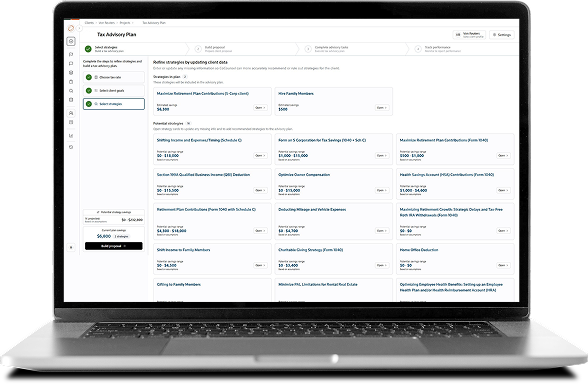
“AI adds the most value when it handles the ‘front‐end heavy-lifting’ so the advisor can focus on interpretation and relationships. Thomson Reuters Ready to Advise, for example, can take in client information and rapidly map it to planning themes and tax saving opportunities: retirement readiness, business transition, entity structure, charitable planning, and so on. That means by the time the firm sits down with the client, they have a structured list of topics and potential strategies to evaluate,” Sunderlin explained.
Sunderlin continued, “CoCounsel can then help with the technical side — researching, surfacing relevant rules, and helping draft internal notes or client‐facing explanations. But in both cases, the firm is still the one prioritizing which strategies actually fit the client, explaining the benefits, scope, and fees, and helping them make decisions. The AI does not replace the advisor; it amplifies their ability to scale quickly and show up prepared, consistent, and clear.”
Another misconception, Sunderlin noted, is that AI functions primarily as a “glorified search engine.” While general-purpose AI tools often yield broad responses, tax-specific AI solutions are built on authoritative tax content and established planning workflows. The value lies not only in finding information but also in helping advisors move from client facts to planning issues and, ultimately, to actionable strategies.
How can AI help advisors prepare for tax planning meetings?
Preparation is often one of the most time-consuming parts of a tax planning engagement. Advisors may need to review prior-year returns, client questionnaires, financial statements, meeting notes, entity structures, and recent tax law changes before discussing planning opportunities. AI can significantly streamline that preparation.
Rather than starting with a blank page, advisors can use AI to quickly assemble relevant client information into an organized planning framework. For example, AI can:
Organize client information from multiple sources
Summarize prior-year returns and planning notes
Identify potential tax-saving strategies based on a client’s fact pattern
Research applicable tax guidance
Draft planning memos, emails, and other client communications
These capabilities help advisors begin planning engagements with more complete information while reducing the amount of manual preparation required.
Planning-focused AI tools can also analyze a client’s fact pattern and highlight areas that may warrant further discussion, including retirement planning, business succession, entity structure, charitable giving, and other tax-saving opportunities.
Sunderlin noted that this preparation changes the nature of the client meeting itself. “When the firm goes into the meeting with the client or prospect, they are not spending the first 20 minutes orienting themselves. They can immediately focus on listening, clarifying priorities, and helping the client understand their options and make informed decisions about how they want to move forward,” Sunderlin said.
What is the best use of AI in tax planning?
While AI can support many aspects of the tax planning process, its greatest value lies in helping advisors work more proactively and consistently. Today, advisors are finding immediate value in three key areas: strategy identification, workflow support, and client communication.
Strategic identification: Planning-focused AI tools can scan client fact patterns, identify potential tax-saving opportunities, and organize those ideas into a structured plan for the advisor to evaluate.
Workflow support: AI enhances the consistency of tax-planning workflows. The technology can help standardize planning by organizing client information, prompting consistent questions, documenting recommendations, and creating repeatable workflows across engagements.
Client communication: AI can help advisors draft client emails, planning summaries, follow-up letters, and internal documentation based on completed research and planning discussions. These drafts provide a strong starting point and allow advisors to tailor each recommendation to the client’s specific circumstances.
“The real magic is the combination [of those three areas]. AI helps you spot more potential strategies, move them through a consistent process, and then communicate them to the client in a way that’s faster and clearer than doing it all manually,” Sunderlin said.
What are the best practices for using AI responsibly in tax planning?
As firms incorporate AI into tax planning, maintaining professional standards remains essential. AI should enhance the advisor’s work, not diminish the quality or reliability of client advice.
Consider these best practices when integrating AI into tax planning:
Keep advisors in control. AI should support professional judgment, not replace it. Every recommendation should be reviewed and approved by a tax professional before being shared with a client.
Verify recommendations. AI-generated suggestions should always be validated against current tax law, supporting authority, and the client’s individual facts and circumstances.
Protect client information. Tax planning involves highly sensitive financial data. Firms should understand how AI vendors manage security, privacy, and governance before incorporating AI into client engagements.
Adopt AI gradually. Rather than redesigning every workflow at once, begin by introducing AI into existing planning activities such as meeting preparation, technical research, documentation, or client communications.
Train your team. Advisors should understand both the strengths and limitations of AI so they know when to rely on automation and when professional judgment is required.
The right AI solution depends on a firm’s goals, existing technology stack, and advisory workflows. While general-purpose AI tools can assist with basic writing and summarization tasks, tax planning requires solutions built specifically for the tax profession.
When evaluating AI tools for tax planning, firms should look for several key capabilities:
Tax-specific capabilities. Choose a solution built for tax research, planning, and advisory workflows, not a general-purpose AI chatbot. Tax-focused tools are designed to understand tax content, apply relevant guidance, and support how tax professionals work.
Transparency and human oversight. Look for AI that explains how it arrived at its recommendations, lets you review and adjust assumptions, and keeps the advisor in control of every final decision.
Data security and governance. Select a solution with enterprise-grade security and clear policies for protecting client data, managing privacy, and supporting responsible AI use.
Workflow integration. The tool should fit naturally into your existing processes, helping you prepare for meetings, analyze client information, document recommendations, and communicate with clients more efficiently, without requiring you to overhaul your workflow.
How Ready to Advise makes an impact for advisory firms
For firms looking to build a more proactive tax planning process, solutions such as Ready to Advise by Thomson Reuters can be a strong option.
“Ready to Advise gives us the confidence because we know it’s built on the backbone of [the Checkpoint] research platform we’ve trusted since the firm was founded,” said Chris Papin, Managing Partner, Papin CPA PLLC.
With Ready to Advise, Papin CPA saw a noticeable shift in how its team approached advisory work. With the platform’s ability to reveal insights early in the client lifecycle, conversations have become more strategic and forward-looking.
Excited by the promise to modernize the advisory process, Lanphier LLP also adopted Ready to Advise. The impact has been transformative, helping the firm move beyond the limitations of a manual advisory model. By embedding AI into its workflows, the firm has unlocked new levels of efficiency, consistency, and strategic depth.
“There’s only so much we can prioritize and manually analyze. The potential with AI in Ready to Advise to expand the volume of potential strategies with our clients is what we’re looking forward to,” said Brittany Lanphier, Managing Partner at Lanphier LLP.
As client expectations continue to evolve, proactive tax planning is becoming a defining characteristic of successful advisory practices. However, AI-powered tax planning works best when it helps advisors prepare smarter, spot opportunities faster, and deliver more consistent guidance, without replacing the human judgment clients rely on.
Learn more about Ready to Advise today, and see how the solution can transform your firm’s tax planning services.
Free demo
Elevate your tax planning advisory services with Ready to Advise
Request demo ↗