No Result
View All Result
SUBMIT YOUR ARTICLES
  • Login
Saturday, August 1, 2026
TheAdviserMagazine.com
  • Home
  • Financial Planning
    • Financial Planning
    • Personal Finance
  • Market Research
    • Business
    • Investing
    • Money
    • Economy
    • Markets
    • Stocks
    • Trading
  • 401k Plans
  • College
  • IRS & Taxes
  • Estate Plans
  • Social Security
  • Medicare
  • Legal
  • Home
  • Financial Planning
    • Financial Planning
    • Personal Finance
  • Market Research
    • Business
    • Investing
    • Money
    • Economy
    • Markets
    • Stocks
    • Trading
  • 401k Plans
  • College
  • IRS & Taxes
  • Estate Plans
  • Social Security
  • Medicare
  • Legal
No Result
View All Result
TheAdviserMagazine.com
No Result
View All Result
Home College

Math is Out, Cake is In: Introducing Students to Rubrics – Faculty Focus

by TheAdviserMagazine
11 months ago
in College
Reading Time: 4 mins read
A A
Math is Out, Cake is In: Introducing Students to Rubrics – Faculty Focus
Share on FacebookShare on TwitterShare on LInkedIn


Rubrics are a valuable tool that supports student growth and facilitates instructor grading and feedback (Suskie, 2018). As instructors, we see this value; unfortunately, many of our students, especially first-year students, are unfamiliar with the concept. This presents an opportunity to raise their awareness of a tool that will benefit them as they master concepts and seek course success.  

The Context

During a two-week mathematics-focused summer bridge program, I teach a segment called Behind the Scenes, which highlights various success strategies students will need to leverage to be successful in college. One lesson exposes these students to the concept of rubrics, covering everything from their purpose, structure, and application.  

The Illustration

As noted by Doyle and Zakrajsek (2018), “The human brain is constantly looking for connections. Connections help you use prior knowledge to build bridges to the new material, creating a more meaningful understanding of the new material” (p. 15). Building off this idea, the lesson begins with an illustration about desserts, specifically cake, a concept which will resonate with most if not all students. The following instructions are given:  

I took a vote and decided that math is out, cake is in. Cake has much more bearing on your future than math. Your assignment is to design the cake I want to eat for lunch today. You will be graded on this, and it will be worth a lot of points. Take a couple of minutes to sketch out your design, making note of the details. You will not be graded on your artistic ability or lack of materials. 

As students are working, I’m walking around the room. Sometimes, they will ask me questions about my preferences. Much to their dismay, I tell them I am not answering questions at that time, but that they will understand why in a few minutes. 

The Discussion

I ask for volunteers to share their designs with me. As the student shares, I find a reason why I do not want to eat their cake. Perhaps there are not enough layers, or it’s not my favorite flavor. I will then subjectively give them a grade, loosely based on the rubric I will eventually show them, but with an element of randomness to aid the discussion. Finally, I’ll show them a picture of the right answer: a three-layer lemon cake decorated with pale yellow frosting, lemon slices, and a few small flowers.  

I then pose a series of questions for discussion: 

What did you think of my grading?  Was it subjective or objective? Why?  If we repeated this assignment, what would you want to know to meet my expectations? 

Understandably, students are not a fan of how I graded, correctly identifying the subjective nature. Based on the grading and feedback they heard me give the volunteers, they can identify several criteria that would be helpful to know in advance. As we talk through these ideas, I make the connection that in higher education the tool we use to be transparent about expectations and objectively grade assessments is called a rubric. Of course, I also backtrack and tell them, “FYI, math is back in – turns out it is useful.” 

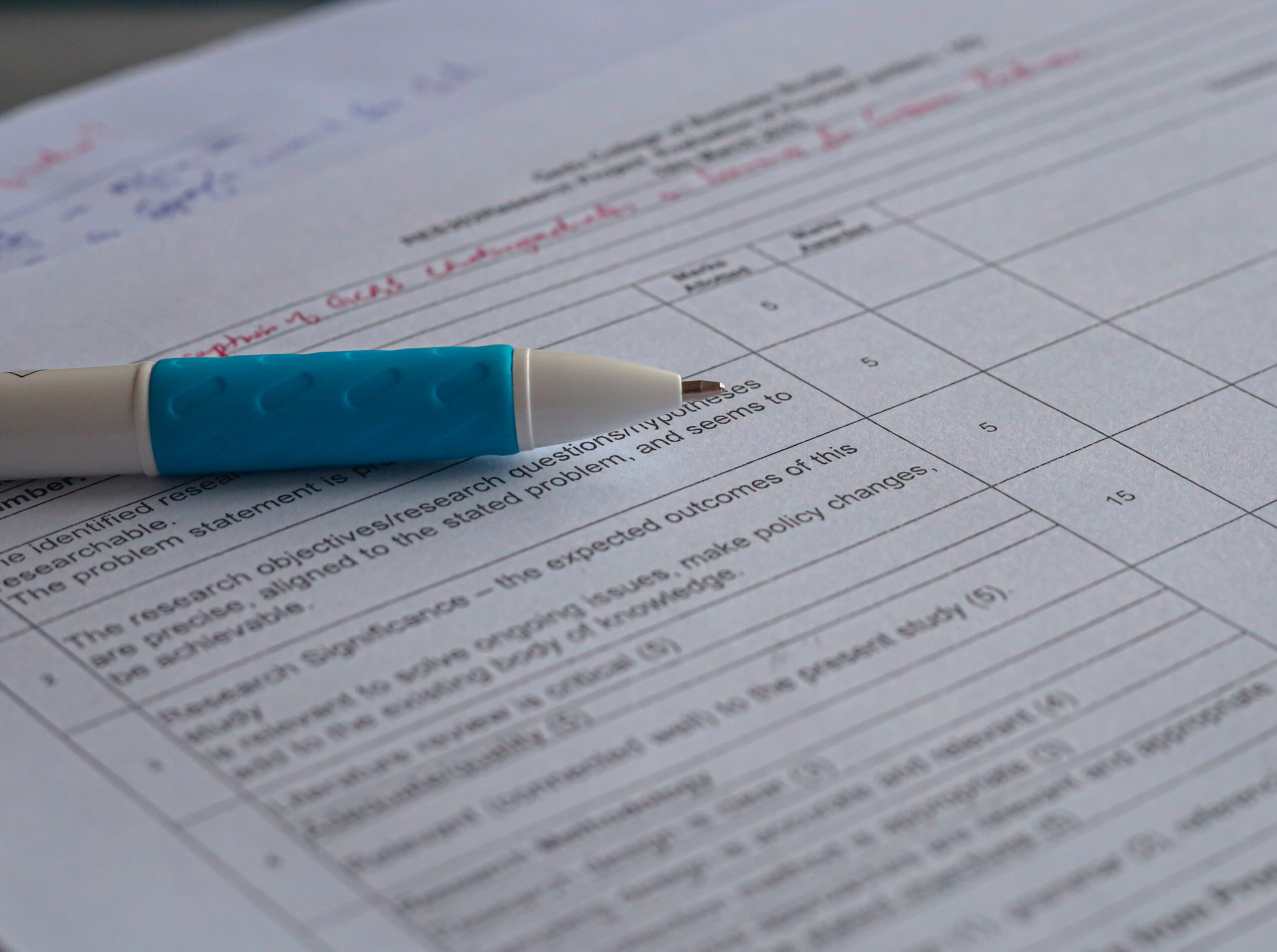
Once we have defined a rubric, we talk about the structure. I present to them a sample cake rubric, and talk about the grid format, with rows representing the criteria we will be evaluating (layers, flavor, decoration); columns representing the performance rating (needs improvement, proficient, advanced); and the cells containing descriptions of performance and point values (0, 5, 10).   

The Application

After we establish what a rubric is and how instructors use it, we turn towards application of rubrics as a way for them to pre-grade their assignments before submitting. Each student in the program will be enrolled in a first-year seminar their first term, which becomes the example from which they can practice. I pass out the first-year seminar rubric along with the assignment prompts, which are consistent throughout the course. I also provide two sample responses, one that clearly does not meet expectations (43 words total), and one that does meet expectations (270 words total). I ask them to work in pairs to review the submissions and grade them using the given rubric, which includes four criteria and two performance levels.  

Pairs are then asked to report out their score for the first submission, and we talk through their decisions. I share with them my grade as well. This process is repeated for the second submission. We also discuss what they liked about the experience and what they found challenging. In all, this lesson takes about thirty minutes but could be shortened or lengthened as needed. 

Doyle and Zakrajsek (2018) further identified that “when learning something new, it helps to be interested in it, see a value to it, pay attention to it, associate it with something you already know, and practice it a lot” (p. 100). The cake illustration is something they already know, and let’s be honest, if it relates to food, college students are very interested. Through the absurd example, they see the value which piques their curiosity and attention. The hands-on practice, while maybe not sufficient in and of itself, at least provides some experience with a new idea from which they can build their confidence.  

This rubric lesson not only raises awareness of a grading technique they will encounter over their time in college, but they get practice with an actual rubric that will be used in their first term. Further, their review of poor and exemplary submissions can help frame the direction they need to take when it comes to their own assignments. As McGuire (2015) pointed out, one way “to help your students gain competence is giving them targeted feedback, rubrics, and exemplars” (p. 88).  

When students understand the purpose of the rubric, they are better positioned to achieve success in their courses. Proactively, it allows them to assess whether they are meeting assignment expectations before the due date. Reactively, it allows them to understand why they missed points, leveraging the feedback as formative assessment and making corrections for future assignments.  

Sarah A. Forbes, PhD, is the Student Academic Success Director and a first-year seminar instructor at Rose-Hulman Institute of Technology. In these roles, she helps students learn new strategies for academic success. Sarah also serves as a first-year seminar instructional designer, summer bridge program director, and academic advising program administrator.

References 

Doyle, T., & Zakrajsek, T. D. (2018). The new science of learning: How to learn in harmony with your brain. Stylus Publishing.  

McGuire, S. Y. (2015). Teach students how to learn. Stylus Publishing. 

Suskie, L. (2018). Assessing student learning: A common sense guide. John Wiley & Sons, Incorporated. 



Source link

Tags: CAKEFacultyFocusIntroducingMathRubricsstudents
ShareTweetShare
Previous Post

Google Cloud is developing a Python-based layer 1 blockchain for institutions

Next Post

The Insurrection Act – Can The POTUS Deploy The National Guard To America’s Cities?

Related Posts

edit post
M awarded to Massachusetts colleges, state facilities for clean energy projects

$23M awarded to Massachusetts colleges, state facilities for clean energy projects

by TheAdviserMagazine
July 31, 2026
0

Listen to the article 3 min This audio is auto-generated. Please let us know if you have feedback. Dive Brief:...

edit post
Trump eyes 0,000 OPT fee

Trump eyes $100,000 OPT fee

by TheAdviserMagazine
July 31, 2026
0

If enacted, the proposal would effectively bar thousands of international students from participating in OPT, having a potentially devastating impact on inbound international mobility...

edit post
Why AI Is Changing What It Means to Be Intelligent – Faculty Focus

Why AI Is Changing What It Means to Be Intelligent – Faculty Focus

by TheAdviserMagazine
July 31, 2026
0

Across higher education, artificial intelligence has rapidly changed how students complete academic work. Essays, summaries, explanations, and structured problem-solving can...

edit post
In case you missed it: headlines from The PIE Live Asia Pacific

In case you missed it: headlines from The PIE Live Asia Pacific

by TheAdviserMagazine
July 30, 2026
0

Delegates gathered on Australia’s Gold Coast this week for The PIE Live Asia Pacific, where sector heavyweights discussed everything from...

edit post
Texas community college funding model faces ‘growing pains’

Texas community college funding model faces ‘growing pains’

by TheAdviserMagazine
July 30, 2026
0

Dive Brief: A performance-based funding model for Texas community colleges has led to financial “growing pains,” Ray Martinez III, CEO...

edit post
“We’ve lost 20 years of growth”: Australian ELICOS and VET sectors hit out at visa policy

“We’ve lost 20 years of growth”: Australian ELICOS and VET sectors hit out at visa policy

by TheAdviserMagazine
July 29, 2026
0

“We are growing to the point of being about 20% lower than we were 20 years ago,” English Australia CEO Ian...

Next Post
edit post
The Insurrection Act – Can The POTUS Deploy The National Guard To America’s Cities?

The Insurrection Act - Can The POTUS Deploy The National Guard To America's Cities?

edit post
U.S. tariffs on Indian goods are now 50%, a level analysts warn is akin to a trade embargo

U.S. tariffs on Indian goods are now 50%, a level analysts warn is akin to a trade embargo

  • Trending
  • Comments
  • Latest
edit post
Georgia Senior SNAP and Meal Resources Older Adults Can Use

Georgia Senior SNAP and Meal Resources Older Adults Can Use

July 24, 2026
edit post
New Jersey Tax-Relief Events: Three July Dates Near Seniors

New Jersey Tax-Relief Events: Three July Dates Near Seniors

July 13, 2026
edit post
Bristlecone pines growing in the White Mountains of California germinated before the Great Pyramid was built, and the oldest one alive today, nicknamed Methuselah, has been quietly adding rings for 4,855 years in soil so poor almost nothing else survives beside it

Bristlecone pines growing in the White Mountains of California germinated before the Great Pyramid was built, and the oldest one alive today, nicknamed Methuselah, has been quietly adding rings for 4,855 years in soil so poor almost nothing else survives beside it

July 8, 2026
edit post
Retail giant exits U.S. fashion after multi-million-dollar scandal

Retail giant exits U.S. fashion after multi-million-dollar scandal

July 1, 2026
edit post
Top Democrats Are Trapped in a Catch 22

Top Democrats Are Trapped in a Catch 22

July 6, 2026
edit post
2 judges suspended in separate cases after being indicted on criminal charges

2 judges suspended in separate cases after being indicted on criminal charges

July 9, 2026
edit post
Stash Review – Does the  Monthly Fee Actually Pay for Itself?

Stash Review – Does the $12 Monthly Fee Actually Pay for Itself?

0
edit post
Psychology says adults who never ask anyone for help aren’t unusually strong or independent — many learned early that needing people creates disappointment, so they built an identity around carrying everything alone before anyone gets the chance to let them down

Psychology says adults who never ask anyone for help aren’t unusually strong or independent — many learned early that needing people creates disappointment, so they built an identity around carrying everything alone before anyone gets the chance to let them down

0
edit post
OpenAI Makes Hardware Passkeys Mandatory For Its Highest-End Cyber Model

OpenAI Makes Hardware Passkeys Mandatory For Its Highest-End Cyber Model

0
edit post
Marketing pros share strategies for advisors to boost AI visibility

Marketing pros share strategies for advisors to boost AI visibility

0
edit post
What is South Carolina Income Tax? Rates & Tax Brackets –

What is South Carolina Income Tax? Rates & Tax Brackets –

0
edit post
Central Banks Change Their Minds on “Safe Haven” Assets

Central Banks Change Their Minds on “Safe Haven” Assets

0
edit post
Central Banks Change Their Minds on “Safe Haven” Assets

Central Banks Change Their Minds on “Safe Haven” Assets

August 1, 2026
edit post
Psychology says adults who never ask anyone for help aren’t unusually strong or independent — many learned early that needing people creates disappointment, so they built an identity around carrying everything alone before anyone gets the chance to let them down

Psychology says adults who never ask anyone for help aren’t unusually strong or independent — many learned early that needing people creates disappointment, so they built an identity around carrying everything alone before anyone gets the chance to let them down

August 1, 2026
edit post
If Bitcoin breaks k over the weekend, a .1B short overhang stands ready to pull price down to k

If Bitcoin breaks $62k over the weekend, a $1.1B short overhang stands ready to pull price down to $60k

August 1, 2026
edit post
2 High-Yield Dividend Stocks Worth Buying Before 2026 Ends

2 High-Yield Dividend Stocks Worth Buying Before 2026 Ends

August 1, 2026
edit post
Americans Are Rolling Record Debt Into New Vehicles. These Top the List

Americans Are Rolling Record Debt Into New Vehicles. These Top the List

August 1, 2026
edit post
America bet everything on trust 250 years ago. That bet is being tested again

America bet everything on trust 250 years ago. That bet is being tested again

August 1, 2026
The Adviser Magazine

The first and only national digital and print magazine that connects individuals, families, and businesses to Fee-Only financial advisers, accountants, attorneys and college guidance counselors.

CATEGORIES

  • 401k Plans
  • Business
  • College
  • Cryptocurrency
  • Economy
  • Estate Plans
  • Financial Planning
  • Investing
  • IRS & Taxes
  • Legal
  • Market Analysis
  • Markets
  • Medicare
  • Money
  • Personal Finance
  • Social Security
  • Startups
  • Stock Market
  • Trading

LATEST UPDATES

  • Central Banks Change Their Minds on “Safe Haven” Assets
  • Psychology says adults who never ask anyone for help aren’t unusually strong or independent — many learned early that needing people creates disappointment, so they built an identity around carrying everything alone before anyone gets the chance to let them down
  • If Bitcoin breaks $62k over the weekend, a $1.1B short overhang stands ready to pull price down to $60k
  • Our Great Privacy Policy
  • Terms of Use, Legal Notices & Disclosures
  • Contact us
  • About Us

© Copyright 2024 All Rights Reserved
See articles for original source and related links to external sites.

Welcome Back!

Login to your account below

Forgotten Password?

Retrieve your password

Please enter your username or email address to reset your password.

Log In
No Result
View All Result
  • Home
  • Financial Planning
    • Financial Planning
    • Personal Finance
  • Market Research
    • Business
    • Investing
    • Money
    • Economy
    • Markets
    • Stocks
    • Trading
  • 401k Plans
  • College
  • IRS & Taxes
  • Estate Plans
  • Social Security
  • Medicare
  • Legal

© Copyright 2024 All Rights Reserved
See articles for original source and related links to external sites.