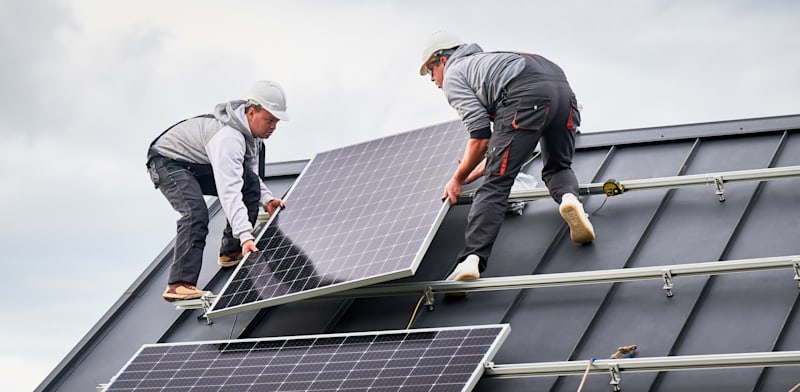
The existing tariff paid to owners of solar roofs – NIS 0.48 to NIS 0.54 per kilowatt-hour – is set to expire at the end of 2026. In preparation for the decision on a new remunerative model, “Globes” has learned that the proposal being considered would change the electricity market and curb future price increases for all consumers.
Under the Ministry of Energy proposal, roofs will be divided by size: home roofs will continue with the existing model of a fixed tariff, but at a lower price, while large roofs such as shopping malls will move to a system of competition in the electricity market alongside incentives for installing storage batteries. Either way, the current rate is considered too high and is expected to drop to only NIS 0.35 per kWh next year. It should be stressed that those who have already installed systems are contractually guaranteed the current tariffs for 25 years.
A revolution in solar roofs
This week, a discussion was held at the Electricity Authority plenary session regarding the payment to owners of solar roofs up to 630 kilowatts, which include everything from homes to shopping malls and large roofs. The current model, which provides a flat rate for all hours of the day, is considered outdated and problematic.
The model proposed by the Ministry of Energy, “Globes” has learned, divides roofs that produce low voltage into three tiers. The first tier, up to 30 kilowatts – which includes all home roofs – continues the existing situation but at a lower tariff.
The amount of the new tariff remains an open question, as it is calculated to cover the cost of equipment and installation and leave the roof owner with a reasonable profit over time, influenced by macroeconomic factors such as the shekel-dollar exchange rate, interest rates and inflation.
According to information obtained by “Globes,” the tariff cut may fall to NIS 0.35 per kWh, compared with NIS0.48 to NIS 0.54 today. This is a dramatic cut. According to the Ministry of Energy’s proposal, the tariff would be reduced by 1% each quarter. This would provide certainty to the market on the one hand and create an incentive to install as quickly as possible on the other.
The second tier, intended for capacities between 30 and 100 kilowatts, such as schools and small shopping malls, will be split into a daytime tariff and a nighttime tariff. The daytime tariff will be significantly lower to reflect the excess solar production at noon, while the nighttime tariff will be higher to incentivize installation of storage batteries, flatten the production curve and shift it to the evening.
The third tier, between 100 and 630 kilowatts, such as shopping centers or factories, will move to a competitive market model similar to large, high-voltage solar fields. These roofs will compete with other producers in the economy and will receive a subsidy in the form of a premium on the competitive price, which will compensate for their small disadvantage compared with the giant solar fields.
RELATED ARTICLES
IEC forced to cut retroactive charges for rooftop solar panels
Rooftop solar panels become mandatory on new houses
Combining these three steps could significantly reduce the burden of solar roofs on the electricity tariff for all consumers. In the existing model, meeting the target of 150,000 additional roofs would add almost NIS 900 million to the tariff – about 2.5% of it – while the new model would cost much less.
Beyond savings, the move is intended to resolve the uncertainty in the market ahead of the expiration of the current model at the end of 2026, as the framework that will replace it has not yet been finalized. For solar entrepreneurs planning new projects, this is a problematic figure that makes it difficult to prepare economically, as they need early certainty about the tariff. The Electricity Authority will have to decide in the coming months, after receiving responses from the public and making adjustments.
Don’t miss the train
In the current situation, the Ministry of Energy has launched the “Don’t miss the train” campaign, designed to encourage the installation of solar roof panels this year in order to lock in the current high rate for 25 years. This means that anyone who installs a system this year will guarantee themselves a preferential price for a quarter of a century, while anyone who waits until next year will have to make do with a lower rate.
However, the model is still preliminary, and the Electricity Authority has come up with additional alternatives: moving to a market model through private electricity suppliers who will set their own prices, holding a tender for each roof on the price, and debating whether to encourage local low-voltage storage on the roofs themselves or to prefer high-voltage storage elsewhere in the grid.
The Ministry of Energy and Infrastructure responds, “We aim to promote the maximum amount of renewable energy to meet the government target of 30% in 2030. Therefore, we must continue to promote dual-use solar installations, ground-based installations, agro-voltaic and other technologies in parallel and in a balanced manner. The Ministry believes that the field of dual-use renewable energy must continue to be promoted with maximum certainty, feasibility and simplicity. All this, while reducing costs to the economy, ensuring maximum benefits to the electricity sector, optimal utilization of the grid and avoiding rapid changes that could lead to stagnation in the market. Beyond that, we will not comment on internal discussions.”
Published by Globes, Israel business news – en.globes.co.il – on July 30, 2026.
© Copyright of Globes Publisher Itonut (1983) Ltd., 2026.