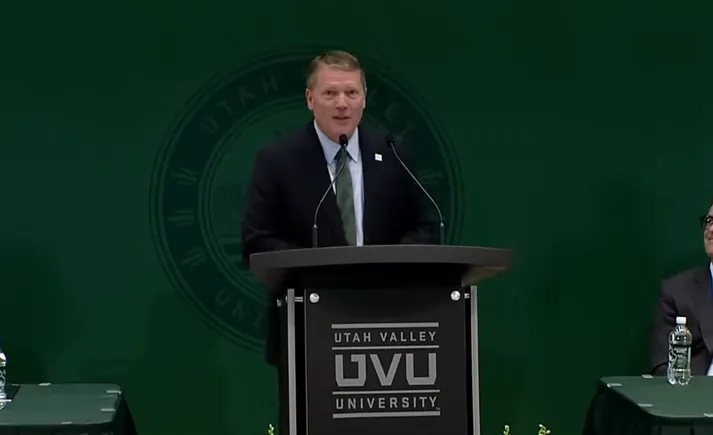
“We are growing to the point of being about 20% lower than we were 20 years ago,” English Australia CEO Ian Aird said of the country’s English language teaching sector (ELICOS) at The PIE Live Asia Pacific 2026.
“We have lost 20 years’ worth of investment in this sector, 20 years of effort to become a world-leading destination for English language study,” he added.
The panellists laid bare the extent of the challenges facing the Australian sector, with record-high visa refusals compounded by fresh increases to Australia’s student visa application fees last month.
“We’re resting on our laurels and we really shouldn’t,” Aird told delegates: “The competition that Australia’s up again is pretty fierce.”
While Department of Home Affairs assistant secretary Matthew Noble insisted Australia had a “globally competitive” study visa grant rate of 78%, Aird said it was a “very different picture” when you read into the disparity between sectors.
We’re saying no to VET but we desperately need the skills at the same timePhil Honeywood, International Education Association of Australia (IEAA)
For instance, while the grant rate for Chinese students going into degree programs is 96%, it drops to 60% for those going into ELICOS or VET.
And despite the fact ELICOS and ASEAN students were spared the worst of the fee hike – with their application charge rising from $2,000 to $2,050 – Aird argued tuition fees were still wildly disproportionate to English language program costs, with the average 17-week course typically costing $5,000.
He pointed out that this makes visa fees for ELICOS students disproportionately high.
“The $2,000 application fee is 40% of that. That’s absurd,” he said. “The equivalent would be the bottom end of a degree student where they’re paying $50,000 for a degree. How likely are they to pay a $20,000 visa application charge?”
What’s more, he argued the separate pricing structure showed two things: “Number one, the government can differentiate visa fees, and number two, the English language sector should have a lower fee.”
On top of Australia having the world’s most expensive visa system, speakers said record-high visa refusal ratings were disproportionately impacting English language and vocational students, inadvertently damaging the country’s skills needs.
“We’ve got this situation where we’re saying no to VET but we desperately need the skills at the same time,” said Phil Honeywood, CEO of the International Education Association of Australia (IEAA).
He emphasised the irony of the fact that the government’s own 2025 Jobs and Skills Australia report found a “raft of vocational diploma-level qualifications that Australia needs as skills going forward”, while these students are having their visas rejected at disproportionate rates.
For the government’s part, Noble reiterated that there hadn’t been a change in visa policy and that the department assesses “each and every application”, sharing concerns about recent application quality among students from South Asia which led to more refusals.
But Honeywood warned that visa refusals in the VET space would lead to Australia falling behind in the regional skills race, effectively allowing other countries to “backfill” Australia’s skills shortages.