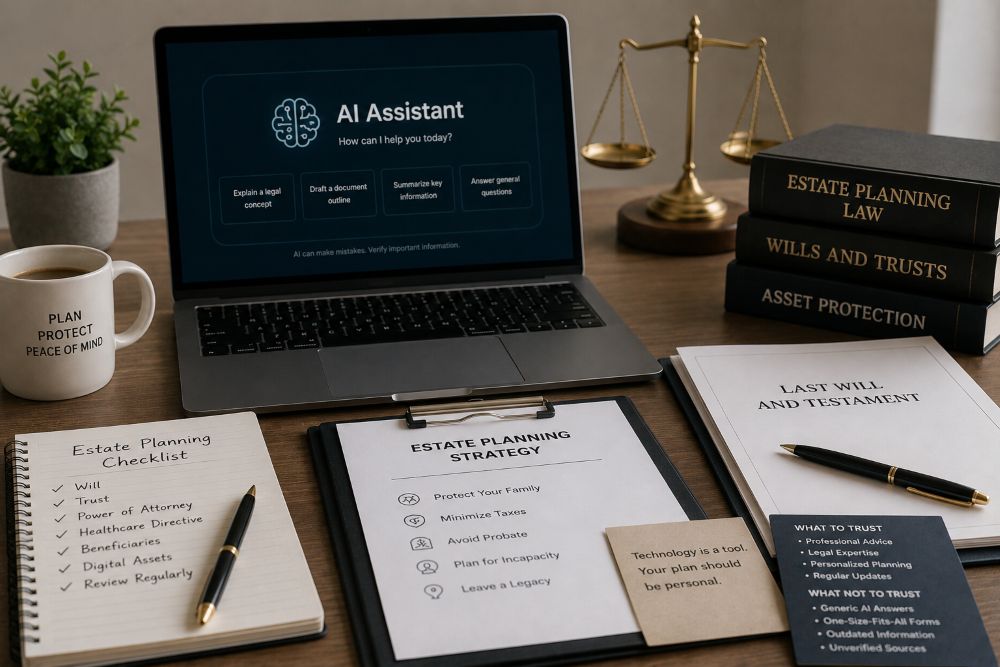
Have you ever asked ChatGPT a legal question just to see what it would say? If so, you’re part of a growing group of people who are turning to artificial intelligence for answers to everything from drafting emails to researching major financial and legal decisions. While the speed and convenience of these tools can be impressive, there is an important distinction between gathering information and receiving legal guidance, particularly when the future of your family, your assets, and your legacy are at stake.
The AI Revolution Meets Estate Planning
A New Front Door
Not long ago, most people began their estate planning research by typing a question into a search engine and sorting through pages of articles, advertisements, and legal resources. Today, many individuals are bypassing that process altogether and turning directly to AI platforms, which can answer detailed questions about wills, trusts, probate, and inheritance planning in a matter of seconds. For those who find legal topics intimidating, this conversational format often feels far more approachable than traditional online research.
The 24/7 LibraryOne of the reasons AI has gained such popularity is its ability to provide immediate access to general legal concepts at any time of day. Rather than spending hours searching for answers, users can ask follow up questions, request explanations in plain language, and receive responses that make complex subjects easier to understand. As a starting point for learning, that convenience can be genuinely valuable.
The Bright Side: What AI Gets Right
Decoding Legal JargonEstate planning documents often contain terminology that is unfamiliar to the average person. Concepts that attorneys use every day can feel overwhelming to someone who has never created a will or trust before. AI does a surprisingly good job of translating legal language into everyday English, helping people build a foundation before they sit down to discuss their goals with legal counsel.
Defining the BasicsAI is particularly useful when it comes to explaining foundational estate planning concepts. It can provide straightforward descriptions of:
The difference between a simple will and a pour over willRevocable trusts and irrevocable trustsProbate and the court process involved in transferring assets after deathCommon estate planning terms that appear in legal documents
For individuals who are just beginning to think about estate planning, these explanations can make the process feel less intimidating and more accessible.
The Danger Zone: Common Mistakes with AI Legal Advice
Mistaking Information for AdviceThe biggest risk arises when people begin treating AI as a lawyer instead of what it actually is: a sophisticated information tool. AI can summarize articles, identify patterns, and explain concepts, but it cannot evaluate your circumstances or determine how the law applies to your family. Estate planning decisions often involve factors that never appear in a prompt, and those missing details can change everything.
Ignoring State Specific LawsEstate planning is heavily influenced by state law, which means a generic answer generated from information gathered across the country may not reflect North Carolina requirements. Advice that works perfectly in another jurisdiction could create unintended consequences here. In some situations, relying on generalized information may even result in documents that fail to accomplish what the person intended.
The Template TrapOne of the most common mistakes we see is the assumption that AI can generate a finished legal document that is ready for signature. While these documents may appear polished at first glance, appearances can be deceiving. Estate planning documents must satisfy legal requirements, coordinate with existing assets, and account for family relationships that rarely fit neatly into a template.
Documents generated through AI often contain problems such as:
Contradictory provisionsMissing statutory requirementsIncomplete instructions for trustees or executorsLanguage that does not align with North Carolina lawProvisions that fail to address family circumstances
A document that saves money today can create expensive disputes years later when loved ones are left trying to interpret unclear instructions.
Why Your Legacy Requires Personalized Legal Guidance
Human Nuance MattersFamily dynamics are often the deciding factor in whether an estate plan succeeds or creates conflict. A chatbot cannot recognize tension between siblings, identify the possibility of a future will contest, or sense hesitation when a client discusses a beneficiary. Those conversations matter because they often reveal risks that never appear on paper.
At Trusts and Estates Law Group, we spend time understanding the people behind the documents. A well drafted estate plan is not simply a collection of legal forms. It is a reflection of your goals, your relationships, and the legacy you want to leave behind.
Tax and Asset ComplexitiesEstate planning rarely involves a single issue. Many families own businesses, investment accounts, retirement plans, real estate, or other assets that require thoughtful coordination. Blended families may have competing interests that need to be balanced carefully, and business owners often have succession concerns that affect both their families and their employees.
An attorney evaluates the entire picture rather than isolated pieces of information. That broader perspective helps identify opportunities and risks that technology alone may overlook.
Accountability MattersAnother factor that is often overlooked is accountability. If an AI generated document contains an error that causes problems after death, there is no professional responsibility attached to the software. There is no legal obligation to correct the mistake and no recourse against a chatbot that produced inaccurate information.When legal counsel prepares and reviews your estate planning documents, there is accountability behind that work. That protection matters when your family may one day rely on those documents during an already difficult time.
Your AI Reality Check: Questions to Ask First
Before relying on an AI generated answer or document, consider the following questions:
Does this reflect current North Carolina law?Who is legally accountable if this document is drafted incorrectly?Did this tool ask about my family relationships, special needs dependents, or business interests?Does this recommendation account for all of my assets and long term goals?Am I saving money today only to create probate disputes and litigation expenses for my heirs later?
If you cannot answer those questions with confidence, it may be time to seek legal guidance before moving forward.
Secure Your Legacy with Confidence
Artificial intelligence has earned its place as a valuable research tool, and there is nothing wrong with using it to learn about estate planning concepts. The problem arises when education is mistaken for legal advice. Your family’s future deserves more than a generalized answer generated from information gathered across the internet.
Effective estate planning requires a thorough review of your assets, a careful understanding of North Carolina law, and thoughtful discussions about the people and priorities that matter most to you. At Trusts and Estates Law Group, we work closely with clients to create estate plans that reflect their goals and provide lasting protection for the people they love.
If you are ready to put a legally sound plan in place, contact Trusts and Estates Law Group today to schedule a consultation. Together, we can help ensure your estate plan reflects your wishes, protects your legacy, and stands the test of time.