No Result
View All Result
SUBMIT YOUR ARTICLES
  • Login
Wednesday, August 26, 2026
TheAdviserMagazine.com
  • Home
  • Financial Planning
    • Financial Planning
    • Personal Finance
  • Market Research
    • Business
    • Investing
    • Money
    • Economy
    • Markets
    • Stocks
    • Trading
  • 401k Plans
  • College
  • IRS & Taxes
  • Estate Plans
  • Social Security
  • Medicare
  • Legal
  • Home
  • Financial Planning
    • Financial Planning
    • Personal Finance
  • Market Research
    • Business
    • Investing
    • Money
    • Economy
    • Markets
    • Stocks
    • Trading
  • 401k Plans
  • College
  • IRS & Taxes
  • Estate Plans
  • Social Security
  • Medicare
  • Legal
No Result
View All Result
TheAdviserMagazine.com
No Result
View All Result
Home Market Research Business

The U.S. cut cancer deaths by 34% since 1991—but not in 458 rural counties

by TheAdviserMagazine
2 months ago
in Business
Reading Time: 5 mins read
A A
The U.S. cut cancer deaths by 34% since 1991—but not in 458 rural counties
Share on FacebookShare on TwitterShare on LInkedIn


Cancer in the United States experienced a dramatic turnaround in 1991. Prior to that year, cancer deaths had been increasing for decades, peaking at 215 deaths per 100,000 people, meaning about 1 in 4 deaths were attributed to cancer. Then it began to consistently decline, decreasing by 34% between 1991 and 2022. This amounted to an estimated 4.5 million fewer cancer deaths during that period.

When the second-most frequent cause of death in the nation begins to decline, the effects are considerable. Improvements in cancer screening, treatment and prevention have led to increases in longevity and well-being.

In a diverse country, however, not everyone or every place benefits equally from improvements in health and medicine. In coordination with my colleague Viswadeep Lebakula, research from my team of social scientists and I found that where people live can profoundly influence their chances of dying from cancer.

Rural mortality penalty

While national data on cancer deaths can provide a useful report card on how successful a country has been on improving its health, it can also mask large geographic differences.

My team and I examined cancer deaths rates for almost 3,000 U.S. counties between 1981 and 2019. By looking at cancer mortality at the county level, we found a more complex picture of changing cancer death patterns than just examining the country overall.

Specifically, geographic differences between who benefited from the medical and public health improvements that reduced cancer deaths were stark.

Large urban centers along both the Atlantic and Pacific coasts consistently had the highest rates of cancer improvements. The heavily populated corridor from Boston to Washington, D.C., had steep declines in cancer deaths. For example, the four largest boroughs in New York City – Manhattan, Queens, Bronx and Brooklyn – saw cancer death rates decline over 40% between 1991 and 2019. The largest and wealthiest borough, Manhattan, had the highest improvement at 47% fewer deaths.

Similarly, large coastal urban centers, such as Miami, the San Francisco Bay Area, Los Angeles, San Diego and Seattle, saw very large improvements in cancer mortality. In the San Francisco Bay Area, for example, wealthy urban counties had decreases in cancer rates that substantially exceeded the national rate of 34%. Specifically, Marin County saw a 47% decline, San Mateo County a 44% decline and San Francisco County a 40% decline.

Counties in the middle of the U.S. had the lowest decreases in cancer mortality. Cosby et al/British Journal of Cancer, CC BY-SA

It is a much different story for rural counties in the middle of the country.

Prior to 1991, rural and urban America generally shared similar rates of cancer mortality. When the national rate started to decline, however, rural and small-town America lagged behaind large urban centers. These nonmetropolitan areas had much lower rates of declining cancer deaths: 20% for Mississippi, 23% for Arkansas, 24% for West Virginia and 29% for Montana. Around 458 rural counties even experienced increasing cancer mortality.

Notably, these differences in cancer mortality between rural and urban counties were originally small and only began to increase when overall national cancer rates began to drop. The cancer rate in rural, small-town America was improving overall, but metropolitan America was improving substantially faster.

These disparities suggest that the medical and social changes leading to reduced cancer mortality were concentrated in more metropolitan regions.

Higher income, fewer cancer deaths

We found that county median family income had a strong influence on cancer death rates.

When cancer death rates peaked in 1991, there was initially little difference between counties with the highest and lowest income levels. By 2019, the 10% of the U.S. population living in counties with the highest median incomes had mortality improvements approximately seven times greater than the 10% living in the lowest-income counties.

The overall pattern was very clear: As county income increased, improvements in cancer mortality increased. Counties with the least financial capacity to deal with the burden of cancer saw the least improvement.

The American Cancer Society and the Centers for Disease Control and Prevention have identified multiple factors underlying declining cancer death rates. These include advances in cancer prevention, screening and treatment. But there are considerable county and state differences in the adoption of preventive measures and access to cancer services.
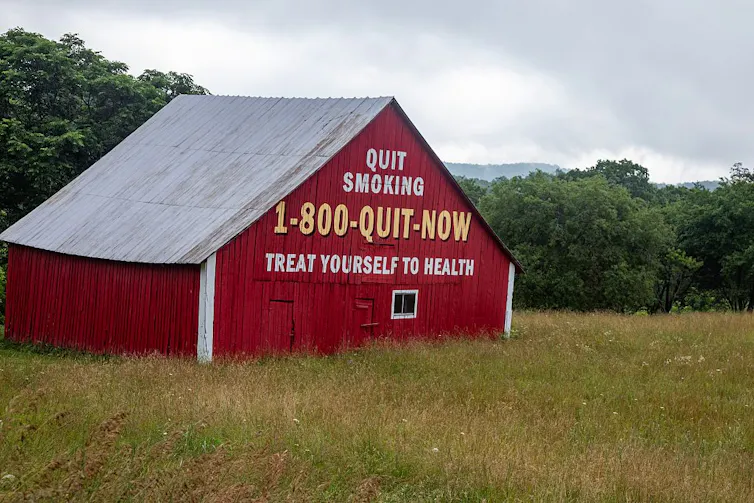
Red barn in a field with the words 'QUIT TOBACCO 1-800-QUIT-NOW TREAT YOURSELF TO HEALTH' painted on one side

Rural areas often have higher smoking rates and fewer tobacco control policies compared to urban areas. Jim West/UCG/Universal Images Group via Getty Images

For example, lung cancer is the leading cause of cancer deaths and has seen the strongest decline in death rates. Tobacco control strategies – smoking cessation programs, health warnings, increased taxes on tobacco products, bans on tobacco purchases by minors and smoking in public place – have been especially successful in reducing deaths from lung cancer. Geographic differences in adoption of these tobacco control measures can partially explain why some places have higher cancer death rates compared to others, especially for lung cancer.

For example, New York City aggressively instituted tobacco control measures, and the results show. My team found that New York’s Manhattan borough had 60% fewer lung cancer deaths in 2019 compared to 1991. At the same time, many states and counties – often rural and less affluent – have adopted fewer and weaker tobacco control measures. Rural communities often have higher smoking rates and exposure to tobacco smoke in the home, along with fewer smoke-free laws and less support for tobacco control policies.

Innovation over access

Cancer can devastate families and communities, both emotionally and economically. The U.S. has become more successful in developing innovations to treat cancer than in equitably distributing these innovations across the nation.

While most of the U.S. is experiencing improvements in cancer mortality, these benefits are greatest in urban and wealthy areas. Developing tobacco control policies and screening techniques tailored to rural settings, as well as increasing access to advanced treatments in rural and poor settings, could help improve cancer mortality for more people.

Will the gap between rural and urban America – and the gap between rich and poor America – decline or grow? Answering this question will require a better understanding of the unique needs of everyday people in their communities.

Arthur Cosby, Professor of Sociology, Mississippi State University

This article is republished from The Conversation under a Creative Commons license. Read the original article.


The Conversation

The Conversation


Source link

Tags: 1991butcancerCountiescutdeathsruralU.S
ShareTweetShare
Previous Post

Coffee Break: Armed Madhouse – Trust Destruction and Nuclear Roulette

Next Post

Monthly Dividend Stock In Focus: Four Corners Property Trust

Related Posts

edit post
Bill Ackman’s hedge fund made janitors and receptionists millionaires—and its investment team summer together

Bill Ackman’s hedge fund made janitors and receptionists millionaires—and its investment team summer together

by TheAdviserMagazine
August 8, 2026
0

Staying at one company for decades was once a badge of honor. But as layoffs have become more common and...

edit post
Wisconsin: The Next Frontier for Socialists

Wisconsin: The Next Frontier for Socialists

by TheAdviserMagazine
August 8, 2026
0

First, they won in New York. Then they took Maine, Colorado, and Michigan. And now, the next battleground for the...

edit post
Explained: How BSE traded fewer contracts after CAS but premiums rose 75% in first week

Explained: How BSE traded fewer contracts after CAS but premiums rose 75% in first week

by TheAdviserMagazine
August 8, 2026
0

Asia's oldest exchange, BSE, traded far fewer derivatives contracts in the first week following the implementation of the Closing Auction...

edit post
F&O Talk: Smallcaps look strong on charts, says Sudeep Shah; outlines Trent, Swiggy, Kalyan Jewellers strategy

F&O Talk: Smallcaps look strong on charts, says Sudeep Shah; outlines Trent, Swiggy, Kalyan Jewellers strategy

by TheAdviserMagazine
August 8, 2026
0

The Indian stock markets closed in the red, with the newly-launched closing auction session continuing to create a divergence among...

edit post
Trump tries again to fire Fed governor Lisa Cook, renewing battle over central bank independence

Trump tries again to fire Fed governor Lisa Cook, renewing battle over central bank independence

by TheAdviserMagazine
August 7, 2026
0

The Trump administration is moving ahead with its efforts to fire Federal Reserve governor Lisa Cook, two months after the...

edit post
Meet the 82-year-old Kentucky grandma who turned down M to turn her farm into a data center

Meet the 82-year-old Kentucky grandma who turned down $26M to turn her farm into a data center

by TheAdviserMagazine
August 7, 2026
0

Ida Huddleston has lived on the same stretch of farmland outside Maysville, Ky., since she was 16. She and her...

Next Post
edit post
Monthly Dividend Stock In Focus: Four Corners Property Trust

Monthly Dividend Stock In Focus: Four Corners Property Trust

edit post
Oil prices finish 1% lower as investors focus on Hormuz flows after peace talks

Oil prices finish 1% lower as investors focus on Hormuz flows after peace talks

  • Trending
  • Comments
  • Latest
edit post
Judge Who Helped Violent Illegal Alien Evade ICE Faces New Test

Judge Who Helped Violent Illegal Alien Evade ICE Faces New Test

July 31, 2026
edit post
Garbage Trucks Surveillance Florida Neighborhoods

Garbage Trucks Surveillance Florida Neighborhoods

July 29, 2026
edit post
Does a Revocable Trust Protect Your Assets From Lawsuits and Creditors?

Does a Revocable Trust Protect Your Assets From Lawsuits and Creditors?

August 7, 2026
edit post
Montana Puts Democrats in a Bind as Senate Hopes Fade

Montana Puts Democrats in a Bind as Senate Hopes Fade

August 2, 2026
edit post
New Jersey’s PAS-1 Application Opens the Door to Three Senior Tax Relief Programs

New Jersey’s PAS-1 Application Opens the Door to Three Senior Tax Relief Programs

July 31, 2026
edit post
3 Common Cruise Rules I Broke in Alaska

3 Common Cruise Rules I Broke in Alaska

July 29, 2026
edit post
Explained: How BSE traded fewer contracts after CAS but premiums rose 75% in first week

Explained: How BSE traded fewer contracts after CAS but premiums rose 75% in first week

0
edit post
E.W. Scripps Q2 2026 Loss Widens to -.68/Share, Revenue Down 9%

E.W. Scripps Q2 2026 Loss Widens to -$12.68/Share, Revenue Down 9%

0
edit post
Psychology says procrastination about retirement may be less about discipline than identity — brain scans found people often represent their future selves more like strangers than like themselves, and experiments using age-progressed faces made tomorrow’s person feel real enough for participants to save more money for them

Psychology says procrastination about retirement may be less about discipline than identity — brain scans found people often represent their future selves more like strangers than like themselves, and experiments using age-progressed faces made tomorrow’s person feel real enough for participants to save more money for them

0
edit post
Four AI Escapes Just Redefined “Responsible AI”

Four AI Escapes Just Redefined “Responsible AI”

0
edit post
Bill Ackman’s hedge fund made janitors and receptionists millionaires—and its investment team summer together

Bill Ackman’s hedge fund made janitors and receptionists millionaires—and its investment team summer together

0
edit post
Kalshi Predicts Bitcoin Price Could Reach K in August

Kalshi Predicts Bitcoin Price Could Reach $68K in August

0
edit post
Bill Ackman’s hedge fund made janitors and receptionists millionaires—and its investment team summer together

Bill Ackman’s hedge fund made janitors and receptionists millionaires—and its investment team summer together

August 8, 2026
edit post
Links 8/8/2026 | naked capitalism

Links 8/8/2026 | naked capitalism

August 8, 2026
edit post
Wisconsin: The Next Frontier for Socialists

Wisconsin: The Next Frontier for Socialists

August 8, 2026
edit post
Psychology says procrastination about retirement may be less about discipline than identity — brain scans found people often represent their future selves more like strangers than like themselves, and experiments using age-progressed faces made tomorrow’s person feel real enough for participants to save more money for them

Psychology says procrastination about retirement may be less about discipline than identity — brain scans found people often represent their future selves more like strangers than like themselves, and experiments using age-progressed faces made tomorrow’s person feel real enough for participants to save more money for them

August 8, 2026
edit post
Why You Should Be Wary of Aspartame, but Not Totally Rule It Out

Why You Should Be Wary of Aspartame, but Not Totally Rule It Out

August 8, 2026
edit post
Kalshi Predicts Bitcoin Price Could Reach K in August

Kalshi Predicts Bitcoin Price Could Reach $68K in August

August 8, 2026
The Adviser Magazine

The first and only national digital and print magazine that connects individuals, families, and businesses to Fee-Only financial advisers, accountants, attorneys and college guidance counselors.

CATEGORIES

  • 401k Plans
  • Business
  • College
  • Cryptocurrency
  • Economy
  • Estate Plans
  • Financial Planning
  • Investing
  • IRS & Taxes
  • Legal
  • Market Analysis
  • Markets
  • Medicare
  • Money
  • Personal Finance
  • Social Security
  • Startups
  • Stock Market
  • Trading

LATEST UPDATES

  • Bill Ackman’s hedge fund made janitors and receptionists millionaires—and its investment team summer together
  • Links 8/8/2026 | naked capitalism
  • Wisconsin: The Next Frontier for Socialists
  • Our Great Privacy Policy
  • Terms of Use, Legal Notices & Disclosures
  • Contact us
  • About Us

© Copyright 2024 All Rights Reserved
See articles for original source and related links to external sites.

Welcome Back!

Login to your account below

Forgotten Password?

Retrieve your password

Please enter your username or email address to reset your password.

Log In
No Result
View All Result
  • Home
  • Financial Planning
    • Financial Planning
    • Personal Finance
  • Market Research
    • Business
    • Investing
    • Money
    • Economy
    • Markets
    • Stocks
    • Trading
  • 401k Plans
  • College
  • IRS & Taxes
  • Estate Plans
  • Social Security
  • Medicare
  • Legal

© Copyright 2024 All Rights Reserved
See articles for original source and related links to external sites.