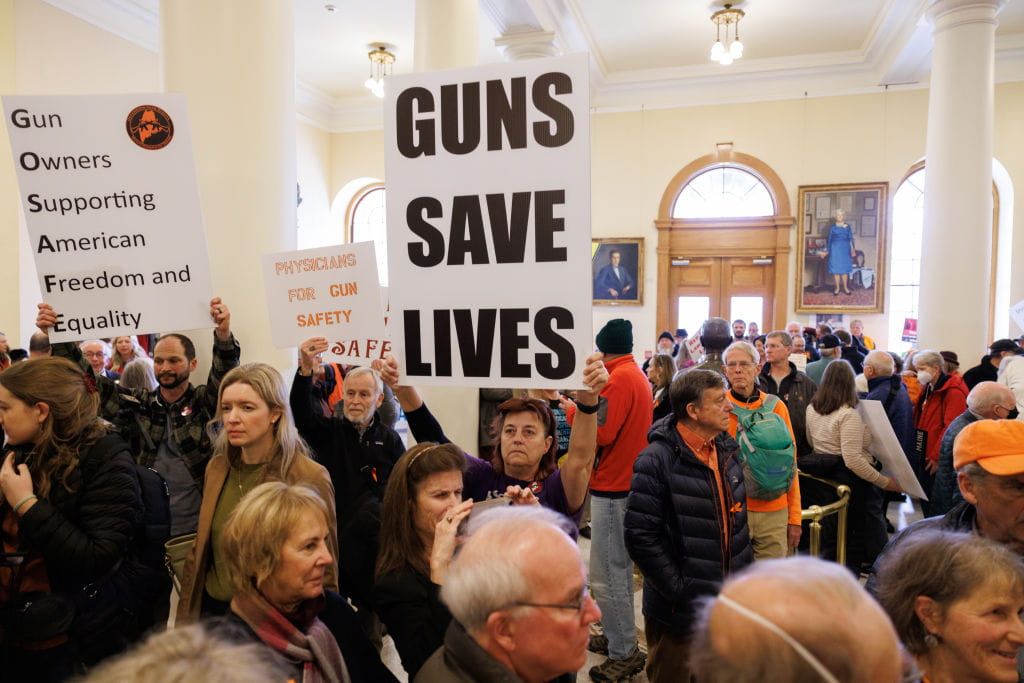
At the core of the ongoing debate between pro- and anti-gun rights activists are statistics. Both sides use crime statistics to support, or try to support, their respective arguments. And on both sides, there are some flaws in the alleged links between the availability of firearms and violent crime rates. The first rule of statistics, after all, is that correlation does not equal causation. Still, as violent crime overall decreases, while the number of armed civilians increases, it becomes all the more difficult for anti-gunners to claim that more guns on the streets lead to higher crime rates.
A survey commissioned by the Crime Prevention Research Center (CPRC), conducted in mid-May of this year by McLaughlin & Associates, reveals a notable increase, since December of 2024, in the number of people who say they carry a gun occasionally, most of the time, or always. One thousand people of diverse ethnicity, income levels, and political persuasions were polled.
The Number of Armed Civilians Jumps
Comparing the most recent survey to a December 2024 study, also commissioned by CPRC, shows the number went up by 5.5%, from 24.3% to 29.8%. Anti-gun groups are unable to claim there’s a link between this higher number of armed civilians and higher crime rates – because the latter is, in fact, continuing a downward trajectory.
Gun control advocates may argue that any link between increased gun carry and fewer violent crimes is purely anecdotal. But there are an awful lot of anecdotes. The number of incidents of “defensive gun use” is estimated to be anywhere between 500,000 and three million times a year. In many cases, no shots were fired, but the mere revelation that the potential crime victim or a bystander was carrying a weapon acted as sufficient deterrence.
This range is so wide because many instances of defensive gun use go unreported. If no crime was committed and no firearms were discharged, many armed civilians would see no reason to report the incident.
The Heritage Foundation’s Data Visualization site contains one of the most comprehensive databases of these cases.
The main takeaway is that almost one-third of Americans carry guns – either all the time or at least sometimes.
According to the Data Visualization numbers, then, in any group of 10 adults, there is a 33.7% chance that at least one person is carrying a gun. In any group of 100 adults, there’s a 98.4% chance. If more guns directly led to more gun crime, one could expect the homicide rate to be orders of magnitude higher than it is, rather than declining.
For Most People, More Gun Control Is Not the Answer
When asked the question “which do you believe would do the most to help fight crime?” 29.6% chose “more gun control laws” as their answer, but 31.4% went with “enforce current laws,” and 30.8% said, “arrest repeat criminals.”
The CPRC also found that women and blacks accounted for larger percentages of the increase in armed civilians than white males. And those who identified as “general election voters” were twice as likely to possess concealed handgun permits.
Women now comprise 45.1% of all those who carry concealed firearms all or most of the time – and 47.5% in Constitutional Carry states that do not require permits to carry concealed.
In the period 2015–2024, concealed carry permit applications for women increased 112% faster than for men. Permits for blacks increased 284% faster than for whites.
All this is to say that Americans of either sex and of all ethnic backgrounds are increasingly carrying firearms in public, while all categories of violent crime continue to trend downward. One could perhaps make the argument that, in this case, correlation does not equal causation – that falling crime rates are not directly linked to the increasing number of guns. That’s a stretch, though, if one accepts that no one can point to any other reason for there being less crime.
One thing that is beyond any doubt, though – because it is now demonstrably true – is that having more armed civilians on the streets has not led to higher crime rates.