It’s a question that’s baffled economists, investors, and strategists for the past several years. Why are American consumers reporting the lowest sentiment readings on record – yet continuing to spend as if all was right with the world?
A Mystery in the Data
Economic data of all types makes the question a true mystery. The University of Michigan’s Consumer Sentiment Index sank to an all-time low of 44.8 in May, for the third-straight monthly decline. Inflation is simmering throughout the economy. And the job market is tepid at best.
Spending, meanwhile, continues to rise, although at increasingly slower paces. So where are consumers getting their mojo?
Enter the ‘G-Shaped’ Economy
Famed investing strategist Ed Yardeni has a theory: We’re living in a “G-shaped” economy.
G stands for “generational,” and it describes a society “in which older Americans, who tend to be among the wealthiest households, provide financial support to their younger adult children and grandchildren,” Yardeni wrote in a recent note.
“In our opinion, much of the affordability crisis in America today is affecting younger generations, while the older generation of Baby Boomers is helping them cope with it.”
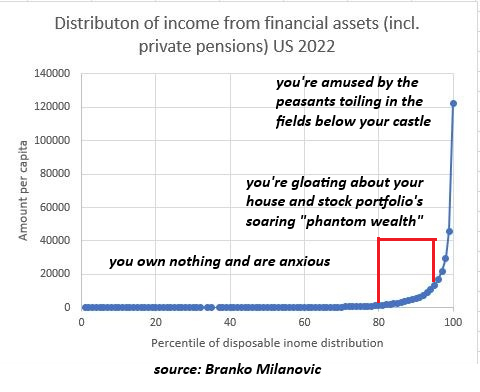
The “G” theme takes another popular idea in recent economic discussion and flips it a bit. Many analysts have pointed to an economy with a pronounced “K” shape, which shows visually how haves, represented by the top diagonal line, do better and better, while have-nots, the lower line, see their fortunes falling.
Boomer Wealth by the Numbers
Yardeni’s theory rests on a few other facts. Disposable income has been flattening in recent months, even as spending continues. But since most baby boomers are retired, he pointed out, they are drawing on their accumulated funds, not paychecks, to support their spending.
In fact, retired workers now account for a record 19.5% of the civilian working-age population, so their spending and working (or not-working) patterns definitely influence the entire economy.
Americans ages 45 and over control nearly 90% of the nation’s wealth, according to household data from the Federal Reserve.
Boomers – those born between 1946 and 1964 – hold 51% of American wealth, including real estate, stocks, pension benefits, private businesses and other assets, collectively valued at $90 trillion as of the end of 2025.
To be sure, parents helping children – and even grandchildren – isn’t new. But the size of the boomer generation and their accumulated wealth, which is also a record high, adds up to what Yardeni calls “an unprecedented demographic shift with profound economic consequences.”
Growing Cracks in the Foundation
But while Yardeni thinks the intergenerational transfers can help hold up the economy in the future, some economists are starting to get more worried.
The government on May 28 downgraded its initial estimate for economic growth in the first quarter of 2026, in large part due to more tepid consumer spending than was initially believed.
Consumption remains higher than it was before the COVID-19 pandemic made comparisons difficult, suggesting that in aggregate, “U.S. households are largely healthy,” said Troy Ludtka, senior US economist with SMBC Nikko Securities Americas in an analysis after the GDP release. But Americans are increasingly falling behind on auto loan, student loan, and credit card payments, Ludtka pointed out.
“The financial strain on households has become more acute in Q2, as the quick rise in inflation has depleted the personal savings rate to an ultra-low 2.6%,” Ludtka added. As gas and food prices just keep rising, spending is likely to decline, he said.