No Result
View All Result
SUBMIT YOUR ARTICLES
  • Login
Monday, May 25, 2026
TheAdviserMagazine.com
  • Home
  • Financial Planning
    • Financial Planning
    • Personal Finance
  • Market Research
    • Business
    • Investing
    • Money
    • Economy
    • Markets
    • Stocks
    • Trading
  • 401k Plans
  • College
  • IRS & Taxes
  • Estate Plans
  • Social Security
  • Medicare
  • Legal
  • Home
  • Financial Planning
    • Financial Planning
    • Personal Finance
  • Market Research
    • Business
    • Investing
    • Money
    • Economy
    • Markets
    • Stocks
    • Trading
  • 401k Plans
  • College
  • IRS & Taxes
  • Estate Plans
  • Social Security
  • Medicare
  • Legal
No Result
View All Result
TheAdviserMagazine.com
No Result
View All Result
Home Market Research Startups

People who keep their phone face-down on every surface they sit at often aren’t being polite, many are quietly trying to stop a nervous system that learned, over years of being on-call, to flinch at every notification

by TheAdviserMagazine
7 minutes ago
in Startups
Reading Time: 6 mins read
A A
People who keep their phone face-down on every surface they sit at often aren’t being polite, many are quietly trying to stop a nervous system that learned, over years of being on-call, to flinch at every notification
Share on FacebookShare on TwitterShare on LInkedIn


The face-down phone gets read as courtesy. A small social gesture, the kind that says you have my attention. That reading is often only half right.

For a lot of people who do it reflexively, the move has very little to do with the person across the table. It is a private act of nervous system management, performed in public, dressed up as manners because manners are easier to explain than the alternative.

The polite framing is convenient. It lets the gesture pass without anyone asking why the screen needs to be hidden in the first place.

What the body is actually doing under the table

A phone screen-up on a surface is not neutral furniture. It is a small, unpredictable source of light, vibration, and sound, and the human stress response tends to track unpredictable stimuli whether the conscious mind is paying attention or not.

Clinical psychologist Yamalis Díaz, speaking to Healthline, described how a steady drip of notifications can keep the fight-or-flight system from shutting off. Adrenaline and cortisol stay elevated. The body stays braced for a threat that may or may not be coming.

That bracing has a cost. The screen does not have to light up for the cost to register; the anticipation alone is enough.

Flipping the phone over is not a cure for that. It is a workaround. If the body cannot stop scanning, at least the scanning has fewer cues to react to.

Notifications the nervous system learned to treat as emergencies

Most phones do not differentiate between a friend sending a meme and a parent calling in tears at 2 a.m. The buzz is the buzz. Over years, the body stops trusting that any given ping is harmless, because some of them weren’t.

This is something close to classical conditioning, the kind that does not need conscious agreement to work. A neutral stimulus, a chime, paired enough times with a stressful outcome, a crisis, a demand, a fight, bad news from a hospital, can become its own stressor. The chime alone can produce the cortisol.

Healthline’s reporting on nervous system regulation describes what tends to happen when stress accumulates faster than the body can recover from it. Baseline arousal creeps upward. Resting is no longer actually restful. The system stays half-on, waiting.

People who lived through years of being on-call, for a sick parent, a volatile partner, a job that punished slow replies, a family member with unpredictable moods, can learn to treat the phone as a hot wire. The screen-down gesture is what those people often do when they sit down somewhere and want, for an hour, to not be a hot wire.

Why “polite” is the cover story

The ‘politeness’ explanation works as a cover story because it is socially useful. ‘I’m putting it away so I can be present with you’ is a sentence that lands well. The alternative, that the screen being visible is something the body cannot tolerate after years of training, is a sentence most people would not want to say at dinner.

So the polite framing does double work. It protects the person from having to explain, and it gives the gesture a socially legible meaning that the people around them can accept without follow-up questions.

The face-down phone, in that frame, is one of the only boundaries the body can enforce without a conversation.

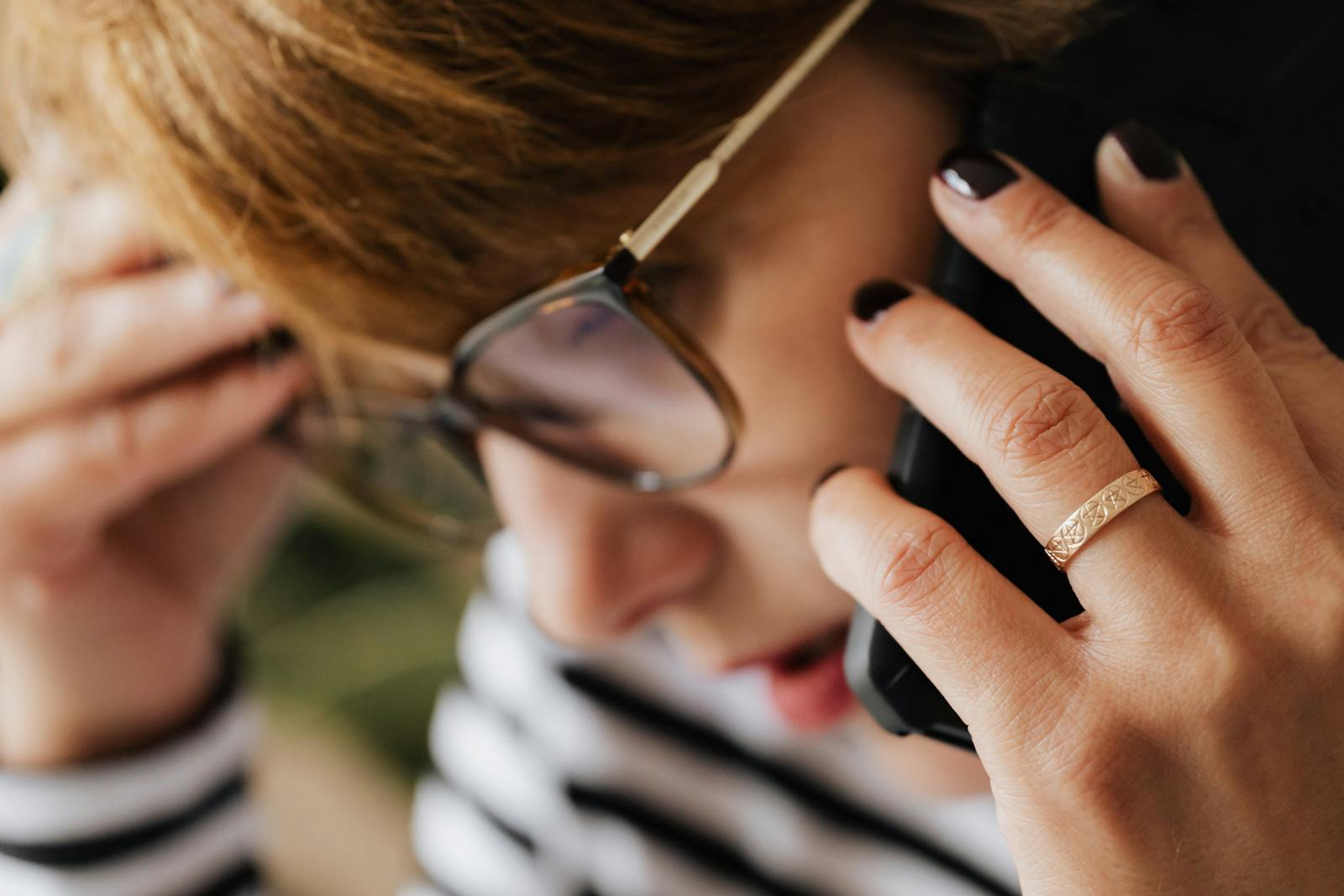
Photo by Ron Lach on Pexels

The avoidance question

This is where the analysis gets uncomfortable, because flipping the phone face-down does share some structural features with avoidance, and avoidance has a complicated track record.

Karen Stollznow, writing in Psychology Today, describes avoidance behaviour as any act that lets a person sidestep a situation that triggers their anxiety. In the short term, it can bring relief. In the long term, it can reinforce the fear it was meant to manage.

So is the face-down phone an avoidance behaviour? Sometimes. Not always.

The clean version of avoidance is the person who never opens the notification, never checks the email, lets the unread count climb into the thousands because looking would mean confronting something they cannot bear to confront. That pattern does feed itself.

The face-down phone is usually different. The person is not refusing to check. They will check. They are just refusing to be checked at in real time, refusing to let the screen run the meeting from the table. The phone is still on. The vigilance is still operating. It has just been turned down by one notch.

Accommodation and the body that learned to be on-call

There is a useful concept from anxiety research called accommodation. Baylor College of Medicine’s LUNA program describes accommodation as the small, well-meaning ways family members adjust their behaviour around an anxious person to keep that person calm. It can work in the short term and quietly entrench the anxiety in the long term.

What is rarely discussed is what happens to the accommodator themselves, the person whose job it was to keep the household calm by being reachable, by anticipating, by smoothing.

That person grows up. Their nervous system does not forget. The body keeps doing the job even after the job is over.

The face-down phone, in adulthood, is sometimes the first small refusal that body has ever made. A small refusal. Still a refusal.

Why the mere presence of the phone matters

The face-down gesture is partly defensive against something subtler than notifications. A 2017 study from the McCombs School of Business at the University of Texas at Austin, led by Adrian Ward, found that the mere presence of a smartphone, even silent, even face-down, can reduce available cognitive capacity. The researchers called it “brain drain.” Separately, Psychology Today’s Matt Johnson, writing on the psychology of the face-down phone, points out that taking out the phone mid-conversation, or even leaving it on the table, tends to drop the quality of the interaction for both parties.

So the gesture is imperfect even on its own terms. Hiding the screen reduces the visual trigger but does not erase the device’s gravitational pull on attention.

People who do it reflexively often know this. They are not trying to achieve a perfect state of presence. They are trying to lower one variable in a system that has too many.
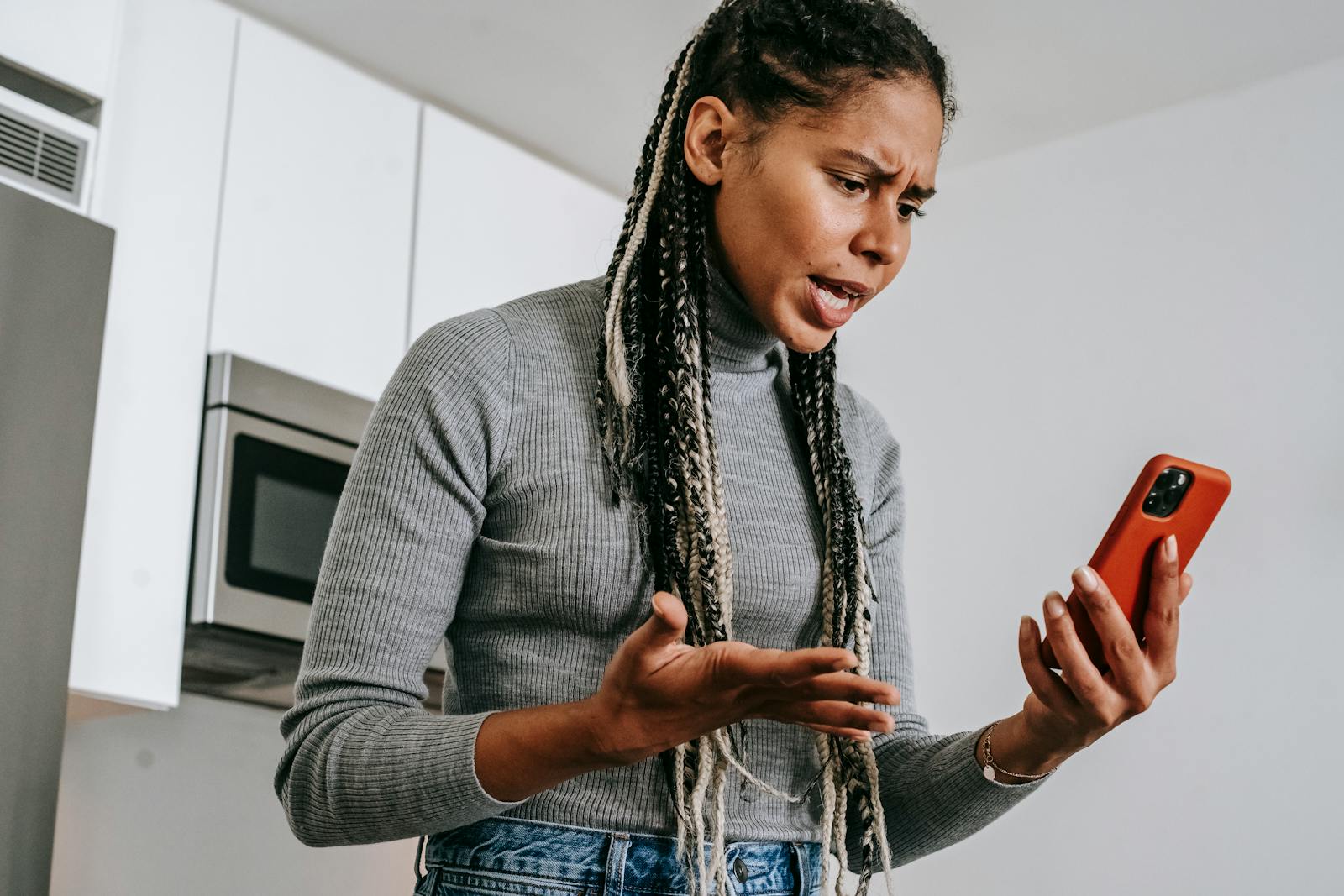
anxious hand near phone
Photo by Alex Green on Pexels

The difference between a coping skill and a flag

A useful question, for anyone who notices themselves doing this: is the face-down phone helping, or is it the floor of a much larger pattern?

If putting the phone face-down lets a person finish a meal, hold a conversation, or sit through a film without the body lurching every few minutes, it is doing its job. It is a coping skill. Keep it.

If the gesture is one of dozens, if the phone has to be in another room, then on silent, then on do-not-disturb, then checked compulsively anyway, the gesture is no longer the intervention. It is a flag on top of a structure that needs more than a flag.

The framing matters because, as the avoidance literature consistently notes, behaviours that reduce anxiety in the moment can quietly expand. AOL’s coverage of avoidance coping describes how strategies that start as small protective gestures can become the architecture of a smaller and smaller life.

The face-down phone sits on the gentle end of that spectrum. It can stay gentle. It can also be a hint.

What the gesture is asking for

Watch what someone does after they place the phone face-down, and you will often see the body let out a small breath. The shoulders drop a quarter inch. The eye contact gets steadier. Whatever was being held in the periphery is briefly off duty.

That breath is the point. The gesture is not really about the phone. It is about the body locating a few minutes in which it is not on-call.

For people who spent their formative years being the one everyone called when something was wrong, those minutes are not trivial. They are the closest thing to off-duty that body has ever been allowed.

So when someone flips their phone over without thinking, the most accurate read is rarely that they are simply being polite. The more accurate read is that they are, very quietly, trying to convince a nervous system trained on being available that this moment does not require it.

That is not rudeness corrected. It is a body asking for a small piece of safety, in the only language it has left that does not require a conversation.



Source link

Tags: arentfacedownflinchLearnedNervousNotificationoncallpeoplePhonePoliteQuietlySitstopSurfacesystemYears
ShareTweetShare
Previous Post

Bank stocks gain on softer bond yields

Related Posts

edit post
The Weekly Notable Startup Funding Report: 5/25/26 – AlleyWatch

The Weekly Notable Startup Funding Report: 5/25/26 – AlleyWatch

by TheAdviserMagazine
May 25, 2026
0

The Weekly Notable Startup Funding Report takes us on a trip across various ecosystems in the US, highlighting some of...

edit post
The economist John Maynard Keynes predicted in 1930 that his grandchildren would be working roughly fifteen hours a week by the early twenty-first century — and the strange thing is that, technologically, he was approximately correct

The economist John Maynard Keynes predicted in 1930 that his grandchildren would be working roughly fifteen hours a week by the early twenty-first century — and the strange thing is that, technologically, he was approximately correct

by TheAdviserMagazine
May 25, 2026
0

It is unusual for a prediction to be half right and half wrong at the same time, but that is...

edit post
Spotify and Universal Music struck a deal to let Premium users make AI covers of UMG songs

Spotify and Universal Music struck a deal to let Premium users make AI covers of UMG songs

by TheAdviserMagazine
May 22, 2026
0

Spotify and Universal Music Group have struck a licensing agreement that will let Premium subscribers create AI-generated covers and remixes...

edit post
SpaceX IPO filing lays out a .75 trillion bet on Mars, AI and Musk control

SpaceX IPO filing lays out a $1.75 trillion bet on Mars, AI and Musk control

by TheAdviserMagazine
May 22, 2026
0

SpaceX is not really selling rockets. At a proposed $1.75 trillion valuation, with Elon Musk locking in just over 85%...

edit post
Africa’s B AI sovereignty plan still runs through 12,000 Nvidia GPUs and Big Tech

Africa’s $60B AI sovereignty plan still runs through 12,000 Nvidia GPUs and Big Tech

by TheAdviserMagazine
May 22, 2026
0

Africa’s AI sovereignty conversation has a vocabulary problem. The word itself suggests independence, self-reliance, a clean break from foreign infrastructure....

edit post
Ten years ago Earth observation startups pitched climate and crop yields; ICEYE just raised €300M in bank debt because the bankable revenue turned out to be something else entirely

Ten years ago Earth observation startups pitched climate and crop yields; ICEYE just raised €300M in bank debt because the bankable revenue turned out to be something else entirely

by TheAdviserMagazine
May 22, 2026
0

Finnish spacetech company ICEYE has originated a €300 million three-year committed revolving credit facility, backed by a seven-bank syndicate of...

  • Trending
  • Comments
  • Latest
edit post
Supreme Court Delivers More Bad Redistricting News for Democrats

Supreme Court Delivers More Bad Redistricting News for Democrats

May 19, 2026
edit post
From Maine to Michigan, Democrats Are Making Communism Great Again

From Maine to Michigan, Democrats Are Making Communism Great Again

May 16, 2026
edit post
Gavin Newsom issues ‘final warning’ amid California’s dire housing crisis — what’s at stake for millions of residents

Gavin Newsom issues ‘final warning’ amid California’s dire housing crisis — what’s at stake for millions of residents

May 3, 2026
edit post
Florida Warning: With Senior SNAP Benefits Averaging 8/Month, Thousands Risk Losing Assistance in 2026

Florida Warning: With Senior SNAP Benefits Averaging $188/Month, Thousands Risk Losing Assistance in 2026

April 27, 2026
edit post
Minnesota Wealth Tax | Intangible Personal Property Tax

Minnesota Wealth Tax | Intangible Personal Property Tax

May 6, 2026
edit post
It’s Time To Talk About Massie

It’s Time To Talk About Massie

May 23, 2026
edit post
People who keep their phone face-down on every surface they sit at often aren’t being polite, many are quietly trying to stop a nervous system that learned, over years of being on-call, to flinch at every notification

People who keep their phone face-down on every surface they sit at often aren’t being polite, many are quietly trying to stop a nervous system that learned, over years of being on-call, to flinch at every notification

0
edit post
The ‘Hantavirus’ Travel Alert: What Cruise Passengers Over 60 Should Know About Recent Rodent-Linked Illness Reports

The ‘Hantavirus’ Travel Alert: What Cruise Passengers Over 60 Should Know About Recent Rodent-Linked Illness Reports

0
edit post
Does Demand Create Supply? | Mises Institute

Does Demand Create Supply? | Mises Institute

0
edit post
Bank stocks gain on softer bond yields

Bank stocks gain on softer bond yields

0
edit post
Fintech firm Mercury hits .2 billion valuation after funding round

Fintech firm Mercury hits $5.2 billion valuation after funding round

0
edit post
As the U.S. and Europe pull back from global climate aid, can Asian funders fill the gap?

As the U.S. and Europe pull back from global climate aid, can Asian funders fill the gap?

0
edit post
People who keep their phone face-down on every surface they sit at often aren’t being polite, many are quietly trying to stop a nervous system that learned, over years of being on-call, to flinch at every notification

People who keep their phone face-down on every surface they sit at often aren’t being polite, many are quietly trying to stop a nervous system that learned, over years of being on-call, to flinch at every notification

May 25, 2026
edit post
Bank stocks gain on softer bond yields

Bank stocks gain on softer bond yields

May 25, 2026
edit post
As the U.S. and Europe pull back from global climate aid, can Asian funders fill the gap?

As the U.S. and Europe pull back from global climate aid, can Asian funders fill the gap?

May 25, 2026
edit post
Here’s Who Gets Social Security Payments on May 27

Here’s Who Gets Social Security Payments on May 27

May 25, 2026
edit post
XRP Price Holds ‘Best Accumulation Zone’as Whales Pull 0M From Binance

XRP Price Holds ‘Best Accumulation Zone’as Whales Pull $170M From Binance

May 25, 2026
edit post
How To Play The Bitcoin 4-Year Cycle For The Most Gains In The Bull Market

How To Play The Bitcoin 4-Year Cycle For The Most Gains In The Bull Market

May 25, 2026
The Adviser Magazine

The first and only national digital and print magazine that connects individuals, families, and businesses to Fee-Only financial advisers, accountants, attorneys and college guidance counselors.

CATEGORIES

  • 401k Plans
  • Business
  • College
  • Cryptocurrency
  • Economy
  • Estate Plans
  • Financial Planning
  • Investing
  • IRS & Taxes
  • Legal
  • Market Analysis
  • Markets
  • Medicare
  • Money
  • Personal Finance
  • Social Security
  • Startups
  • Stock Market
  • Trading

LATEST UPDATES

  • People who keep their phone face-down on every surface they sit at often aren’t being polite, many are quietly trying to stop a nervous system that learned, over years of being on-call, to flinch at every notification
  • Bank stocks gain on softer bond yields
  • As the U.S. and Europe pull back from global climate aid, can Asian funders fill the gap?
  • Our Great Privacy Policy
  • Terms of Use, Legal Notices & Disclosures
  • Contact us
  • About Us

© Copyright 2024 All Rights Reserved
See articles for original source and related links to external sites.

Welcome Back!

Login to your account below

Forgotten Password?

Retrieve your password

Please enter your username or email address to reset your password.

Log In
No Result
View All Result
  • Home
  • Financial Planning
    • Financial Planning
    • Personal Finance
  • Market Research
    • Business
    • Investing
    • Money
    • Economy
    • Markets
    • Stocks
    • Trading
  • 401k Plans
  • College
  • IRS & Taxes
  • Estate Plans
  • Social Security
  • Medicare
  • Legal

© Copyright 2024 All Rights Reserved
See articles for original source and related links to external sites.