
U.S. healthcare’s financial backbone runs on dozens of systems that were never built to talk to each other, with a single insurance claim passing through electronic health records, billing platforms, clearinghouses, payer portals, and bank accounts before any payment lands. That fragmentation costs providers more than $125B a year in earned revenue lost to denials and underpayments, with roughly 15% of claims denied and nearly two-thirds of those denials never resolved. Joyful Health addresses the root cause by building a unified financial system of record for healthcare revenue, connecting clinical encounters, claims, remittance data, payer rules, and bank deposits so providers can finally see the full lifecycle of every claim. On top of that foundation, the company applies AI to identify exactly where claims fail, surface the highest-value recovery opportunities, and run investigation workflows that previously required teams of specialists cross-referencing spreadsheets across half a dozen systems. The platform pairs that automation with experienced revenue cycle operators who carry complex claims through appeals and payer follow-up to resolution, allowing providers to recover earned revenue without expanding headcount. To date, the company has processed more than $1.4B in transactions and delivers a recovery rate above 95% across a range of healthcare specialties.
AlleyWatch sat down with Joyful Health Cofounder and CEO Eliana Berger to learn more about the business, its future plans, recent $17M Series A round that brings the company’s total funding to $22M, and much, much more…
Who were your investors and how much did you raise?Joyful Health recently raised $17M in Series A funding. The round was led by CRV, with participation from existing investors and strategic partners across healthcare and financial infrastructure. Those investors included XYZ Venture Capital, Designer Fund, Inflect Capital, and Go Global Ventures.
Tell us about the product or service that Joyful Health offers.
Joyful Health builds AI-powered financial infrastructure for healthcare revenue. We help organizations understand what actually happened to their money, across the full lifecycle of a claim, and recover what’s been lost along the way.
Our platform connects fragmented data across systems like EHRs, billing platforms, clearinghouses, payer portals, and bank deposits to reconstruct the timeline of every claim. Using AI, we resolve inconsistencies across those systems, determine why a claim didn’t get paid, and identify the highest-value recovery opportunities.
From there, we combine AI-supported workflows with experienced operators who work those claims end-to-end: investigating denials, filing appeals, resubmitting documentation, and following through with payers until resolution.
We operate directly inside our customers’ existing systems and alongside their teams. The result is more recovered revenue, clearer financial visibility, and additional capacity without adding headcount.
What inspired the start of Joyful Health?
Growing up, I watched my family run a therapy practice. They delivered excellent care, but there was constant uncertainty around payment: what had been paid, what was still outstanding, and where revenue was getting stuck.
Years later, working with healthcare organizations as a CFO, I saw the same pattern at scale. Data lived in multiple disconnected systems, and no one could see the full story of a claim from care delivery to payment.
That lack of visibility makes it incredibly difficult to understand financial performance and even harder to fix it. Joyful was built to solve that problem: to make revenue visible, explainable, and ultimately controllable.
How is Joyful Health different?
Most solutions in this space either show you the problem or outsource the work. Joyful does both and connects them.
We don’t just provide dashboards, and we don’t operate as a traditional RCM vendor. We combine claim-level intelligence with hands-on execution. We investigate what happened, recover what’s recoverable, and document root causes so the same issues don’t repeat.
We also focus specifically on the most complex claims, the small percentage that drives the majority of revenue loss, rather than high-volume, low-complexity billing.
And importantly, we work inside existing systems and alongside internal teams, so organizations gain capacity and visibility without disrupting operations.
What market does Joyful Health target and how big is it?
Joyful serves insurance-driven healthcare organizations, typically multi-site provider groups and platforms. The broader market is significant. U.S. healthcare providers lose or fail to collect more than $125 billion each year due to denied or underpaid claims.
We focus on the portion of that problem driven by complexity, where claims require multiple touches, investigation, and follow-up to reach resolution.
What’s your business model?
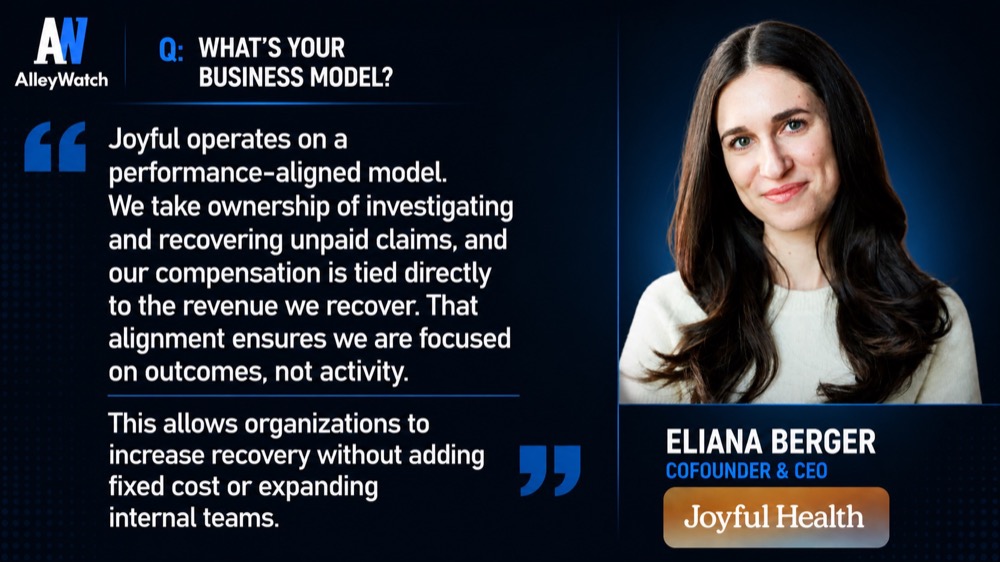
Joyful operates on a performance-aligned model. We take ownership of investigating and recovering unpaid claims, and our compensation is tied directly to the revenue we recover. That alignment ensures we are focused on outcomes, not activity.
This allows organizations to increase recovery without adding fixed cost or expanding internal teams.
How are you preparing for a potential economic slowdown?
In a tighter economic environment, financial clarity and cash flow become even more important. Our focus is helping organizations improve visibility into their revenue, recover what they’ve already earned, and reduce volatility in collections.
Internally, we’re focused on disciplined growth, investing in core infrastructure, and continuing to deliver measurable financial outcomes for customers.
What was the funding process like?
The process was thoughtful and analytical. Investors spent time understanding not just the size of the problem, but why it persists and why it hasn’t been solved by existing solutions.
Once we aligned on the idea that this is fundamentally an infrastructure problem, not just a billing problem, the conversations became much more straightforward.
What are the biggest challenges that you faced while raising capital?
The main challenge was category definition. Joyful doesn’t fit neatly into traditional buckets like RCM outsourcing or healthcare SaaS. We had to clearly articulate what we are building, a new layer of financial infrastructure, and why combining intelligence with execution is necessary to solve the problem.
What factors about your business led your investors to write the check?
A few things stood out.
First, the scale and persistence of the problem. Denied and underpaid claims represent one of the largest sources of lost revenue in healthcare, and it’s not being solved by existing approaches.
Second, the technology. Investors understood that this is fundamentally a data and infrastructure problem. Healthcare financial data is fragmented, inconsistent, and often unlabeled. Our platform uses AI to connect that data, reconstruct what actually happened to a claim across systems, and determine the right action to take. That ability to move from fragmented signals to clear, claim-level understanding, and then act on it, is what makes the model work.
Third, our perspective. Before starting Joyful, we worked alongside healthcare organizations as CFOs. We experienced firsthand how difficult it is to explain revenue, forecast cash flow, and understand where money is getting stuck. That shaped how we built the company, not as a billing tool, but as financial infrastructure designed to make revenue visible and controllable.
Finally, early results. We’ve shown that combining this technology with execution can drive meaningful recovery outcomes, with a model that aligns incentives directly with our customers.
Together, those pieces made it clear that this isn’t just an incremental improvement, it’s a different way of approaching the problem.
What are the milestones you plan to achieve in the next six months?Over the next six months, we’re focused on continuing to build the automation layer on top of the infrastructure we’ve put in place.
That starts with improving how we connect and interpret data across systems, making it faster and more reliable to reconstruct what happened to every claim. From there, we’re expanding how much of the recovery workflow can be automated, including identifying root causes, prioritizing claims, and initiating actions like appeals and resubmissions.
At the same time, we’re increasing overall recovery capacity for customers, combining automation with human operators to ensure accuracy and follow-through on complex cases.
We’re also focused on deepening integrations within customer environments so we can operate more seamlessly alongside their existing teams and systems.
The goal is to continue shifting more of the process from manual, fragmented work to structured, automated workflows, improving both recovery outcomes and the consistency of financial visibility.
What advice can you offer companies in New York that do not have a fresh injection of capital in the bank?
Focus on understanding your customer and the problems you are being ‘hired’ to solve. When you understand your value, product market fit, and ideal customer profile you’re in a tremendous position to build, experiment, and generate early results and leading indicators. From there, fundraise if you feel you’re ready.
Where do you see the company going now over the near term?
Near term, we’re focused on deepening the infrastructure layer we’re building for healthcare revenue. That starts with continuing to improve how we reconstruct and understand what happened to every claim, connecting fragmented data across systems and making it explainable at a claim level. As that foundation strengthens, we expand our ability to identify, prioritize, and recover the most complex unpaid claims.
AI plays a key role here, but in a very practical way. It allows us to interpret messy, inconsistent financial data across systems, reconstruct the full lifecycle of a claim, and determine the right action to take. From there, we combine AI-supported workflows with human operators to actually execute the recovery work.
What’s your favorite spring destination in and around the city?Prospect Park in Brooklyn, especially early in the morning.

You are seconds away from signing up for the hottest list in NYC Tech!
Sign up today