Financial advisors with clients who are worried about the impact of politics on their retirement security express a mix of “frothy optimism” and “fundamental concern,” a new study found.
Processing Content
In general, advisors “have a much rosier view of the economy” than investors, but the “ambivalence in advisors’ views may help explain why they do not appear to have much impact on their clients’ confidence,” according to a study released last month by the Center for Retirement Research at Boston College and sponsored by Jackson National Life Insurance. The analysis stemmed from an independent survey conducted last July by Greenwald Associates of more than 1,400 mass affluent U.S. adults between 45 and 79 years old with at least $100,000 in investable assets and 400 advisors with 75 or more clients and a substantial share of the base among those aged 50 or over. And it followed the release in March of other findings from the poll suggesting that many advisors aren’t discussing Medicare, the federal government’s debt or tariff policies with their clients.
That data showed, however, that advisors and clients have been talking about the risks posed by Social Security’s projected insolvency in 2033 and the estimated 23% cut to benefit payments that would entail. And the latest release of figures from the poll demonstrated that the investors and advisors share similar levels of unease about the U.S. government’s debt, tariffs and rising Medicare costs, to the point that a significant share of both groups took action or recommended doing so by the middle of last year.
In all, the numbers added up to a murky conclusion indicating that advisors, who are often hired for the so-called peace of mind they provide clients, aren’t always delivering.
“The pattern of responses from advisors paints a picture of frothy optimism at a high level, coupled with fundamental concern about the implications of policy on financial security,” the report’s authors, Center for Retirement Research Senior Advisor Alicia Munnell and Associate Director of Health and Insurance Gal Wettstein, wrote.
“When asked in any great detail about specific policies or about the appropriate posture to strike between conservative and aggressive investment behavior, the advisors generally display an increased preference for safety as opposed to chasing returns,” they continued. “Putting on a brave face despite underlying concerns may be a response to clients’ need for reassurance. The ambivalence in advisors’ views may help explain why they do not appear to have much impact on their clients. Regression results show that the correlations between having a financial advisor, on the one hand, and the change in investors’ concern for either their investments or their financial future, on the other, are statistically insignificant in both cases.”
READ MORE: What do RIAs pay for Schwab as custodian? It all depends
Same world, different perspectives
Much of that divergence in outlook between investors and advisors comes from the difference between the short-term fears of daily political and economic news and experts’ knowledge about the long-term gains of investing over decades, according to financial behaviorist Jacquette Timmons, who coaches advisors and investors on the emotional aspects of money.
Jacquette Timmons
Advisors can’t control the outcomes of policy issues like tariffs or federal debt, but they can acknowledge what clients are seeing, she noted. Then they should explain how the clients’ financial plan is taking the unknowns into account while providing flexibility in the possible responses to any developments in the future.
“They’re not looking at that long history — they’re looking at, ‘Oh my God, the market is down, what if this continues?’ They are not responding in the context of a long-term perspective, they are responding to what is happening right now or what they are feeling right now,” Timmons said. “The disconnect comes from the lens through which they are both reacting to the same moment in time. One has history. The other is saying, ‘I don’t care about your history. This is what I’m feeling right now.'”
Sudden moves in stock values and politics over the years have likely trained advisors well in talking about subjects such as the all-time highs for the S&P 500 and Nasdaq indices this week or, at the time of the poll last year, the passage of the One Big Beautiful Bill Act. But that doesn’t mean advisors and clients are drawing the same conclusions.
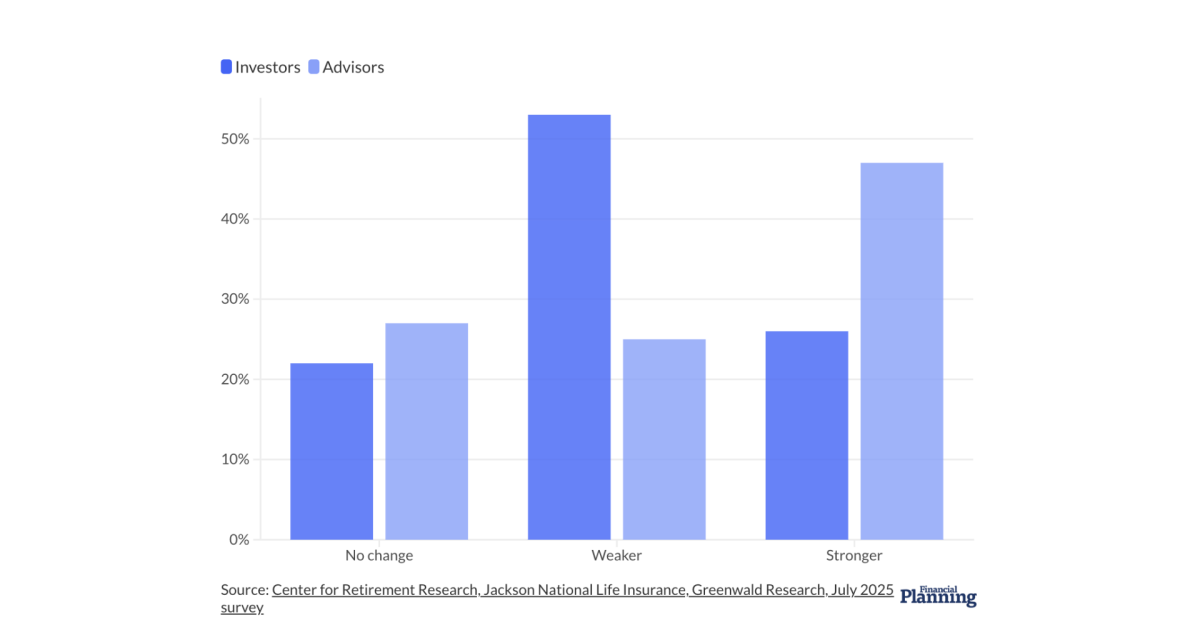
When asked whether they viewed the economy as growing weaker, stronger or staying the same since the beginning of 2025, 53% of the investors said they had assessed it as weaker, compared to only 25% of advisors. At least 27% of the advisors and 22% of the investors said there had been no change to their view. And 47% of the advisors believed that the economic outlook had turned stronger during the year, while just 26% of the investors had that belief. The discrepancy in the two groups’ overall outlook spilled into other subjects as well.
“While investors say the government’s future actions will weaken their financial security by a nearly two-to-one margin (47% versus 24%), the views of advisors are again very different,” the study said. “Only 31% of advisors believe the government will weaken their clients’ finances, while 36% believe government actions will be positive.”
READ MORE: Edward Jones and American Funds: A 60-year revenue-sharing alliance
Underneath the surface
However, advisors’ “positive outlook for retirement is also somewhat contradicted by their concern regarding specific policy risks,” and there are some important implications to the “underlying pessimism of advisors beneath their overall positive sheen,” the study said.
The majority of the advisors said they were worried about a decline in the stock market (63%), reductions to Social Security benefits (65%), changes to tariffs (67%), hikes to Medicare costs (72%), spikes in inflation (79%) and levels of federal debt (87%). A small share (11%) suggested clients delay retirement since the beginning of 2025. But a greater percentage of advisor respondents recommended spending reductions (21%), reallocations of investments for tax purposes (42%), vehicles to hedge against losses (43%) and altering investments (49%).
When it came to altering investment strategies, the largest portion of the group, 36%, said they had recommended “no change” in the first half of 2025, with 21% reporting there was no clear pattern over the year, 18% calling for greater risks in client portfolios and 25% instructing clients to lower their risks.
Nearly two-thirds of the advisors, 64%, said their level of concern about their clients’ future had stayed the same through the first six months of the year, while 28% said it had increased and 9% said it had decreased.
Among the investors, 46% said their level of concern about their own financial well-being had stayed the same in 2025, compared to 39% who said it had climbed and 15% who said it had fallen. More than 60% said their confidence that the federal government would pass laws to benefit Americans had dropped in the first half of last year. A third had shifted their investment portfolios to more conservative allocations, 28% had boosted their emergency savings and 21% had delayed their retirement.
“One resource that could help older Americans cope with the heightened level of policy uncertainty is their financial advisors,” Munnell and Wettstein wrote. “Advisors, however, seem conflicted.”