In Herman Melville’s final novella, Billy Budd, a ship’s captain named Edward Vere orders the hanging of a sailor he knows to be morally innocent. Billy Budd struck a superior officer and killed him, but only because he was falsely accused of mutiny and could not speak in his own defense. Vere is not confused about any of this. He tells the drumhead court exactly what he believes: that Billy is innocent in the eyes of God and nature. Then he argues for the death sentence anyway, on the grounds that the Mutiny Act—the law of the British crown—demands it. The sailor’s allegiance is to the King. The King’s law has spoken. Billy hangs, and his last words are “God bless Captain Vere.” Melville gives us no resolution. The novella ends with the question it opened: what does it mean when institutional allegiance and moral reality point in opposite directions, and a man with authority chooses the institution?
That question is the operational question facing American military officers right now, and it has been for most of the past eighty years. The difference between Vere’s situation and theirs is the difference that should change everything. Vere’s allegiance was to a king. An American officer’s allegiance is to a document. The oath of a commissioned officer of the United States reads:
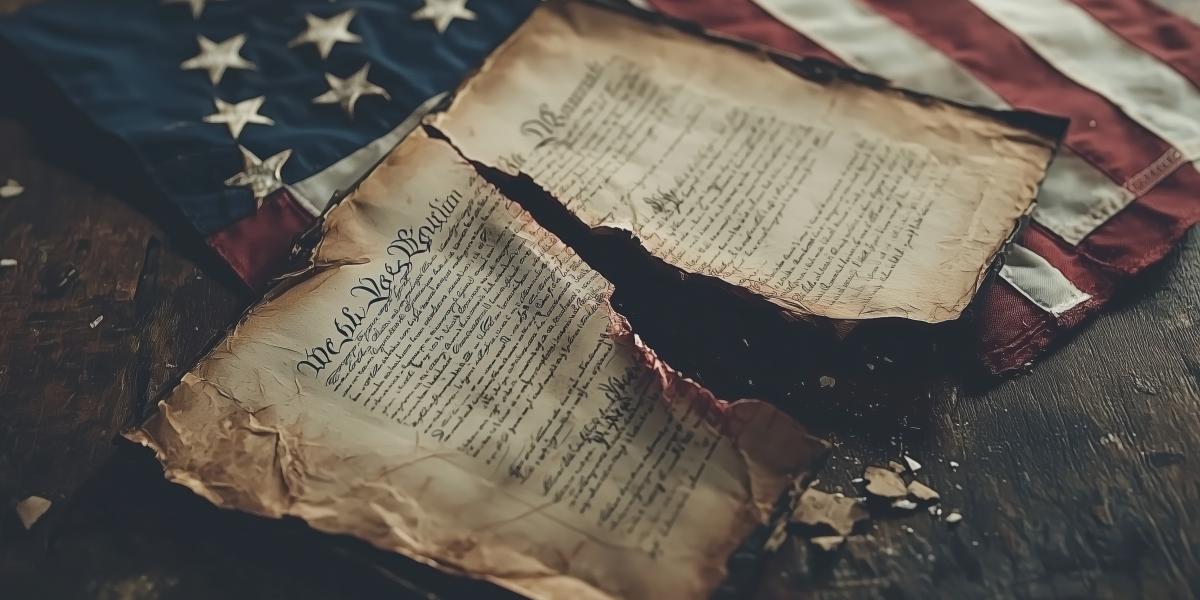
I, [name], do solemnly swear that I will support and defend the Constitution of the United States against all enemies, foreign and domestic; that I will bear true faith and allegiance to the same; that I take this obligation freely, without any mental reservation or purpose of evasion; and that I will well and faithfully discharge the duties of the office on which I am about to enter. So help me God.
There is no mention of the president. There is no pledge of personal loyalty to any individual or administration. The enlisted oath adds obedience to the president and officers, but the commissioned officer’s oath does not. An officer swears to the Constitution, and to nothing above it. The president is not the king. That distinction is not accidental, and it is not ceremonial.
The men who drafted Article II and designed the military commission structure had lived under a king, had fought a war against that king’s army, and understood with precision what it meant for soldiers to owe their loyalty to a person rather than to a law. The oath was written to foreclose that possibility, to make the source of military authority the Constitution itself rather than whoever happened to occupy the executive office. The officer’s obligation to the chain of command flows from the constitutional order and is only legitimate insofar as that order is being honored. To treat the oath as a formality, as a ceremony with no operational content, is not discipline. It is a slow institutional fraud perpetrated against the document and against every soldier who serves under the assumption that the officers above them are bound by something more than the preferences of the current administration.
Mises explains this dynamic in The Theory of Money and Credit, observing that “if war is regarded as advantageous…then laws will not be allowed to stand in the way of going to war. On the first day of any war, all the laws opposing obstacles to it will be swept aside.” That is a description of what has happened in every undeclared American war since Korea. The constitutional requirement for a congressional declaration is not repealed, it is not argued against, it is simply set aside because the executive has already decided the war is advantageous, and the institution follows. The officer who treats the oath as a live obligation is the only remaining friction against exactly that process.
The record bears this out. Korea and Vietnam were never declared. The invasions of Grenada, Panama, Iraq, Syria, and Libya were never declared. The war in Afghanistan consumed twenty years under an Authorization for Use of Military Force so broad it functioned as a blank check drawn on the constitutional treasury. Article I, Section 8 assigns the power to declare war to Congress, not to the president. That language has not changed. What has changed is the institutional willingness to treat its absence as a technicality. If the oath had been enforced as written, if officers had understood their allegiance to the Constitution as a live obligation rather than a professional ritual, the architecture of American foreign policy over the past eight decades would look profoundly different. The wars that could not survive a constitutional question would not have been fought. The men who did not come home from those wars might have. That is not a comfortable calculation, but it is the one the oath demands.
The war with Iran forces the question into the open again. When Congress was given the opportunity to reassert its constitutional role, the resolution was rejected that would have required the president to seek congressional approval for further military action. The branch of government constitutionally-assigned the war power declined to exercise it. Every member of Congress who voted against that resolution took a similar oath as every military officer in the field. An officer asking whether deployment into that conflict is constitutionally grounded is not being difficult. They are doing the only thing the oath ever actually asked of them.
This obligation carries force for the all-volunteer military, in ways that are rarely acknowledged. In The Ethics of Liberty, Rothbard drew a sharp distinction between the drafted soldier and the volunteer. Conscription, he argued, is structural coercion—the drafted soldier did not choose the terms of their service and cannot be held to have accepted them freely. The volunteer did choose, and those terms include the oath. An officer who swears freely to defend the Constitution and then deploys in support of an undeclared war has not simply made a personal ethical compromise. They have violated the terms of the agreement the institution asked them to make. Rothbard’s insight is that the soldier who invokes the Constitution is not the one breaking the contract. The institution that sent them to war without a declaration is.
Ulysses S. Grant understood this from personal experience. Writing in his Personal Memoirs, he looked back on the Mexican-American War with unsparing honesty: “For myself, I was bitterly opposed to the measure, and to this day regard the war which resulted as one of the most unjust ever waged by a stronger against a weaker nation.” He had served, followed orders, and performed his duty in a war he believed was wrong from the beginning. He also understood why resistance is nearly impossible once the machinery starts. “Once initiated there were but few public men who would have the courage to oppose it.” And finally, with a candor that should unsettle anyone who has worn a uniform: “Experience proves that the man who obstructs a war in which his nation is engaged, no matter whether right or wrong, occupies no enviable place in life or history.” Grant was not lamenting this. He was describing the mechanism that enforces silence and naming it honestly as the thing that makes oath enforcement so rare.
Hayek located what is ultimately at stake. In The Road to Serfdom, he wrote that the rule of law “means that government in all its actions is bound by rules fixed and announced beforehand.” When an executive launches a war during negotiations, without a declaration, and Congress declines to even vote on the question, the rule of law has not been strained. It has been abandoned in that domain entirely. What remains is rule by men, by whichever men currently hold the relevant offices and feel sufficiently urgent about the moment. Hayek understood that this is how free societies lose their character, not in a single dramatic rupture but in the accumulated weight of precedents, each defensible on its own terms, that together establish that constitutional constraints apply to everyone except those empowered to declare an emergency.
Courts provide no corrective action. The political question doctrine allows federal courts to decline jurisdiction over war powers disputes by declaring them beyond judicial resolution, which, in practice, means the constitutional question is returned to the political branches that have already demonstrated their unwillingness to answer it. The officer is left alone with the oath.
The oath of commission is not a loyalty pledge to a person or an administration, it is a public declaration, made freely, that the officer understands their authority to derive from a constitutional order and accepts a personal obligation to defend that order. American officers are not Billy Budd; they are Captain Vere. They hold the power, they convene the courts, and they decide whether the machinery runs.