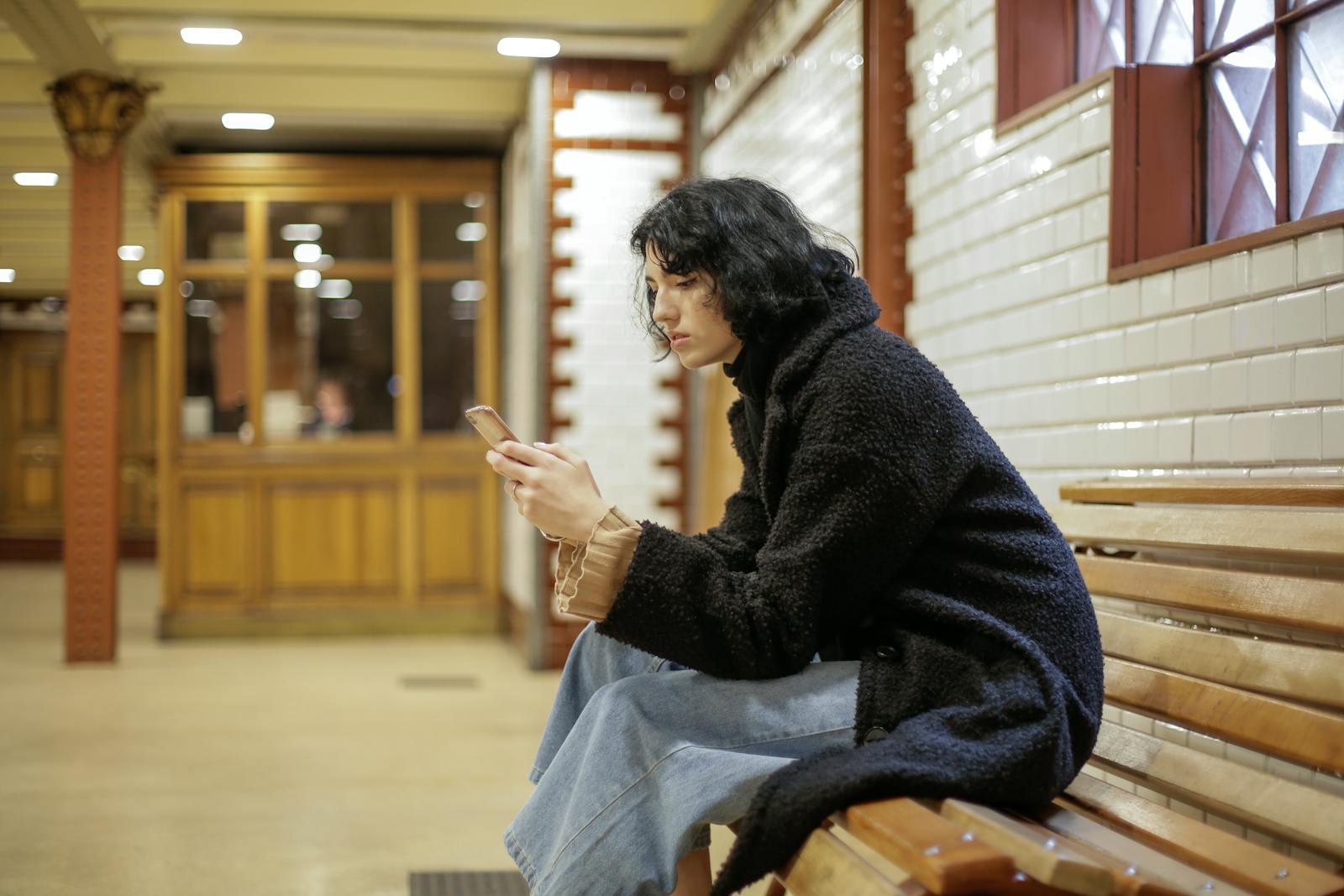
Three calls this month. Zero returned. She’s doing the math again, the way she’s done it for thirty years, without ever once admitting out loud that she’s doing math.
She would not describe it as keeping score. She would describe it as caring.
But the ledger is there. It has always been there. She notices it the way you notice a loose floorboard you’ve stopped stepping on: not with alarm, just with the quiet recognition of someone who has learned to live around a flaw in the house. Somewhere underneath the ritual of dialing her sister again, an experiment has been running for decades. The hypothesis never changes. The result never changes either.
The caretaker who is also the test subject
There’s a particular kind of person who reaches out constantly. They remember birthdays. They text after the surgery. They ask how the interview went. They are, by every social metric, the warm one in the group.
And underneath all that care, a quieter machinery is running. A hypothesis being tested. The hypothesis is simple: if I stopped doing this, would anyone come looking for me?
Most of them have been running the experiment long enough to already know the answer. They keep checking anyway, the way a person keeps pressing a bruise to confirm it still hurts.
This article is about that experiment. Not just why it exists, but what it actually costs the person running it, and what happens when they finally decide to stop treating every phone call as a test and start treating it as a choice.
Why the experiment exists at all
Nobody sets out to become this person. They usually arrived here through a specific kind of childhood, the kind where attention wasn’t reliably offered and had to be earned. A new longitudinal study published in the Journal of Personality and Social Psychology, led by Keely Dugan at the University of Missouri, followed 1,364 children from infancy into adulthood and found that early dynamics with mothers predicted attachment styles across every major relationship in adult life: with parents, with friends, with romantic partners.
Dugan’s team identified two dimensions that shape how adults show up in their relationships. Attachment anxiety, which is the low-level hum of uncertainty about whether the people you love will actually be there. Attachment avoidance, which is the learned conviction that it’s safer not to ask.
The chronic check-in-er usually lives in the first zone. They aren’t avoidant. They’re reaching, constantly, because the reaching itself is the thing that keeps the relationship visible to them. If they stop, they suspect it will disappear.
And here’s the part that’s hard to say out loud: they’re often right.
What reciprocal altruism has to do with it
Humans are wired for give-and-take in a way that goes back much further than our own lifetimes. Evolutionary psychologists have written extensively about reciprocal altruism, the idea first formalized by Robert Trivers that we help others with an unconscious expectation of being helped in return. When someone takes without giving back, we feel outraged. When we take without returning, we feel apologetic. The entire social fabric runs on this ledger.
What this means is the chronic check-in-er isn’t being weird or needy. They’re operating on the oldest social math our species has. They’re giving, and their nervous system is quietly waiting for the return: not as a transaction, but as confirmation that the relationship is alive in both directions.
When the return doesn’t come, year after year, something in them starts to hollow out. It doesn’t look like anger. It looks like a slightly wearier voice on the phone.
The disguise is good because it has to be
Here’s why it’s so hard to see this pattern from the outside. They don’t point out that they’re always the one initiating contact. They don’t keep a visible tally. They would be mortified to be perceived that way.
What they do is absorb. A psychologist writing for Forbes described three types of emotional disconnection in long-term relationships, including the slow drift into transactional rather than emotional contact: conversations that sound fine but are really just logistics. The chronic check-in-er often tolerates an entire web of operational relationships because the alternative is admitting that the closeness they’ve been performing is thinner than it looks.
They’d rather keep calling than find out what happens if they stop.
The cumulative cost of being the default person
From the outside, these people look saintly. From the inside, the experience is often exhausting and faintly resentful. They love the people they’re checking in on. They also feel invisible to them.
I wrote recently about the specific resentment that builds when one person does invisible relational work and the other person benefits without ever noticing it exists. That dynamic doesn’t stay inside marriages. It shows up between siblings, between old friends, between a mother and her adult children. Anywhere one person has appointed themselves the keeper of the connection, the same slow withdrawal starts to take hold.
The word caregiver usually gets applied to people tending to a sick parent or a disabled child. But the emotional caregivers of a family or friend group, the ones holding all the threads, burn out in almost identical ways. A recent analysis of caregiver burnout data from A Place for Mom found that the stress of caregiving is rarely a single crisis. It’s the cumulative weight of being the default person, the one whose absence would be felt first.
The chronic check-in-er is living that pattern in miniature, over decades, without anyone ever calling it work. And because nobody calls it work, nobody thinks to thank them for it. The burnout doesn’t announce itself. It shows up as shorter phone calls. A little more flatness in the voice. A gradual narrowing of what they’re willing to share.
Silicon Canals has written before about how the person who always offers to drive, always picks the restaurant, always plans the trip is almost never the controlling one in the group. They’re the one who learned, early and painfully, that if they didn’t organize the connection, the connection wouldn’t happen. The check-in is the softer, more emotional version of the same adaptation. And it wears the same grooves.
What happens when they finally stop
This is the part I’ve watched play out in my own life and in the lives of people I know. Someone gets tired. They stop initiating. They wait to see what arrives on its own.
What arrives is usually nothing. Not because nobody cares but because attention is a limited resource and most people are navigating their own crises, and the one who used to reach out was functioning as the connective tissue that held several relationships upright. When they pull back, the tissue simply dissolves.
Silicon Canals has written about how you will be forgotten by most people you know, not because you didn’t matter but because you are competing with every screen, every urgency, every crisis that isn’t you. The chronic check-in-er figured that out before most people. That’s why they kept calling.
The problem with learned helplessness on the other side
Part of why the experiment keeps returning the same result is that the people on the receiving end of all this care have, over time, developed a kind of learned helplessness about the relationship. They don’t call because someone else always calls. They don’t plan because someone else always plans. They’ve been trained, gently and without malice, to sit back and receive.
They aren’t bad people. They’re people who’ve adapted to an ecosystem where their participation was optional, and so they opted out. Most of them would be genuinely hurt to discover they’ve been failing a test they didn’t know was being administered.
The thing I had to learn about friendship and follow-through
I spent the first fifty years of my life believing that friendships maintained themselves. Then my best friend Ray moved across the country, and within eighteen months we’d gone from talking every week to talking twice a year. Nobody was angry. Nobody had done anything wrong. We’d just both assumed the other one would pick up the phone, and neither of us did.
What saved me after that was a Saturday morning breakfast with three other men at the same diner, which I started because I’d already lost one friendship to passivity and wasn’t willing to lose three more. Twenty years later, we still go. I am, unambiguously, the one who reminds everyone. If I stopped, the breakfast would stop. I’ve made peace with that because I know what the alternative costs.
But I also know there’s a version of me that’s been quietly waiting, for twenty years, to see if one of them would text first on a Saturday when I forgot. It hasn’t happened yet. That’s the experiment. It runs whether I want it to or not.

What changes when the pattern gets named
Dugan’s research, notably, ended on a hopeful note. Attachment styles are not life sentences. They respond to new relational experiences. The anxious check-in-er can, over time, develop more secure expectations. But only if they first recognize that the experiment they’ve been running was never designed to produce a satisfying result. It was designed to confirm what they already believed about themselves, which is that they are the kind of person who has to earn the attention other people seem to receive for free.
Naming the pattern doesn’t make it stop. But it changes what’s available. Once you can see it clearly: I have been the one reaching for thirty years, and I am tired, and some part of me has been waiting the whole time to see if I’m worth reaching for. Now you have a choice you didn’t have before.
You can keep checking in because you want to, not because you’re testing. You can let some relationships thin out without treating that as a personal failure. You can ask directly for what you’ve been hoping someone would offer unprompted, which feels humiliating at first and stops feeling humiliating after the third or fourth time.
And you can do the thing that sounds simplest but is, for people wired this way, almost unbearable: you can tell someone what you actually need. Not by withdrawing and seeing if they notice. Not by performing care until you collapse and then resenting them for not catching you. But by saying, plainly, I would like you to call me sometimes. It would mean something to me if you did.
The quiet grief underneath it all
The hardest part isn’t the behavior. It’s the grief that sits underneath it. The recognition that you have spent decades being the one who remembered, and that most of the people you remembered were not, in the same way, remembering you.
That grief doesn’t mean the relationships were fake. It means they were uneven. And you built your identity on being the person who could carry the unevenness without complaining.
So here’s the question you’re going to have to sit with, and I don’t have a gentler version of it to offer: if you stopped calling tomorrow, who would notice, and how long would it take them?
Count the names. Count the days. That number is the one you’ve been avoiding for thirty years, and no amount of reaching out one more time is going to change it. The experiment already has its answer. The only real question left is what you’re going to do now that you can’t unknow it.
Are you going to keep performing care for people who have quietly agreed to let you? Or are you finally willing to find out who you are when you aren’t the one holding the phone?
Feature image by Andrea Piacquadio on Pexels