
No Result
View All Result
SUBMIT YOUR ARTICLES
  • Login
Saturday, June 20, 2026
TheAdviserMagazine.com
  • Home
  • Financial Planning
    • Financial Planning
    • Personal Finance
  • Market Research
    • Business
    • Investing
    • Money
    • Economy
    • Markets
    • Stocks
    • Trading
  • 401k Plans
  • College
  • IRS & Taxes
  • Estate Plans
  • Social Security
  • Medicare
  • Legal
  • Home
  • Financial Planning
    • Financial Planning
    • Personal Finance
  • Market Research
    • Business
    • Investing
    • Money
    • Economy
    • Markets
    • Stocks
    • Trading
  • 401k Plans
  • College
  • IRS & Taxes
  • Estate Plans
  • Social Security
  • Medicare
  • Legal
No Result
View All Result
TheAdviserMagazine.com
No Result
View All Result
Home Market Research Cryptocurrency

How AI is fueling Bitcoin miners 500% stock gains

by TheAdviserMagazine
2 months ago
in Cryptocurrency
Reading Time: 8 mins read
A A
How AI is fueling Bitcoin miners 500% stock gains
Share on FacebookShare on TwitterShare on LInkedIn


Make CryptoSlate preferred on

Publicly listed Bitcoin miners liquidated more than 32,000 Bitcoin during the first quarter of 2026, marking a record sell-off as the industry’s largest operators redirect billions in capital toward artificial intelligence.

This historic shift is unfolding precisely as the economics of Bitcoin validation reach a critical pressure point.

With mining profitability hovering near cyclical lows, weighted production costs surging, and network hashrate showing persistent signs of strain, the infrastructure giants that defined the last crypto boom are fundamentally reengineering their business models.
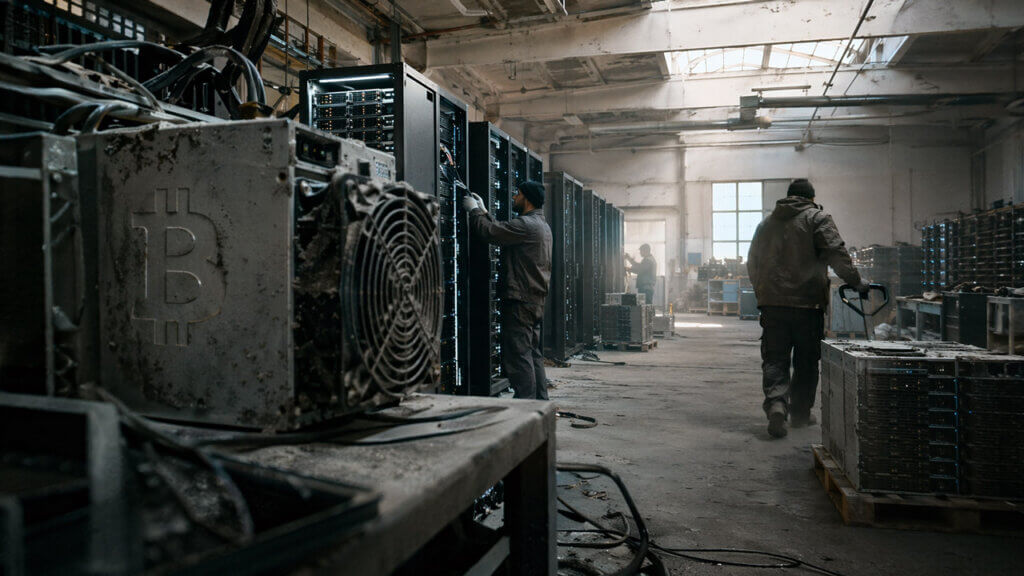
Latest Bitcoin data proves BTC miners need price to retake $80k to stop lure of $4B in AI revenueLatest Bitcoin data proves BTC miners need price to retake $80k to stop lure of $4B in AI revenue
Related Reading

Latest Bitcoin data proves BTC miners need price to retake $80k to stop lure of $4B in AI revenue

Yet top 10 public miners could earn $4.7B–$9.3B from BTC vs up to $4.1B in long-term AI contracts, reshaping Bitcoin’s security base.

Apr 18, 2026 · Liam ‘Akiba’ Wright

Public BTC miners turn to the balance sheet

The sheer magnitude of the first-quarter liquidation reflects the severity of the capital pivot.

Public mining firms unloaded more Bitcoin in the first three months of 2026 than they did throughout 2025.

To contextualize the scale of the sell-off, the Q1 offload easily surpassed the roughly 20,000 Bitcoin dumped by the industry during the chaotic Terra-Luna collapse in the second quarter of 2022.

According to on-chain data from CryptoQuant, miner reserves have steadily eroded throughout the cycle, with prominent operators now using their digital treasuries as vital liquidity engines rather than long-term strategic holdings.
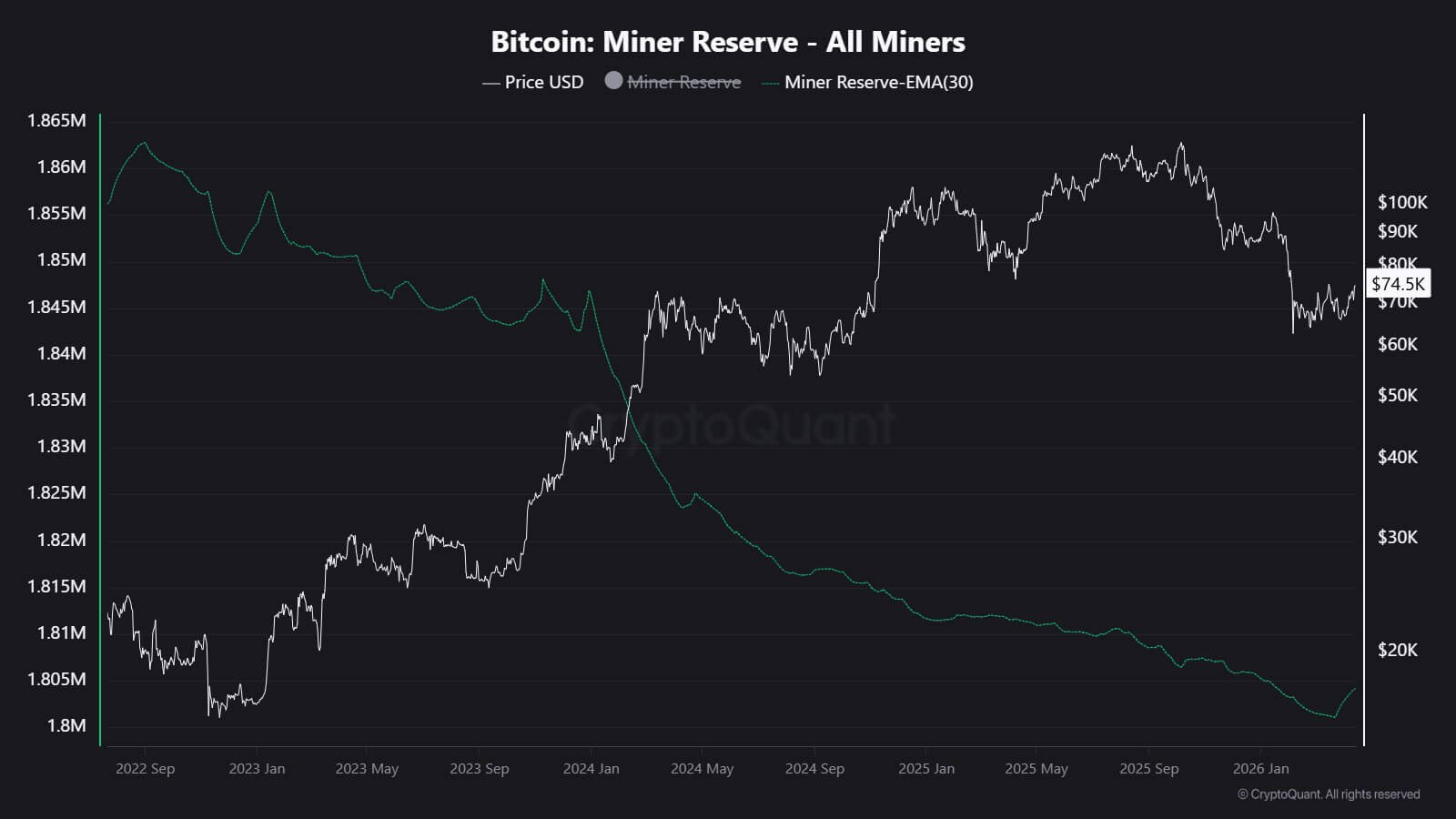
Bitcoin Miners' Reserves
Bitcoin Miners’ Reserves (Source: CryptoQuant)

The firm noted that, since the start of the current cycle, miners have recorded a net sell of 61,000 BTC. This heavy selling activity is led by Marathon Digital, which offloaded over 13,000 BTC and has since dropped out of the top three Bitcoin holders.

Other BTC miners selling their holdings include Cango, which sold 2,000 Bitcoin for roughly $143 million to extinguish Bitcoin-backed debt obligations and clear its balance sheet. Core Scientific unloaded around 1,900 Bitcoin in January to raise $175 million, while Riot Platforms sold 4,026 BTC.

Post-halving economics break the old model

The engine driving this mass exodus of capital is a broken economic model, exacerbated by the April 2024 halving, which slashed block rewards from 6.25 BTC to 3.125 BTC.

The programmatic 50% cut in block subsidies fundamentally repriced the revenue baseline for the entire sector, leaving operators highly vulnerable to market fluctuations.

Since that reduction, BTC mining economics have been defined by unrelenting downward pressure.

James Butterfill, head of research at digital asset manager CoinShares, noted that the weighted average cash cost to produce a single Bitcoin for public operators surged to nearly $80,000 in the final quarter of 2025.
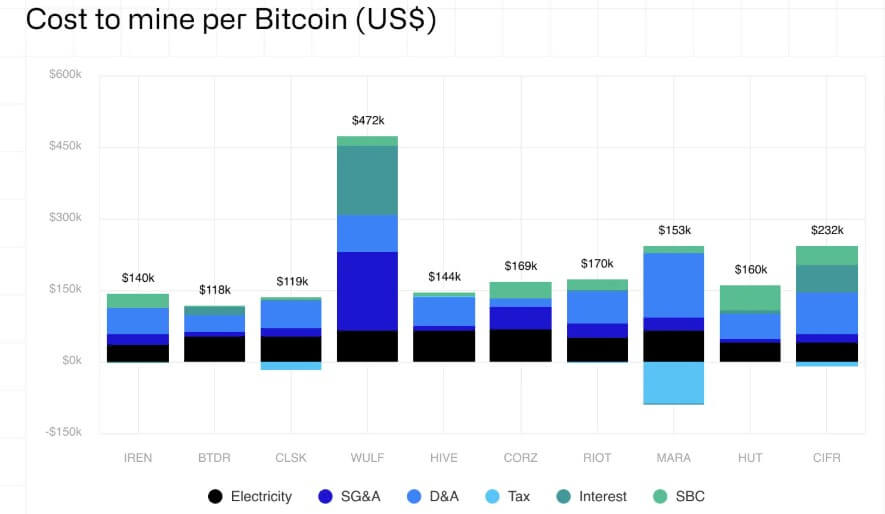
Average Bitcoin Mining Cost per MinerAverage Bitcoin Mining Cost per Miner
Average Bitcoin Mining Cost per Miner (Source: CoinShares)

Meanwhile, the revenue side of the equation continues to deteriorate. Hashprice, the metric tracking expected revenue per unit of computing power, plummeted to between $28 and $30 per petahash per second per day in Q1 2026, marking some of the lowest profitability levels on record.

With transaction fees remaining structurally weak at less than 1% of total block rewards, miners are highly dependent on spot price appreciation.

However, with Bitcoin hovering around $77,000, substantially below its cycle peak of approximately $126,000 reached in October 2025, miners are caught in a vise.

Ballooning debt burdens and massive electricity overheads are squeezing cash flow to the breaking point, forcing executives to look elsewhere for earnings.

Why Wall Street is rewarding the AI pivot

Faced with shrinking margins, pure-play operators are finding that boards of directors and institutional investors are aggressively rewarding a pivot toward AI and high-performance computing.

Unlike the volatile, spot-market nature of Bitcoin mining, AI data centers offer stable, predictable, multi-year revenue contracts with technology giants like Google, Microsoft, and Anthropic.

The equity market’s verdict has been unambiguous. Mining companies that set AI revenue targets of 80% or higher have seen their stock prices skyrocket by an average of 500% over the past two years, securing vastly superior market multiples compared to their pure-play mining peers.

Butterfill estimates that public miners could derive up to 70% of their revenues from AI by the end of this year, a steep climb from roughly 30% today.
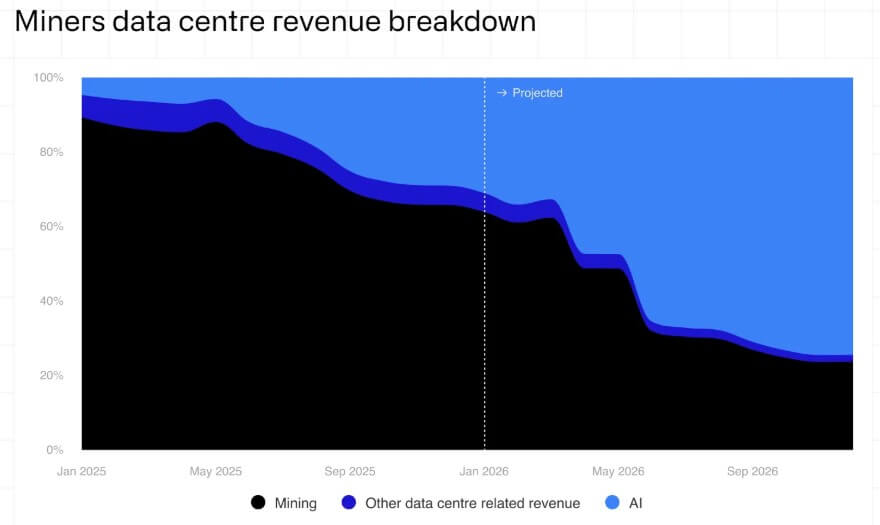
Bitcoin Miners Data Centre Revenue ProjectionBitcoin Miners Data Centre Revenue Projection
Bitcoin Miners Data Center Revenue Projection (Source: CoinShares)

With more than $70 billion in cumulative AI and high-performance computing contracts announced across the public mining sector, capital is no longer flowing toward next-generation ASIC replacements.

Instead, debt and equity are being funneled into data-center-style infrastructure. Operators like TeraWulf, IREN, and Cipher have taken on billions in collective debt to fund these buildouts, driven by the underlying unit economics.

While electricity accounts for roughly 40% of Bitcoin mining revenue, energy costs for AI cloud operators leasing high-powered chips are in the low single digits.

Does less Bitcoin mining investment mean less security?

The wholesale migration of computing infrastructure has ignited a sharp debate over the long-term security of the Bitcoin network.

On the one hand, the bearish thesis holds that as public miners halt reinvestments in mining hardware and commit their massive energy capacities to AI, the network’s security backbone risks hollowing out at a critical juncture.

CryptoSlate Daily Brief

Daily signals, zero noise.

Market-moving headlines and context delivered every morning in one tight read.

5-minute digest 100k+ readers

Free. No spam. Unsubscribe any time.

Whoops, looks like there was a problem. Please try again.

You’re subscribed. Welcome aboard.

Charles Edwards, founder of Capriole Investments, views the trend with profound alarm, noting projections that the average Bitcoin revenue share among top public miners will collapse to just 30% within three years.

He observed:

“If these numbers are even half accurate… the energy and commitment to Bitcoin is under significant threat.”
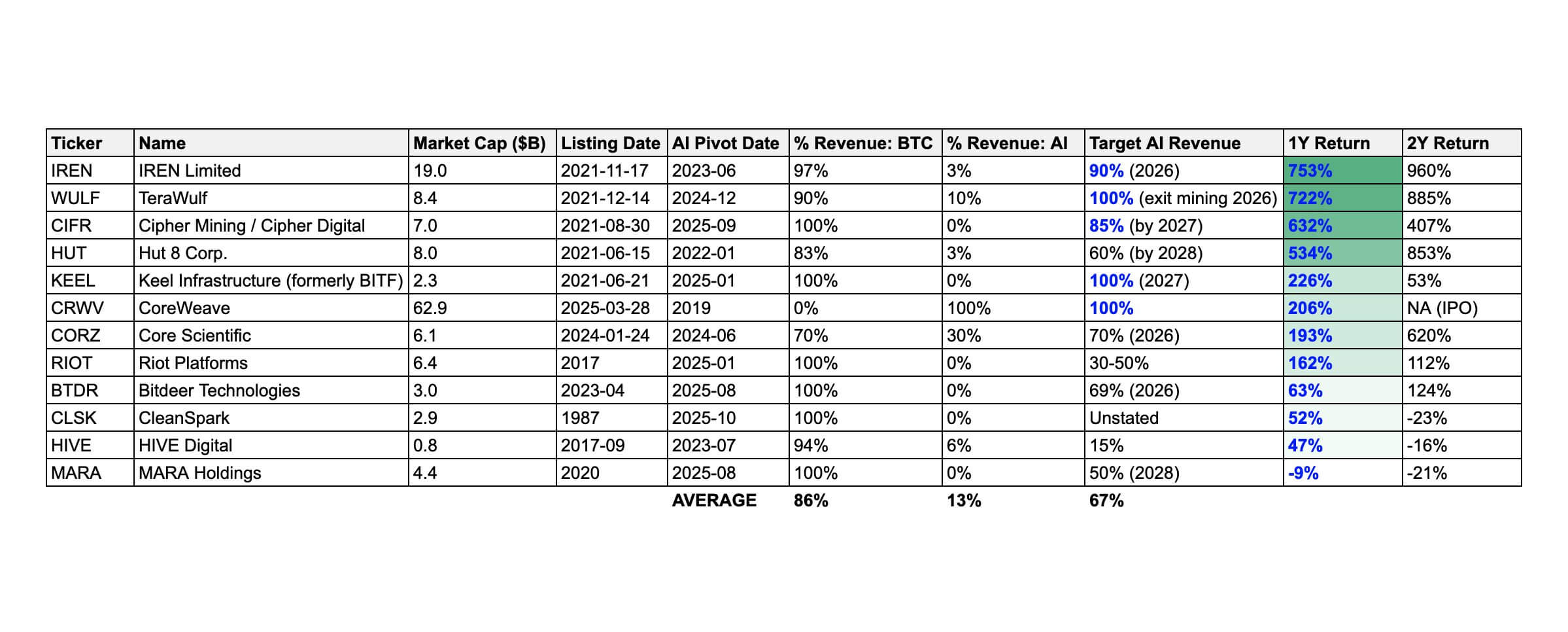
Public Bitcoin Miners Revenue ProjectionPublic Bitcoin Miners Revenue Projection
Public Bitcoin Miners Revenue Projection (Source: Capriole Investments)

Adding cultural texture to this shift, Bitcoin researcher Paul Sztorc noted that the industry is quietly scrubbing its original roots.

According to him, dedicated mining publications have rebranded to focus on broader energy themes, and major industry conferences have swapped out mining stages for energy-focused platforms, reflecting a sector actively distancing itself from pure crypto workloads.

Yet, veterans of the protocol argue this is precisely how the system was engineered to survive.

Blockstream CEO Adam Back countered the alarmism, pointing to Bitcoin’s self-adjusting difficulty mechanism. If computing power leaves, mining difficulty drops, instantly improving profit margins for the remaining operators.

Back argued:

“It’s an arbitrage, with equilibrium when mining margin is the same as AI workloads.”

He also described a “positive reflexivity” in which higher margins mean surviving miners sell less Bitcoin to cover power costs.

Meanwhile, James Check, an on-chain analyst at CheckOnchain, views the transition through the lens of pure capitalism. He noted:

“Massive turnover is literally the intended design of the difficulty adjustment.”

In his view, the AI pivot is a highly rational diversification strategy for infrastructure firms that simply “buy power and compute,” noting that AI serves as a constant baseload while Bitcoin mining remains an intermittent tool to balance grid loads.

The second half of the halving cycle

As the Bitcoin network progresses through the second half of this halving epoch by recently crossing block 945,000 in April 2026, the public mining industry faces a profound identity crisis.

Hashrate Index argued that the next two years, leading up to the 2028 halving, will severely test the protocol’s self-correcting mechanisms against the gravitational pull of Wall Street’s AI capital.

The outstanding questions facing the market are now structural, rather than cyclical. It remains to be seen whether the spot price of Bitcoin can stage a robust enough recovery to comfortably clear the near-record cash costs of production, or if network transaction fees will permanently remain a negligible fraction of total revenue.

If the underlying spot economics do not materially improve, the market will be forced to weigh whether the current, unprecedented pace of treasury liquidations can be sustained without permanently dampening asset prices.

Furthermore, the industry must determine the baseline at which the network’s computing power will stabilize definitively once the marginal players have exited the ecosystem.

Ultimately, the most pressing tension is existential. By 2027, the publicly traded companies that heavily drove the industrialization of Bitcoin validation over the past half-decade may no longer be miners in the traditional sense.

Instead, they are on track to become diversified energy and high-performance computing conglomerates, holding only residual, legacy exposure to the digital asset that originally built them.


Source link

Tags: BitcoinfuelinggainsMinersstock
ShareTweetShare
Previous Post

Adam Smith’s Warning About Wealth, Fame, and Status (with Ross Levine)

Next Post

Is it time to buy dollars?

Related Posts

edit post
US House Bill Seeks To Ban Lawmakers From Wagering On Predic

US House Bill Seeks To Ban Lawmakers From Wagering On Predic

by TheAdviserMagazine
June 20, 2026
0

A new US House bill is targeting a fast-growing corner of the event-contract market by seeking to ban members of...

edit post
JPMorgan Says 20% of Miners Operating at a Loss as Bitcoin Trades Below Production Cost

JPMorgan Says 20% of Miners Operating at a Loss as Bitcoin Trades Below Production Cost

by TheAdviserMagazine
June 20, 2026
0

Key TakeawaysJPMorgan says Bitcoin stayed below its $78K production cost for 5 straight months.Public miners sold 32,000+ BTC in Q1...

edit post
Philippines Is Ready for RWA Tokenization, SEC Commissioner Says

Philippines Is Ready for RWA Tokenization, SEC Commissioner Says

by TheAdviserMagazine
June 20, 2026
0

The Philippine Securities and Exchange Commission  (SEC) has signaled that the country is ready to accommodate the tokenization of real-world...

edit post
Capital B Shareholders Approve Massive Financing Plan For Bitcoin Treasury Strategy

Capital B Shareholders Approve Massive Financing Plan For Bitcoin Treasury Strategy

by TheAdviserMagazine
June 19, 2026
0

Trusted Editorial content, reviewed by leading industry experts and seasoned editors. Ad Disclosure TL;DR Capital B shareholders have approved...

edit post
US-Iran Deal Collapse Triggers 2M Liquidations In Bitcoin, Ethereum, XRP

US-Iran Deal Collapse Triggers $192M Liquidations In Bitcoin, Ethereum, XRP

by TheAdviserMagazine
June 19, 2026
0

The crypto market saw a steep wave of liquidations following uncertainty regarding the implementation of the recently announced US-Iran deal....

edit post
Franklin Templeton new ETFs would convert US companies stock dividends into Bitcoin exposure

Franklin Templeton new ETFs would convert US companies stock dividends into Bitcoin exposure

by TheAdviserMagazine
June 19, 2026
0

Franklin Templeton, the $1.78 trillion asset management firm, is attempting to push cryptocurrency deeper into conventional investment portfolios with a...

Next Post
edit post
Is it time to buy dollars?

Is it time to buy dollars?

edit post
US Dollar: Can Greenback Strengthen Amid Iran Uncertainty, Rising Energy Risks?

US Dollar: Can Greenback Strengthen Amid Iran Uncertainty, Rising Energy Risks?

  • Trending
  • Comments
  • Latest
edit post
5 Pennsylvania Rebate Rules Seniors Should Check Before the Property Tax/Rent Deadline

5 Pennsylvania Rebate Rules Seniors Should Check Before the Property Tax/Rent Deadline

June 18, 2026
edit post
Florida Roads Become a Battleground for Illegal Immigration

Florida Roads Become a Battleground for Illegal Immigration

June 9, 2026
edit post
Louisiana’s Age-Tiered Homestead Exemption: 8 Details About the Proposed 2028 Amendment

Louisiana’s Age-Tiered Homestead Exemption: 8 Details About the Proposed 2028 Amendment

June 15, 2026
edit post
The 8 States That Still Tax Social Security in 2026

The 8 States That Still Tax Social Security in 2026

June 6, 2026
edit post
It’s Time To Talk About Massie

It’s Time To Talk About Massie

May 23, 2026
edit post
A Tax on Social Media – Blue-State Governments’ Newest Ploy

A Tax on Social Media – Blue-State Governments’ Newest Ploy

June 5, 2026
edit post
Ford Leads Among Carmaker Recalls So Far in 2026. Here’s Why

Ford Leads Among Carmaker Recalls So Far in 2026. Here’s Why

0
edit post
Iran floats ‘insurance fees’ and asserts control over Hormuz

Iran floats ‘insurance fees’ and asserts control over Hormuz

0
edit post
Retail’s Incremental Total Experience Shift: Select Brands See Significant Improvement

Retail’s Incremental Total Experience Shift: Select Brands See Significant Improvement

0
edit post
All Trump Is Saying Is Give Peace a Chance

All Trump Is Saying Is Give Peace a Chance

0
edit post
From Scholasticism to Enlightenment Liberalism

From Scholasticism to Enlightenment Liberalism

0
edit post
US House Bill Seeks To Ban Lawmakers From Wagering On Predic

US House Bill Seeks To Ban Lawmakers From Wagering On Predic

0
edit post
Iran floats ‘insurance fees’ and asserts control over Hormuz

Iran floats ‘insurance fees’ and asserts control over Hormuz

June 20, 2026
edit post
US House Bill Seeks To Ban Lawmakers From Wagering On Predic

US House Bill Seeks To Ban Lawmakers From Wagering On Predic

June 20, 2026
edit post
New York Seniors: 6 STAR Tax Relief Rules That Could Put a Bigger Check in Your Mailbox

New York Seniors: 6 STAR Tax Relief Rules That Could Put a Bigger Check in Your Mailbox

June 20, 2026
edit post
In 1844, Samuel Morse tapped out ‘What hath God wrought’ from the US Capitol to a Baltimore railroad depot, and the four-word message took 38 miles of copper wire and a verse his friend’s daughter had chosen from the Book of Numbers

In 1844, Samuel Morse tapped out ‘What hath God wrought’ from the US Capitol to a Baltimore railroad depot, and the four-word message took 38 miles of copper wire and a verse his friend’s daughter had chosen from the Book of Numbers

June 20, 2026
edit post
Hotstocks KW 25 / 2026: Ausgewählte Tech-Outperformer der Woche

Hotstocks KW 25 / 2026: Ausgewählte Tech-Outperformer der Woche

June 20, 2026
edit post
Netflix, Inc. (NFLX) Still One of the Best Falling Stocks to Buy despite Roku and Warner Bros Acquisition Blows

Netflix, Inc. (NFLX) Still One of the Best Falling Stocks to Buy despite Roku and Warner Bros Acquisition Blows

June 20, 2026
The Adviser Magazine

The first and only national digital and print magazine that connects individuals, families, and businesses to Fee-Only financial advisers, accountants, attorneys and college guidance counselors.

CATEGORIES

  • 401k Plans
  • Business
  • College
  • Cryptocurrency
  • Economy
  • Estate Plans
  • Financial Planning
  • Investing
  • IRS & Taxes
  • Legal
  • Market Analysis
  • Markets
  • Medicare
  • Money
  • Personal Finance
  • Social Security
  • Startups
  • Stock Market
  • Trading

LATEST UPDATES

  • Iran floats ‘insurance fees’ and asserts control over Hormuz
  • US House Bill Seeks To Ban Lawmakers From Wagering On Predic
  • New York Seniors: 6 STAR Tax Relief Rules That Could Put a Bigger Check in Your Mailbox
  • Our Great Privacy Policy
  • Terms of Use, Legal Notices & Disclosures
  • Contact us
  • About Us

© Copyright 2024 All Rights Reserved
See articles for original source and related links to external sites.

Welcome Back!

Login to your account below

Forgotten Password?

Retrieve your password

Please enter your username or email address to reset your password.

Log In
No Result
View All Result
  • Home
  • Financial Planning
    • Financial Planning
    • Personal Finance
  • Market Research
    • Business
    • Investing
    • Money
    • Economy
    • Markets
    • Stocks
    • Trading
  • 401k Plans
  • College
  • IRS & Taxes
  • Estate Plans
  • Social Security
  • Medicare
  • Legal

© Copyright 2024 All Rights Reserved
See articles for original source and related links to external sites.