
Highlights
AI tools help auditors accelerate research, analyze documents, and standardize workflows efficiently.
Auditors should evaluate AI tools based on authority, workflow fit, document intelligence, and governance controls.
Leading AI audit platforms include Thomson Reuters CoCounsel Audit, DataSnipper AI, Caseware, CCH Axcess Audit, and Inflo.
Audit firms are being asked to do more without getting more time, more budget, or more headcount. At the same time, audit and accounting standards continue to evolve, engagements are becoming more complex, and firms are under growing pressure to deliver work that is consistent, review-ready, and easy to defend.
That is why AI tools are getting so much attention in audit. According to the Thomson Reuters Institute 2026 AI in Professional Services Report, 34% of tax, accounting, and audit firms are already using generative AI in their work, with another 47% planning or considering using it. But choosing the right tool is not just about finding the tool that automates the most tasks. For audit teams, the better question is this: Which AI tool helps professionals move faster while still supporting sound judgment, stronger documentation, and defensible results?
Today’s market includes a growing mix of audit-focused AI tools and adjacent platforms. Some are strongest in Excel-based document work. Others emphasize engagement workflows, analytics, or cloud audit management. And some are designed to combine authoritative research, document analysis, and workflow support in one place.
This guide looks at what AI tools can do for auditors today, the key criteria firms should use to evaluate them, and how leading options — including Thomson Reuters CoCounsel Audit, DataSnipper AI, Caseware, CCH Axcess Audit, and Inflo — compare.
Jump to ↓
What can AI-powered tools do for auditors today?
What are the key criteria for evaluating AI audit tools?
What are the leading AI tools for audit firms?
How to choose the best overall AI audit tool
AI in audit is no longer limited to broad promises about productivity. The most useful tools now support specific parts of the engagement lifecycle, helping firms reduce manual work while improving consistency and reviewability.
Accelerate technical research and standards lookup
One of the clearest use cases for AI in audit is faster research. Audit teams regularly need to answer technical questions about accounting treatment, auditing standards, disclosure expectations, internal controls, and documentation requirements. Traditionally, that work can take significant time, especially when professionals are switching among multiple research tools, PDFs, internal guidance, and workpapers. AI-powered research tools can shorten that process dramatically by allowing staff to ask questions in plain language and get answers quickly.
Analyze source documents and extract key information
Another strong use case is document analysis. Auditors spend a large amount of time reviewing contracts, financial statements, workpapers, board minutes, internal control documentation, and supporting evidence. AI can help extract key data, summarize lengthy documents, compare versions, and surface inconsistencies that may require follow-up.
Standardize repeatable workflows
AI tools can also help firms bring more consistency to recurring work. Audit teams often rely on manual processes, partner memory, or locally maintained templates for tasks such as preparing memos, reviewing client documents, drafting communications, and performing common analyses. That can create unnecessary variability across teams and offices.
The right AI tool can help standardize these workflows through reusable templates, workspaces, and guided processes. This can reduce training time for junior staff, make it easier for managers to enforce consistency, and help firms preserve institutional knowledge.
Improve review readiness and defensibility
For auditors, one of the most important benefits of AI is not just faster work, but more reviewable work. Tools that show citations, maintain traceability to source documents, and support structured outputs can reduce review friction and help teams defend conclusions more confidently.
That distinction is important. In audit, the goal is not autonomous decision-making. It is better support for professional judgment. AI should help professionals prepare better work, ask better questions, and identify issues earlier, while keeping humans in control.
White paper
A comprehensive guide for audit professionals evaluating AI solutions
Read white paper ↗
Because many AI tools make similar high-level claims, firms need a practical framework for comparing them. The following criteria can help separate tools that are merely useful from tools that are truly valuable in audit practice.
1. Authority and defensibility of answers
For auditors, this should be one of the first questions. Where do the tool’s answers come from? Can users quickly verify them? Are outputs grounded in authoritative content or only in uploaded files?
A tool may produce polished summaries, but if those outputs are not backed by trusted sources, they may create more review work instead of less. In contrast, a platform that provides cited, authoritative answers can improve both speed and confidence.
2. Workflow fit
The best AI tool is not necessarily the one with the longest feature list. It is the one that fits how your team actually works.
Some firms want AI primarily inside Excel. Others want it embedded in a broader audit platform. Others need a workspace that combines research, document analysis, templates, and collaboration without forcing users to jump among disconnected systems.
The right fit depends on the firm’s current environment, major pain points, and appetite for change.
3. Document intelligence
Many audit tasks begin with documents, so firms should evaluate how well a tool can handle real-world files: contracts, workpapers, financial statements, spreadsheets, board minutes, and mixed-format client support.
Key questions include:
Can it summarize effectively?
Can it extract relevant details?
Can the tool compare documents?
Can it flag inconsistencies?
Can it handle unstructured files?
These capabilities can make a major difference in daily adoption.
4. Governance, privacy, and security
Audit firms cannot evaluate AI tools on capability alone. Data handling, privacy, retention, and enterprise controls matter just as much. Firms should look for clear security practices, transparency around model use, and controls that support responsible deployment.
This is particularly important for firms that want to scale AI beyond small pilot groups and into broader engagement workflows.
5. Ease of adoption
Even a strong product will struggle if staff find it difficult to use or managers do not trust the outputs. Natural-language interaction, familiar workflows, and clear citations can all help accelerate adoption. The easier it is for users to get value quickly, the more likely the tool is to become part of daily practice.
6. Breadth versus point-solution focus
Some AI tools are purpose-built for a narrow set of tasks and do those tasks very well. Others aim to support a wider range of work across research, analysis, automation, and collaboration.
Neither model is inherently better. But firms should be honest about what they need. If the goal is solving one specific workflow problem, a point solution may be enough. If the goal is broader operational leverage, a more comprehensive platform may deliver more value over time.
7. ROI and scalability
Finally, firms should evaluate whether the tool saves time only at the staff level or whether it also reduces manager review time, improves consistency, and supports broader firm operations. True ROI often comes from reducing rework, simplifying review, and helping firms scale expertise without proportional increases in headcount.
Below is a look at five well-known AI tools for auditors: Thomson Reuters CoCounsel Audit, DataSnipper AI, Caseware, CCH Axcess Audit, and Inflo. Note that the tools mentioned are not identical. Some are best understood as document-focused assistants, some as AI-enabled audit platforms, and some as broader research-and-workflow solutions.
CoCounsel Audit
Key differentiators
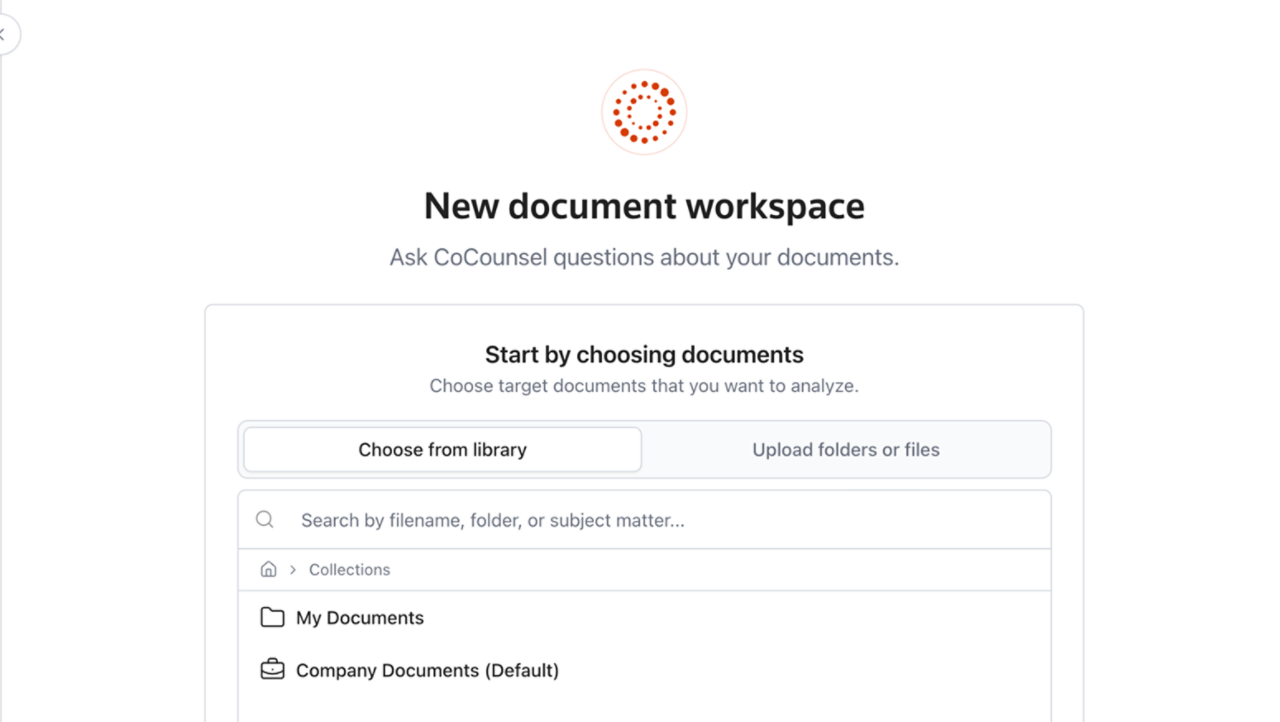
Built around a four-part workflow: Ask, Analyze, Automate, and Access. In practice, that means one place to research, review documents, create workpapers, and keep engagement materials together.
Connects answers to authoritative audit and accounting sources, including FASB, GASB, AICPA, IFRS, and Thomson Reuters Checkpoint.
Supports document review and workpaper creation in the same workspace, including the ability to upload and analyze multiple client documents at once and generate workpapers with citations. Also integrates with SharePoint and outputs can be exported for use in tools like Excel.
Includes guided templates and a shared workspace meant to help firms keep work more consistent across staff and preserve firm knowledge over time.
Considerations
May be more than a firm needs if the only goal is a narrow document-extraction tool or a basic chat assistant.
Best fit firm profile
Firms that want one audit-focused product for cited research, document review, workpaper drafting, and repeatable team workflows.
CoCounsel Audit
Request a free demo of CoCounsel Audit today to see how it can automate your firm’s complex tasks
Request demo ↗
DataSnipper AI
Key differentiators
Built around audit and finance work with a strong Excel center of gravity, including Excel Agents for analysis and testing inside Excel.
Puts heavy focus on traceability: the company says every AI insight is linked back to its source, and its AI answers link back to source material.
Customer prompts and documents are retained for up to 24 hours and then deleted.
Considerations
Firms looking for deep, citation-based audit research should verify whether their needs go beyond DataSnipper’s document and testing focus.
Best fit firm profile
Firms that want Excel-centered audit support, source-linked document review, and evidence-focused testing workflows.
Caseware
Key differentiators
Positions its AI as embedded across planning, fieldwork, and reporting, rather than added on as a separate point tool.
Says its digital assistant, AiDA, provides context-aware guidance based on the engagement and can surface methodology, applicable standards, and firm guidance within the workflow.
Pairs that assistant with other named capabilities such as Extractly for pulling and structuring data from documents and Validate for financial statement checks, change tracking, and discrepancy review.
Makes governance a central part of the pitch, including firm-defined boundaries, audit trails, and mandatory professional review.
Considerations
May be a stronger fit for firms that already want AI inside a wider Caseware workflow, rather than firms shopping first for standalone research depth.
Firms should test how well AiDA, Extractly, and Validate map to their own methodology and review process.
Best fit firm profile
Firms that want AI woven into a broader Caseware engagement environment, with strong attention to governance and in-context workflow support.
CCH Axcess Audit
Key differentiators
Presented as a cloud-based audit suite with multiple modules.
Recent updates center on Expert AI and a preview of Document Analysis Agents inside CCH Axcess Engagement. Wolters Kluwer says these agents can review items such as board minutes and contracts, return summaries, flag risks, and support follow-up questions in chat.
Connects audit workflow tools with CCH AnswerConnect research inside the broader CCH Axcess family.
Considerations
May be most attractive to firms already working inside the CCH Axcess family and wanting audit, methodology, validation, and research tools under one vendor.
Best fit firm profile
Firms that are already invested in the Wolters Kluwer ecosystem and want audit workflow, methodology, validation, and research tools connected within a single vendor environment.
Inflo
Key differentiators
Positions itself as a digital audit platform with four main solution areas: Working Papers, Audit Data Analytics, Digital Collaboration, and Quality Management.
States that its audit methodology is risk-based and activity-focused.
Pitches an audit-first, explainable AI approach that keeps professional judgment, evidence, and documentation in auditors’ hands.
Considerations
Firms that put the highest weight on citation-backed technical research should compare that need carefully against Inflo’s wider platform focus, since its public positioning centers more on audit workflow, analytics, collaboration, and quality management than on deep research content libraries.
Best fit firm profile
Firms pursuing a digital-audit model that combines working papers, analytics, client collaboration, quality management, and explainable AI with human oversight.
The best AI tool for your firm depends on the problems you need to solve. AI is quickly becoming part of the modern audit toolkit, but firms should resist choosing based on novelty alone. The right solution is the one that fits your workflows, supports human judgment, and helps your team produce work that is easier to review, easier to support, and easier to defend.
Recommended evaluation process:
Define 3–5 real use cases from busy season.
Pilot with actual managers and seniors, not just innovation teams.
Measure:
Time to answer
Time to first usable draft/workpaper
Review-note reduction
Ease of citation verification
Adoption across staff levels
Review security, retention, and governance requirements with IT/risk.
Decide whether you want a point solution or a platform strategy.
While several tools offer meaningful value in specific parts of the audit process, CoCounsel Audit stands out as a strong, highly comprehensive option for firms that want to unify cited research, document analysis, workpaper support, and repeatable workflows in a single audit-focused environment. CoCounsel Audit helps firms do more rather than just move faster. It helps auditors work more consistently, reduce friction in review, and scale expertise across teams.
For example, CoCounsel Audit helped Plante Moran streamline technical research, improve efficiency, and build confidence in AI through a pilot involving more than 140 participants. Nearly all respondents said the tool was useful for practice staff, 91% said it was faster than traditional research methods, and 87% felt the firm should purchase it and make it available to all staff.
If your firm is evaluating AI for audit, the best next step is to see how the tool performs against your real-world use cases. First, use the CoCounsel Tax & Audit ROI calculator to see your potential savings. Then, request a demo of CoCounsel Audit and see for yourself how it can support the speed, precision, and confidence your audit teams need in 2026.

CoCounsel Audit
Scale expertise across your team with AI auditors can count on
Learn more ↗